
Alignment Is A Contact Sport: Why Shared Context Creates Decision Velocity
Prime Positioning - Episode 8: Alignment isn't agreement. It's shared context that travels.

Prime Positioning - Episode 8:
Alignment isn’t agreement. It’s shared context that travels.
Strategic Decision Architecture is claimed as territory. Kedaris call is scheduled. Now comes the harder part—proving they can practice what they’re about to sell. Today, the real work begins.
The Real Work Begins
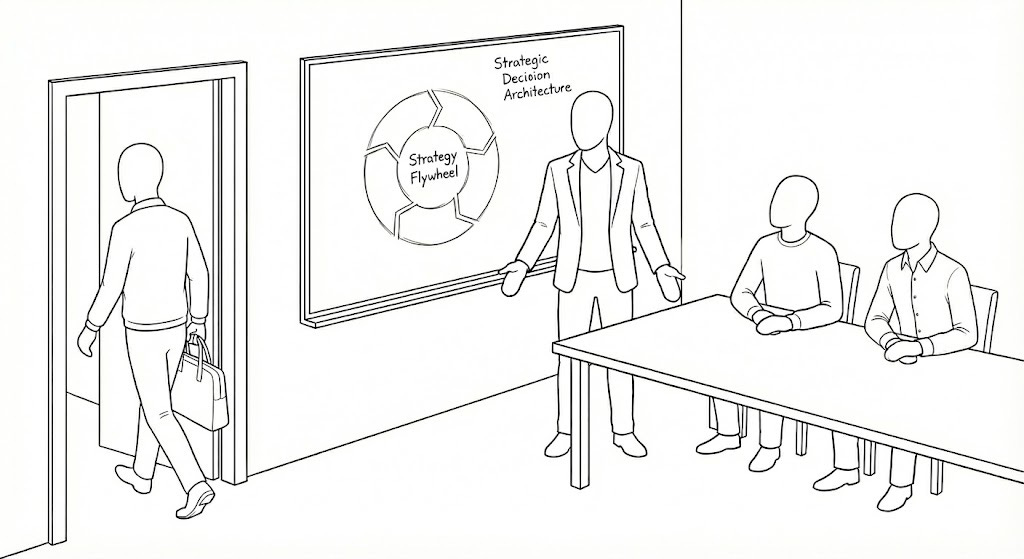
The conference room still held the artifacts of their day before: Strategy Flywheel on the main board, and the positioning framework they’d built.
Sam was already there. But something was different. His bag was packed. Laptop closed.
“Before we wrap up,” Sam said, “I need to tell you something.”
“You don’t need me anymore.”
The room shifted. James felt it before the words landed.
The Marketing VP started to object, but Sam raised a hand.
He gestured at the walls—the work they’d done over three days. “You built this. The flywheel. The positioning. Strategic Decision Architecture as your territory. Demo, Sell, Build as your sequence. Kedaris as your proof point.”
He looked at James directly. “You have everything you need for your Lightning Strike.”
James felt the weight of what’s ahead. Not anxiety—something more grounded. The realization that Sam was right.
“What do we do first?” the Engineering Director asked. Not to Sam. To James.
The shift was already happening.
James walked to the timeline on the wall. “Kedaris call is tomorrow at 2 PM. Four-week transformation beta. But we don’t pitch transformation we haven’t practiced ourselves.”
“So we practice first,” the Product VP said.
“Starting now. This meeting. This morning.” James turned to face his team. “Every meeting. Every decision. Starting with this one.”
Sam stood. Grabbed his bag, “I’ll leave you to it.”
No extended goodbye. Just acknowledgement that Dayanos was dialed in.
At the door, he paused. “One thing. The flywheel isn’t a framework you explain. It’s a practice you repeat. Alignment doesn’t come from understanding—it comes from contact. Real decisions, made together, under real pressure.”
Then he left.
The room was quiet for a moment. The team looked at James.
“Week one goal,” James said. “Prove we can practice what we’re claiming. Not perfect. Functional. Show ourselves we can do this before we try to teach anyone else.”
The Marketing VP nodded. “What’s the first decision?”
James almost smiled. Not because it was easy. Because she’d asked the right question.
“How do we approach Kedaris. Capability pitch or product pitch.” He looked around the room. “Let’s decide it together. Using the flywheel. Right now.”
The Product VP opened his laptop. The Engineering Director pulled up his notes from the workshop.
And the practice began.
Practice Makes Progress
“Where do we start?” the Engineering Director asked.
James almost laughed. That was exactly the right question—and he didn’t have a clean answer. Sam would have known. But Sam was gone.
“The decision in front of us,” James said. “Kedaris. Tomorrow’s call. Do we pitch capability transformation or product features?”
“Capability,” the Marketing VP said immediately. “That’s our whole positioning. Strategic Decision Architecture.”
“But they don’t know what that means yet,” the Product VP countered. “We need something concrete. Features they can evaluate.”
“If we lead with features, we’re playing Amalakai’s game,” the Marketing VP shot back.
James watched the exchange. Normal meeting dynamics. Point, counterpoint, building toward... what? Usually these discussions circled until someone with authority made a call, or they scheduled another meeting to “align further.”
“Hold on,” James said. “Let’s use what we built.”
He pointed to the flywheel. “Prime Positioning. What’s our transformation story? What does Kedaris become?”
The Product VP answered first. “A high-velocity decision-making organization.”
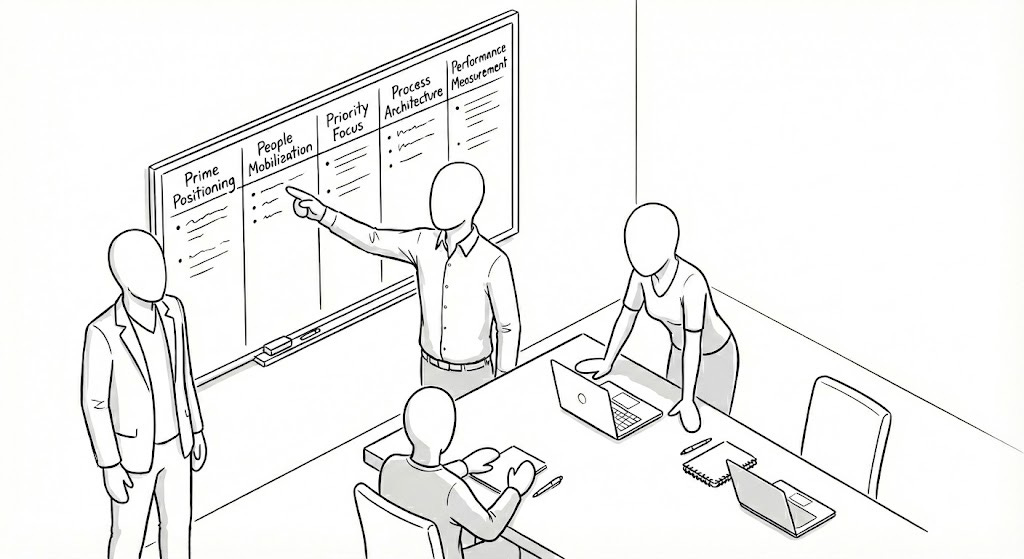
“Good. People Mobilization. What did we learn about what Kedaris actually needs? Not what we assume—what we know.”
The Marketing VP pulled up her notes. “Lisa mentioned they see opportunities closing before they can act. Not lack of data. Lack of decision capability.”
“So their pain is decision speed, not decision quality,” the Engineering Director said slowly. “They’re not making bad decisions. They’re making slow ones.”
James nodded. “Priority Focus. Given that pain, what matters most in tomorrow’s call?”
“Proving we understand the transformation,” the Product VP said. “Not listing features.”
“Process Architecture. How do we structure the call to demonstrate that understanding?”
The Marketing VP was already thinking. “We don’t pitch. We diagnose. Ask Lisa to describe a recent missed opportunity. Then show how Strategic Decision Architecture would have changed the outcome.”
“Performance Measurement. How do we know if the call worked?”
“She commits to the beta,” the Engineering Director said. “Four weeks. That’s the proof point.”
James stepped back from the whiteboard.
The Product VP looked at his notes. “We made the Kedaris decision.”
“In how long?”
The Marketing VP checked her watch. “Twelve minutes.”
Silence. The Engineering Director looked from the whiteboard to his notes and back again.
“We didn’t need an alignment meeting,” he said slowly.
“The context was already there,” the Product VP said. “Positioning. Customer understanding. Priorities. We were already working from the same—”
He stopped. Looked at James.
The Marketing VP leaned back. “We just coordinated without coordinating.”
James nodded. Let it settle.
“Each of you. With your teams. Today.” James looked around the room. “Don’t explain the flywheel. Use it. Pick a real decision your team needs to make. Work through it using the five elements. Let them experience what we just experienced.”
“What if it doesn’t work?” the Product VP asked.
“It won’t. Not smoothly. Not the first time.” James remembered Sam’s words. “Alignment is a contact sport. And the only way to improve is practice.”
The Marketing VP was already making notes. “I have a positioning decision with my team this afternoon. We’ve been circling on it for a week.”
“Perfect. Use the flywheel. Make the decision. See what happens.”
The Engineering Director nodded. “I’ve got a technical prioritization that’s been stuck in review loops. I’ll try it tomorrow.”
“Product?” James asked.
“Feature scoping meeting Wednesday. Usually takes three sessions to land anything. I’ll run it through the flywheel.”
James looked at the room. Three days ago, they’d been scattered. Aligned on nothing except urgency. Now they had shared architecture. Shared context. Shared practice.
“Week one,” James said. “Awkward contact. Real decisions. We prove to ourselves it works before we try to prove it to anyone else.”
The team stood. Laptops closing. Energy different than before—not anxious momentum, but focused purpose.
The practice had begun.
Driving Decisions With Your Operating Rhythm
Product Team. Day 5. 11:00 AM
The Product VP just finished drawing at the whiteboard in his team meeting. Some looked curious, some skeptical.
“Another framework?” the senior product manager asked. “We just finished implementing the new prioritization matrix.”
“This isn’t a framework we implement,” the Product VP said. “It’s a practice. Right now. On a real decision.”
He wrote the five flywheel elements on the board. “We’ve been circling on the mobile notification feature for three weeks. Today we decide.”
“We don’t have enough user data to—”
“Let’s find out.” The Product VP pointed to the first element. “Prime Positioning. What transformation does this feature enable for customers? Not what it does. What they become.”
Silence. Then the senior product manager spoke slowly. “Customers who catch opportunities before they close. That’s the whole Decision Velocity premise.”
“Good. People Mobilization. What do we actually know about how customers miss opportunities now?”
A junior PM pulled up research notes. “The exit interviews from Q2. Three customers mentioned notification fatigue. They get alerts but can’t distinguish signal from noise.”
“So it’s not about more notifications,” another PM said. “It’s about better filtering. Judgment-level alerts.”
The Product VP moved through the remaining elements. Priority Focus—what matters most given that insight. Process Architecture—how they’d structure the build. Performance Measurement—how they’d know it worked.
Fifteen minutes later, they had a decision. Not the feature they’d been debating for three weeks. A different feature. Better scoped. Clearer purpose.
“That was faster than usual,” the senior product manager said.
The Product VP nodded. “Same information. Different structure. We’ll do this again Thursday.”
Kedaris Call. Day 5. 2:00 PM
James and the Marketing VP sat in the small conference room, laptop open, video call with Lisa from Kedaris.
“Thanks for making time,” James said. “I know your calendar is brutal.”
“It is. So let’s skip the pleasantries.” Lisa’s tone wasn’t rude—just efficient. “Your team reached out about decision velocity. I’m curious, but skeptical. We’ve had three consulting engagements in two years. Lots of frameworks. Not much change.”
James felt the Marketing VP tense beside him. This wasn’t the warm reception they’d hoped for.
“Fair,” James said. “Can I ask what those engagements focused on?”
“Digital transformation.” Lisa said with audible quotation marks. “Everyone had a methodology. Nobody moved the needle.”
“What needle were you trying to move?”
Lisa paused. The question had landed differently than she expected.
“Speed,” she said finally. “We see opportunities in our market—openings, shifts, signals—and by the time we’ve aligned internally and made a decision, the window’s closed. Our competitors who should be slower than us somehow beat us every time.”
“Because they decide faster?”
“That’s what I can’t figure out.” Lisa leaned forward slightly. “We have better data. Better analysis. Better people. But when it’s time to actually commit to a direction, we get stuck in review loops. Meetings about meetings.”
She shook her head. “By the time everyone’s comfortable, the opportunity is gone.”
James recognized the pattern. He’d lived it six months ago at Dayanos.
“You’re not making bad decisions,” he said. “You’re making slow ones.”
“Exactly.” Lisa’s expression shifted—the first crack in her skepticism. “So what’s your pitch? More platform features to test?”
“No, a question.” James leaned back. “What if the problem isn’t your decision-making process? What if it’s your decision-making architecture?”
“What’s the difference?”
“Process is how you run meetings, who approves what, how information flows. Architecture is the underlying context that enables judgment.” James glanced at the Marketing VP, who pulled up a simple diagram. “Process optimization makes existing decisions faster. Architecture transformation makes different decisions possible.”
Lisa studied the diagram. “Keep going.”
“Your teams are smart. Your data is good. But every decision requires rebuilding context from scratch. Who are we serving? What matters most right now? What are we optimizing for? That context doesn’t travel. So every meeting starts at zero.”
“And you’re saying there’s a way to make context travel?”
“We’re saying we’ve built one. Strategic Decision Architecture. Five elements that create shared context across an organization. When context is already present, decisions happen at the speed of opportunity—not the speed of alignment.”
Lisa was quiet for a moment. “Hmm..so, what level of commitment are you asking for?”
“Four weeks.” James outlined the structure. “Week one, we baseline your current Decision Velocity. Measure where you are. Week two and three, we install the flywheel in your actual leadership meetings. You practice coordination through shared context. Week four, we measure improvement and document the transformation.”
“And if it doesn’t work?”
“Then you have a clear diagnosis of why your organization makes slow decisions. That’s valuable either way.”
Lisa considered this. “You’re not selling more software.”
“No. We’re not selling anything you install and forget. We’re offering a transformation. Your organization becomes capable of judgment at opportunity speed. That capability stays with you whether you work with us again or not.”
“What’s the investment?”
“Four-week transformation commitment. If your Decision Velocity doesn’t measurably improve, you pay nothing. If it works, we discuss contract terms.”
“Four weeks is a significant commitment for our exec team.”
“Then start with your leadership team only. Baseline your Decision Velocity. If the diagnostic doesn’t reveal anything actionable, we stop there. No hard feelings.”
Lisa paused. “That’s... actually reasonable. Okay, when would we start?”
“Next week, as we ramp up our Lightning Strike.” James caught himself—internal language. “We’re in our own transformation right now. You’d be our first external proof point.”
Lisa almost smiled. “You’re practicing what you’re selling.”
“We wouldn’t ask you to transform into something we haven’t become ourselves.”
The call ended ten minutes later. Four-week commitment confirmed. Baseline sessions scheduled for the following week.
The Marketing VP closed the laptop. “You didn’t pitch.”
“No.”
“You described transformation. What she’d become. Not what we’d deliver.”
James nodded. “We can describe it because we’re living it.”
First customer engaged.
The Lightning Strike had its proof point.
Engineering Team. Day 6.
The Engineering Director faced more resistance.
“We already have processes,” the tech lead said. “Sprint planning. Architecture reviews. We don’t need another layer.”
“This isn’t a layer. It’s context.” The Engineering Director drew the flywheel. “Our processes tell us what to build and when. This tells us why—and whether we should build it at all.”
“The authentication refactor,” the Engineering Director continued. “Three architecture reviews. Still no decision. Let’s test the flywheel on it.”
The tech lead crossed his arms. “Because the trade-offs are genuinely complex.”
“Walk me through them using this structure.” The Engineering Director pointed to Prime Positioning. “What transformation does the refactor enable? Not technical benefit. Customer outcome.”
The tech lead paused. “Faster login means faster time-to-decision when opportunities appear. If authentication adds friction at the wrong moment—”
“They miss the window,” a senior engineer finished. “That’s the whole point of Decision Velocity.”
“Priority Focus. Given that outcome, what matters most about the refactor?”
“Speed of the authentication flow itself,” the tech lead said slowly. “Not the elegance of the architecture. We’ve been optimizing for maintainability when we should optimize for latency.”
The conversation shifted. Twenty minutes later, they had an approach. Not consensus on every detail—but clear direction on what mattered most.
“How did we just decide that in twenty minutes?” the senior engineer asked. “We’ve been stuck for two weeks.”
The Engineering Director looked at the flywheel still on the whiteboard. “We started somewhere different this time.”
“Customer transformation instead of architecture trade-offs,” the tech lead said.
The senior engineer nodded slowly. “The context was already there.”
Marketing Team. Day 7.
The Marketing VP had the smoothest session—her team lived closest to customer voice. The Kedaris call had been two days earlier—and she'd watched the transformation story land in real time.
Ten minutes through the flywheel, they’d completely reframed. No one-pager—they’d offer Lisa a diagnostic instead. Demonstrate Strategic Decision Architecture rather than describe it.
“That’s the second time this week we’ve avoided building the wrong thing,” the content lead said.
Creating Context That Travels
Day 8. 2:00 PM.
James and the leadership team gathered in the conference room. A full week of practice behind them.
“Before we scatter for the weekend,” James said, “what shifted this week? What do we know now that we didn’t know Monday?”
The Marketing VP went first. “Lisa mentioned something yesterday. Kedaris isn’t just slow at decisions—they’re slow at recognizing when a decision is even needed. Opportunities pass before anyone flags them as decision points.”
“That’s different from what we assumed,” the Product VP said. “We thought the bottleneck was alignment. But if they’re not even identifying decision moments—”
“Changes how we approach their baseline next week,” the Engineering Director finished.
James nodded. “What else?”
“When I explained Strategic Decision Architecture to my team,” the Product VP said, “the phrase that resonated was ‘context that travels.’ They immediately connected it to rebuilding context in every meeting.”
“’Context that travels’ is becoming our signature phrase,” the Product VP continued. “Two customer calls this week, both responded immediately. It’s clearer than ‘Strategic Decision Architecture’ as an entry point.
“Good phrase,” the Marketing VP noted. “I’ll use that with Kedaris.”
The Engineering Director leaned forward. “Authentication refactor. We reframed around customer transformation instead of technical elegance. Completely changed our approach. Shipping a week earlier because we stopped optimizing for the wrong thing.”
“My team made four decisions this week using the flywheel,” the Marketing VP added. “Before this, we averaged maybe one before escalating to me.”
The Product VP looked around. “We just did something.”
“Say more,” James said.
“Everyone just... absorbed what the others learned. Marketing’s insight about Kedaris. Engineering’s timeline shift. My team’s feature scoping.” He paused. “I walked in not knowing any of that. Now I do.”
The Engineering Director leaned forward. “And I can use it. Don’t need a separate meeting to coordinate with Product because I already know their context.”
“Every week,” James said. “Friday afternoons. Before we scatter.”
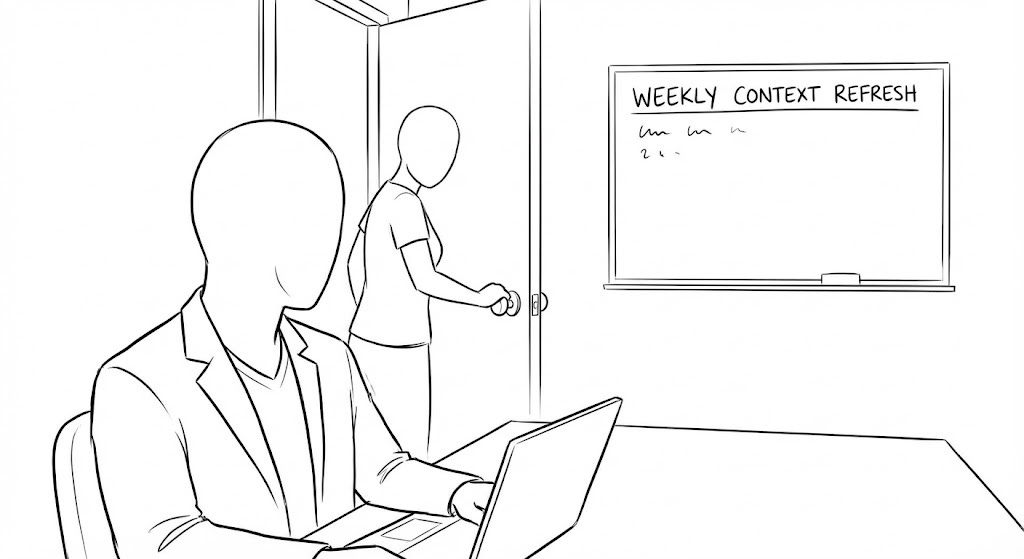
He wrote on the whiteboard:
WEEKLY CONTEXT REFRESH
“Same time next week.”
The team stood. Not because time ran out. Because the meeting completed its work.
The Power Of Habit
Days 11-15. Week Two.
The following week moved differently. Not faster—clearer.
The difference was subtle at first. Then impossible to ignore.
Engineering’s architecture review—usually a two-hour debate that ended with “let’s schedule a follow-up”—concluded in forty minutes. Three decisions made. No follow-up needed.
“We started from customer transformation instead of technical trade-offs,” the Engineering Director told James afterward. “Different outcome. Everything else fell into place.”
Product’s feature scoping session. The Product VP had warned his team it might take multiple meetings to land the mobile notification approach.
It took one.
“We kept asking ‘what transformation does this enable?’” the Product VP told James. “Killed two feature ideas in the first ten minutes. The one we kept was obvious once we framed it that way.”
A day later, the Product VP caught the Engineering Director in the hallway after a leadership sync.

“Quick question about the authentication timeline,” the Product VP said. “I was going to schedule thirty minutes with your team, but—”
“You already know our Priority Focus from last week,” the Engineering Director said. “Latency over elegance. What do you need?”
“Just whether the faster approach affects our mobile notification integration.”
“It doesn’t. We’re touching different parts of the stack.”
“Done. Thanks.”
The Product VP walked away. Then stopped. Turned back.
“Did we just skip a meeting?”
The Engineering Director almost smiled. “We had the context. Didn’t need to rebuild it.”
Neither of them fully registered what had happened. But James saw it from across the hall. Signs of transformation—coordination that doesn’t require coordinating.
Friday. Day 15.
James’s leadership team arrived prepared. No fumbling for insights. No long explanations. Each person knew what they were sharing before they sat down.
“People Mobilization,” James started. “What shifted?”
“Kedaris baseline is complete,” the Marketing VP said. “Lisa’s current Decision Velocity is lower than we expected. Bigger gap means bigger transformation opportunity.”
The Product VP connected it immediately to their own customer research. Priority Focus revealed Engineering’s authentication timeline shift. Process Architecture showed the feature scoping efficiency.
“We had a ‘water cooler’ meeting,” the Product VP said, glancing at the Engineering Director. “Wednesday. Cross-functional question, resolved in a couple minutes because we already had shared context.”
James paused. “Say more.”
“I was going to schedule time with Engineering. Then I realized I already knew their priorities from last Friday. Asked my question. Got my answer. Done.”
The Marketing VP leaned forward. “You skipped a meeting.”
“Didn’t need it. The context was already there.”
James looked around the room. Week one had been awkward contact. Week two was something else.
“Performance Measurement,” he said. “What are we seeing?”
“More decisions per meeting,” the Product VP said. “And apparently, fewer meetings between them.”
“Same time next week,” James said.
A thirty-minute meeting. Done in fifteen.
As the team filed out, the Marketing VP lingered.
“James, you got a minute?”
He turned. “What’s up?”
She closed the door.
“Two weeks ago, I wasn’t sure about any of this. New frameworks. Sam’s workshop. The whole Lightning Strike concept.” She shook her head. “Felt like another pivot. Another direction change that wouldn’t stick.”
“And now?”
“Our meeting just took fifteen minutes. And we made more decisions in two weeks than we usually make in two months.” She paused. “But that’s not what got me.”
“What did?”
“When Product and Engineering solved that integration question in the hallway. No meeting. No calendar invite. No alignment session.” She looked at him directly. “That doesn’t happen here. That’s never happened here.”
James nodded. He’d seen it too.
“We starting becoming…different,” she said. “Not just aligned on a strategy. Actually different. The way we work changed.”
“That’s the transformation we’re selling.”
“I know. That’s what I’m saying.” She straightened. “When I talk to Kedaris, I’m not describing a methodology anymore. I’m describing what happened to us. That’s a completely different conversation.”
“True. We are transforming right alongside Kedaris.”
She headed for the door, then stopped. “You should reach out to Ramorian.”
Ramorian. The account that started everything. The loss that triggered the board mandate.
“It’s early,” he said. “We haven’t proven anything externally yet.”
“You will. Kedaris will work.” She opened the door. “And when it does, you’ll want Ramorian to already know you’re different. Plant the seed now.”
Then she hurried out.
James sat alone in the conference room. The flywheel on the whiteboard. Less than thirty days left.
He opened his laptop. Found the last email thread with Ramorian—months old, their polite rejection still sitting in his inbox.
He started typing.
“Hi David—it’s been a while. I know we parted ways, but something’s changed at Dayanos. Significantly. I’d love to share what we’ve been building. No pitch. Just a conversation about where we’re headed. Would you have thirty minutes in the next week?”
His cursor hovered over Send.
Not yet. Need more evidence first.
PRACTICE: The Sport Of Alignment
Time: 2 minutes
Alignment isn’t created through presentations. It’s created through coordinated decisions under real pressure.
Think about your last three strategic meetings. How many actual decisions did you make? Not discussions. Not alignments. Not action items. Decisions.
If the answer is less than one per meeting, you’re coordinating around decisions instead of making decisions together.
James’s team discovered: The difference wasn’t working harder. It was starting from shared context—customer transformation, strategic positioning, current priorities—instead of rebuilding that context every time.
AI Prompt:
Here’s our current coordination challenge:
[Describe what’s creating misalignment or slow decisions—meetings that circle, decisions that stall, context that doesn’t travel between teams]

Our leadership team includes:
[List roles/functions represented]

The decisions we need to make faster:
[Describe 2-3 recurring decision types that get stuck]

Help me design a 30-minute meeting where:

1. Each person shares ONE insight per category:
   - Customer/market: What shifted in our understanding?
   - Positioning: How is our story landing?
   - Priorities: What matters most right now?
   - Process: What did we learn about how we work?
   - Measurement: How do we know it’s working?

2. Context refreshes without becoming a status meeting
   - Insights, not accomplishments
   - What changes how we think, not what we did

3. The meeting enables faster decisions BETWEEN weeks
   - Shared context travels through the week
   - Cross-functional questions get resolved without scheduling

Design this meeting so it’s:
- **Sustainable:** high value, people show up prepared
- **Coordinating:** Builds shared context
- **Progressive:** Gets better with practice

Show me the structure, including:
- How to open (setting the frame)
- How to move through each element (time per section)
- How to close (what people leave with)
- How to evolve it over the first month
Next Episode: Crossing the Change Chasm (Now Live)
James is seeing his transformation. His team makes more decisions, in less time, with growing cross-functional coordination. Now comes the real test—Kedaris. Two more weeks to prove Strategic Decision Architecture isn’t just something Dayanos discovered, but something Dayanos can deliver.
The Lightning Strike enters its critical phase.
Subscribe to follow James’s transformation journey, and share with a leader who’s tired of meetings about meetings.