
The Strategy Screenplay Test: Run the Table Read Before Your Team Starts Building
Strategy that only lives in your head is already dead.

Imagine you just spent two days at a strategy off-site. Thousands of dollars. The best facilitator money could buy.
But by the next week, that strategy is already fragmenting. Different interpretations in different meetings. Decisions that don’t quite align.
Your plan didn’t survive first contact. But what plan does?
So you create new messaging - in all-hands meetings, planning sessions, one-on-ones. Your team nods. They take notes. They seem aligned.
Three weeks later, planning stalls again. Six months later, execution misses targets you thought were clear. You hire consultants to figure out what went wrong.
It wasn’t your team’s competence. It was something more fundamental.
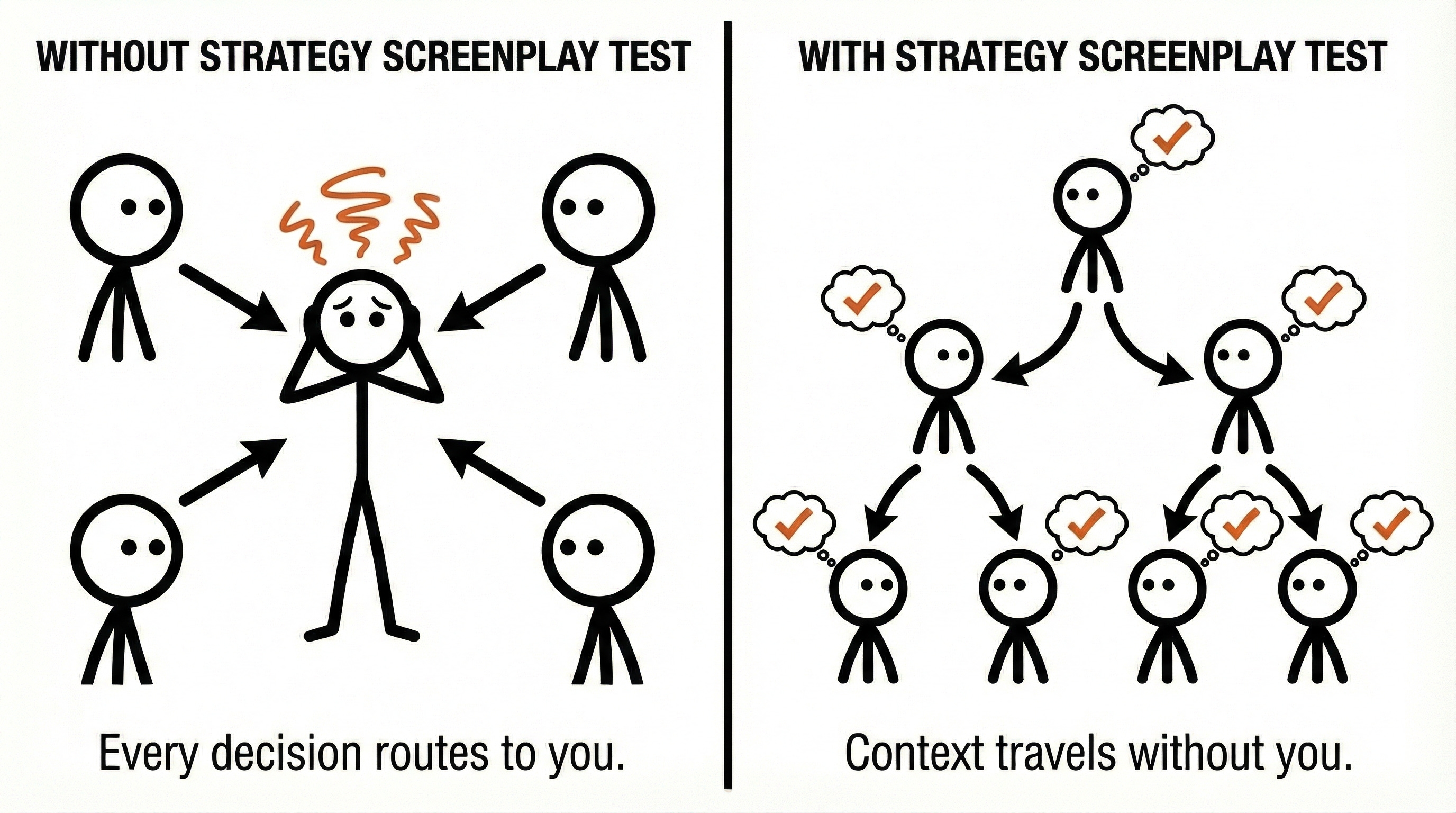
Your strategic context doesn’t travel.
By the time individual contributors make daily decisions, they’re working from telephone-game fragments of your original intent.
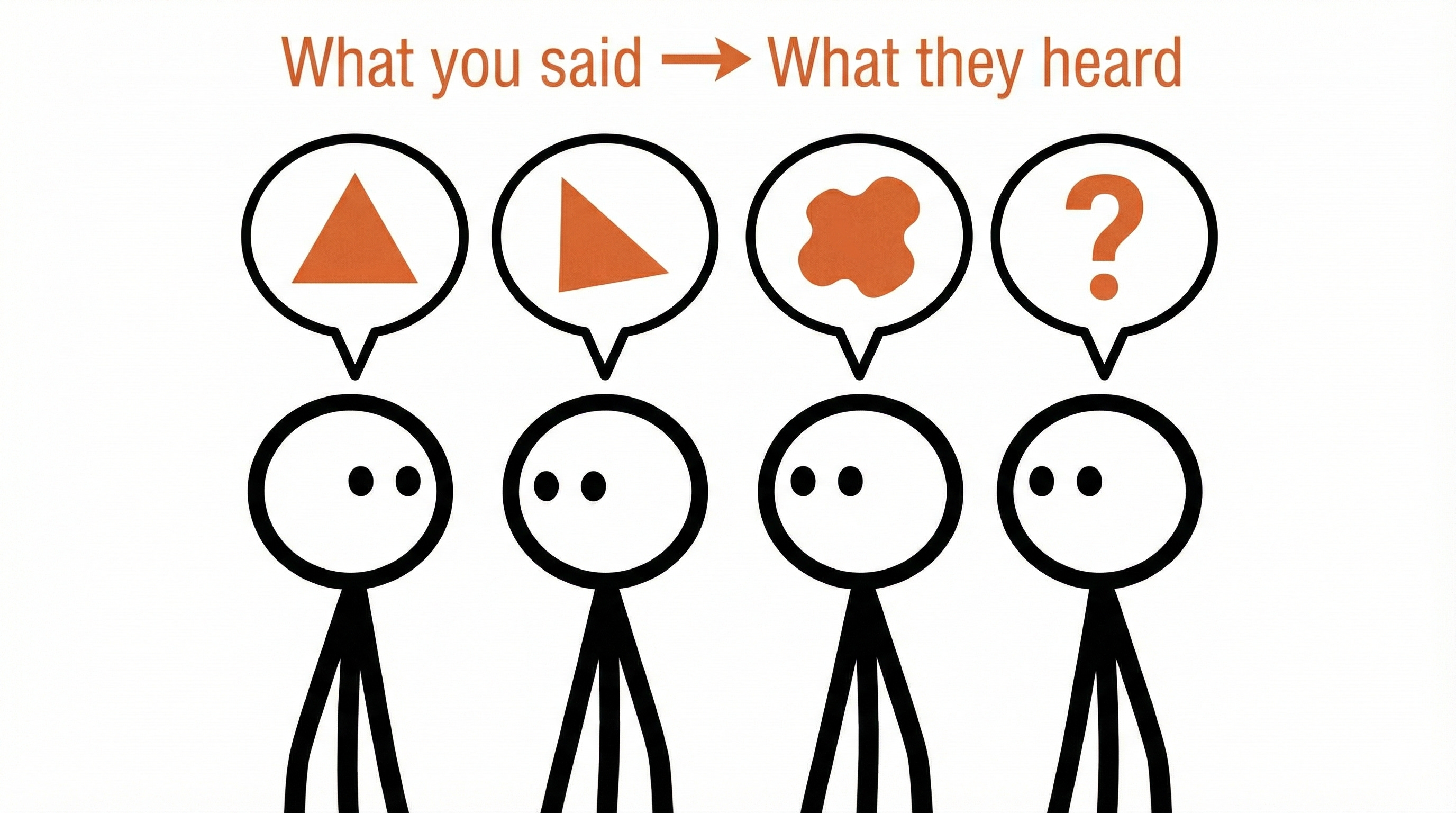
Think of it like a screenplay that makes perfect sense to the writer but confuses the director. You know exactly what you meant. But by the time you see the movie, it’s too late to fix the script.
And what makes this so frustrating: you already know how to prevent this in other domains.
In product development, you test before shipping. You don’t build the full product, discover it doesn’t work, then fix it. You prototype. You validate. You iterate before committing resources.
In filmmaking, they do table reads. The actors sit around a table and read the screenplay aloud before a single camera rolls. If lines don’t land, if scenes don’t track, if the story breaks - they discover it in an afternoon, not after months of production.
But in strategy? You message and hope.
You speak your strategy into the organization and assume it arrives intact. You plan based on what you said, not what they heard. You execute based on alignment you never actually verified.
Until now, with something I call the Strategy Screenplay Test.
Building is the most expensive way to discover you weren’t aligned.
Every failed execution, every planning cycle that spiraled into alignment meetings, every consultant brought in to “get everyone on the same page” - these are all symptoms of the same root cause: your strategy can’t be produced without you in the room.
The Strategy Screenplay Test is a building pre-mortem. Run it before your team builds, not after.
Not a document you write. Not a strategy deck you present. Not another framework to fill out.
A spoken test of whether your strategy can be executed without you directing every scene.
Here’s what it looks like:
Turn on a recorder. Speak your strategy aloud - as if you’re handing the screenplay to someone who starts directing tomorrow. Stop recording. Get the transcript. Hand it to your teammate.
Then ask the only question that matters: Can they execute from this alone, without you in the room?
That’s the test.
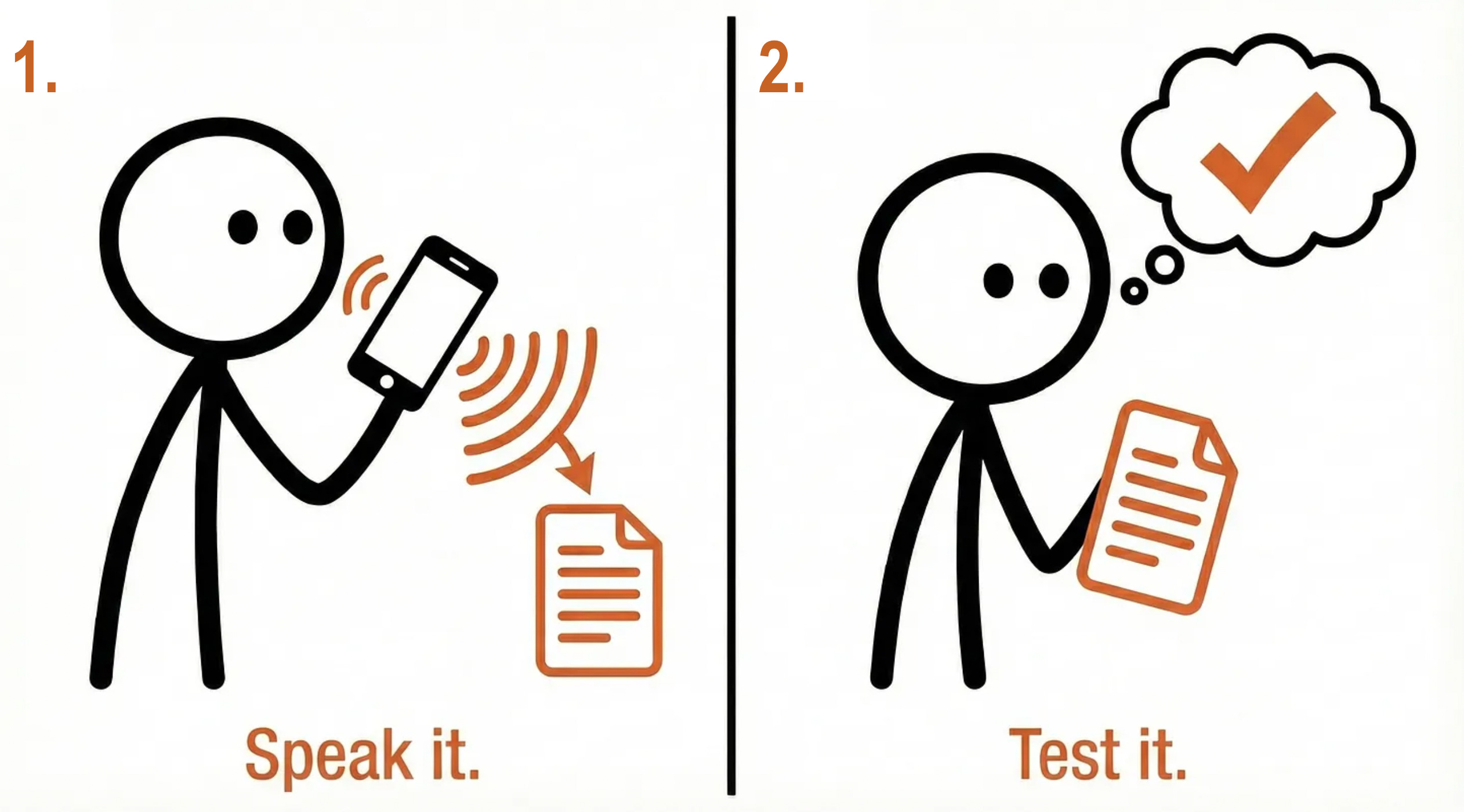
Why voice? Why not just write it down?
Because voice exposes what documents hide.
Written strategy lets you edit as you go. Polish the fuzzy parts. Arrange bullet points until they look coherent. Hide contradictions behind formatting.
Spoken strategy has nowhere to hide. When you speak your strategy aloud, you discover in real-time where your thinking breaks down. The pauses. The circular explanations. The moments where you say “you know what I mean” because you don’t actually know how to frame it.
Voice recording captures how you actually communicate strategy - in meetings, in planning sessions, in the hallway conversations where real alignment happens or doesn’t.
Here’s what the Strategy Screenplay exposes:
Vague transformation stories. “We help companies grow better” - grow how? Better than what? Measured by whom?
Contradicting priorities. “Focus on retention AND new acquisition AND expansion” - which one wins when they compete for resources Tuesday morning?
Missing execution details. “Improve customer experience” - how? Starting when? Who owns it? What does success look like?
Unclear success signals. “We’ll know we’re winning when things improve” - improve by what measure? Over what timeframe? Compared to what baseline?
Hollywood runs table reads for exactly this reason. They find breaks in an afternoon, not after production.
The Strategy Screenplay Test makes intuitive sense the moment you hear it. Of course you should verify your strategy can be executed before planning cycles begin. Of course you should discover gaps in framing before they become gaps in execution.
But most leaders have never run this test.
Not because they didn’t want to. Because it’s always been inaccessible.
Analyzing strategy sessions—for what exactly?
Reading through transcripts looking for gaps? Hiring consultants to interpret what you said? There was no clear methodology, no calibrated framework for turning a transcript into actionable feedback.
Too expensive. Too slow. Too uncertain.
So leaders defaulted to the only scalable option: framing and hope. Speak the strategy, assume it landed, discover the gaps downstream when they’re expensive to fix.
The off-site became the workaround. Pay thousands for a facilitated environment where alignment might happen. Trust the process. Hope the context sticks.
But hope isn’t a diagnostic. And off-sites don’t come with verification.
The test was always right. The test was always needed. The test was never feasible to run.
But now you can.
AI can analyze what you said against what you meant.
That’s the unlock.
You speak your strategy, get the transcript, and ask: “Could someone execute this tomorrow without me in the room?”
AI tells you exactly where the screenplay breaks down.
Before: Discover gaps after three weeks of planning, six months of execution, and $50k in consultants.
Now: Discover gaps in thirty minutes with tools you already have.
That’s a category shift in when you learn.
Here’s how to run it.
Don’t start with your strategy.
You'll speak for ten minutes, get the transcript, realize it's a mess, and conclude the test is broken.
It's not. You're just not calibrated yet.
Start with something you already know cold: your perfect day.
Not your strategy. Not your quarterly priorities. Your perfect day - the one you’d design if you had complete control.
Turn on your phone’s voice recorder. Speak your perfect day aloud, as if you’re scripting it for someone to produce tomorrow. Stop recording. Get the transcript.
Then ask AI: “Could someone produce this perfect day for me based solely on this recording?”
Here’s what you’ll discover:
“Morning routine” is too vague. Wake up when? Do what exactly? For how long?
“Relaxing afternoon” has no execution details. Where? Doing what? With whom?
“Quality time with family” can’t be scheduled. What activities? How long? Which family members?
You’ll find contradictions you didn’t notice while thinking it. “Peaceful morning” followed by “high-energy workout at 6am.” “Uninterrupted focus time” in a day packed with meetings.
This is the calibration.
You’re learning what “someone could produce this tomorrow” actually requires. You’re feeling the difference between fuzzy thinking and execution-ready clarity. You’re building the skill on familiar territory before the stakes go up.
Why perfect day? Because you can’t claim you don’t know the content. If your perfect day transcript is vague, the problem isn’t missing information - it’s framing. That’s exactly what you need to see.
By the time your perfect day scores clean, you know what the standard feels like.
The Strategy Screenplay Test
Prompt 1: Picture Your Perfect Day
Before You Start: Open voice mode in Claude or ChatGPT. Say:
“Transcript only - just capture what I say verbatim. I’ll ask you to organize it later. Begin.”
Speak your perfect day for 3-5 minutes—morning to night, as if scripting it for a director to film tomorrow.
When done, say: “End transcript.”
Then paste the prompt below into the same conversation.
I'm running the Perfect Day exercise as practice for The Strategy Screenplay Test.

The standard: Could someone else picture my Perfect Day without asking clarifying questions?

I recorded myself speaking my perfect day (3-5 minutes) using these prompts:

- POSITIONING: What makes this YOUR perfect day? What are you optimizing for that someone else might not?
- PRIORITY: What gets your attention and what do you protect against? What are you saying no to?
- PROCESS: Walk through the day. What happens, in what order, and when?
- PERFORMANCE: How do you know the day worked? What signals tell you it was a good day?
- MOBILIZATION: Why does this day matter? What does it enable you to become or create?

Analyze my transcript. For each element, score clarity (1-10) and identify gaps.

Provide:
1. Overall "Could Produce" Score (1-10)
2. Element-by-element breakdown (which are clear, which need work)
3. Three specific quotes where clarity breaks down
4. Pattern diagnosis: Where is my framing strong? Where does it get fuzzy?

Here's my transcript:
[PASTE YOUR RECORDING TRANSCRIPT HERE]
You just completed Day 1 of a strategy off-site.
Thirty minutes. No facilitator. No conference room.
The difference is stakes. Perfect day is yours - you know the content, you control the outcome, failure costs nothing. Strategy involves your team, your resources, your results.
But the skill is identical.
Speak it. Transcribe it. Test it. Iterate until it’s executable.
Most leaders spend two days and thousands of dollars at off-sites hoping to achieve what you just practiced in half an hour: clarity that someone else can act on.
You also discovered your baseline pattern. Where your framing is sharp - and where it gets fuzzy.
Here’s how your context travels.
Hand this exercise to a teammate who’s heard your strategy - in meetings, planning sessions, one-on-ones. They already have an understanding of where you’re headed. Now you’re testing whether that understanding is executable.
Ask them to record themselves explaining your strategy. Not from notes. Not scripted. Just speak it aloud as if they’re briefing someone who starts executing tomorrow.
Ten to fifteen minutes. Get the transcript.
Then compare: what they said versus what you meant.
The threshold is simple: could your teammate hand their transcript to someone starting tomorrow, and that person execute your strategy without you in the room?
If yes - your context travels. Enter planning with confidence.
If no - you’ve found exactly where articulation breaks down.
Maybe your transformation story landed but your priorities didn’t. Maybe they nailed the what but missed the why. Maybe they understood the direction but couldn’t frame how you’d measure success.
Either way - three to four hours of testing prevents months of building in the wrong direction.
Velocity without the rework tax.
Prompt 2: Business Strategy Screenplay
Same process. Different stakes.
Before You Start: Open voice mode. Say:
“Transcript only - just capture what I say verbatim. I’ll ask you to organize it later. Begin.”
Speak your strategy for 10-15 minutes—as if briefing someone who starts executing tomorrow without you in the room.
When done, say: “End transcript.”
Then paste the prompt below into the same conversation.
I'm running The Strategy Screenplay Test on my business strategy.

The standard: Can someone produce my strategy from this screenplay alone, without me in the room?

Analyze my transcript against five elements:

1. PEOPLE MOBILIZATION: Is the transformation story clear? Who becomes what? Why do they care?
2. PRIME POSITIONING: What transformation are we owning? Is the category territory defined?
3. PRIORITY FOCUS: Are priorities clear and non-contradictory? What are we NOT doing?
4. PROCESS ARCHITECTURE: Is the execution pathway specified? Could someone start tomorrow?
5. PERFORMANCE MEASUREMENT: Are success signals defined? How do we know it's working?

Provide:
1. "Strategy Screenplay Produces Execution" Score (1-10)
2. Which elements are clear, which are missing
3. Three critical gaps that prevent production
4. One strength to build on

Here's my transcript:
[PASTE YOUR RECORDING TRANSCRIPT HERE]
Ready to run it?
Option 1: Discover Your Strategic Baseline
Take the Strategy Screenplay Test in 5 minutes.
Record your Perfect Day, get your 5-element strategic baseline, see your pattern.

Option 2: Run It Yourself (DIY)
Use the prompts above. Record your voice in Claude or ChatGPT. Test your screenplay. Iterate until it travels.
Time: 3-4 hours.
Option 3: Get the Full Diagnostic (Waitlist)
Execution clarity is Day 1. But some teams execute perfectly—in the wrong direction. That’s a positioning problem - Day 2.
MyClaritySprint is building both - integrated voice analysis, calibrated feedback, the full diagnostic architecture.