
Customer Transformation Ownership: Why Customer Centricity Is Only Half The Story
Features are copied. Stories are owned.

Two camps have been arguing past each other for decades.
One side says talk to your customers. Survey them. Interview them. Let their feedback drive your roadmap. Customer-centricity isn’t just good practice—it’s gospel.
The other side quotes Steve Jobs:
“Some people say give customers what they want. But that’s not my approach. Our job is to figure out what they’re going to want before they do. I think Henry Ford once said, ‘If I’d asked customers what they want, they would have told me a faster horse.’ People don’t know what they want until you show it to them. That’s why I never rely on market research. Our task is to read things that are not yet on the page.”
This quote gets weaponized constantly.
See? Jobs didn’t do customer research. He just knew. The visionary doesn’t need data—they need intuition.
Except that’s not what Jobs said.
Read it again. “Our task is to read things that are not yet on the page.”
You can’t read what’s not yet on the page unless you know what’s already on the page. Jobs wasn’t dismissing customer understanding. He was dismissing the limitation of only asking customers about their present.
He still had to know their present intimately. Otherwise, how would he know what wasn’t yet written?
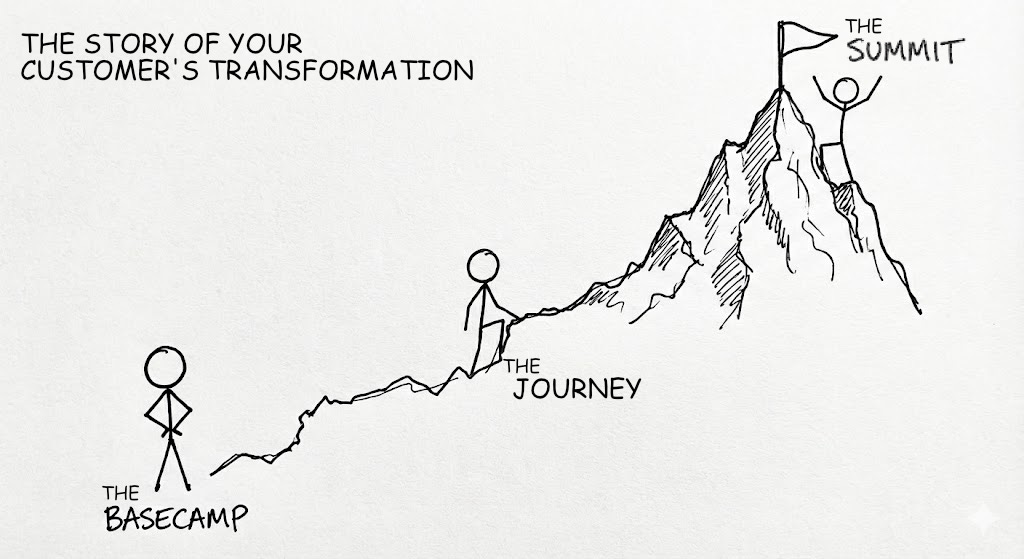
One side is right—about base camp. Customers know their present. Their frustrations. Where they’re stuck. What’s broken. You need this understanding or you’re building in the dark.
The other side is right—about summit. Customers can’t articulate a destination they’ve never seen. They can tell you about faster horses. They can’t tell you about automobiles. That vision is your job.
The debate was never “listen to customers” versus “ignore customers.”
Customers can give you everything about their present. They can’t give you much about their future. As a strategic leader, you need both. You need to know base camp well enough to speak to their reality. And you need to know summit well enough to guide them somewhere they couldn’t have asked for.
When you know both—where customers are AND where they’re going—you own something most companies never build.
You have a transformation story. Not a marketing asset. A strategic one.
The Customer As The Hero
Here’s the shift most companies miss.
Customer-centricity puts the customer at the center of your attention. Transformation story ownership puts the customer at the center of your narrative.
Different thing entirely.
Customer-centricity has you constantly asking “what does the customer want?” You survey. You listen. You respond. You stay at base camp with them—attentive, reactive, stuck.
Transformation ownership asks a different question: “What transformation is this customer trying to achieve?”
The customer isn’t someone to serve. The customer is a hero on a journey. They have a base camp—where they are now, with all its frustrations and limitations. They have a summit—where they’re trying to get to, even if they can’t fully articulate it yet.
Your business exists to guide that transformation.
When you own a transformation story, every strategic decision runs through one filter: Does this advance the customer’s journey from base camp to summit?
Product decisions. Pricing decisions. Partnership decisions. Messaging decisions. Hiring decisions.
If the answer is yes, you’re building on owned territory.
If the answer is no—or “we’re not sure”—you’re operating on rented ground. You might be executing efficiently. You might be growing revenue. But you’re not building strategic advantage. You’re paying rent to whoever actually owns the transformation story in your market.
Most companies never realize this distinction exists.
They think strategy is about competitive positioning. Market share. Differentiation.
But underneath all of that sits a more fundamental question: Do you own the transformation your customers are trying to achieve? Or are you renting space in someone else’s story?
1997: Apple’s Rented Territory Problem
When Steve Jobs returned to Apple in 1997, the company was 90 days from bankruptcy.
But the financial crisis wasn’t the real problem. The real problem was strategic incoherence. Apple had 14 product lines, 25 disconnected marketing campaigns, and no clear answer to the question: What transformation are we guiding customers toward?
Jobs diagnosed it bluntly: “Incoherent agenda, moving various products without clearly defined purpose or method.”
Apple was renting positioning from Microsoft and IBM. “Better computer” was the implicit promise. Faster specs. More features. Competing on territory someone else owned.
The customer? Absent from the narrative entirely.
The Transformation Story Jobs Installed
Jobs didn’t start with product strategy. He started with a question: Who is our customer, and what journey are they on?
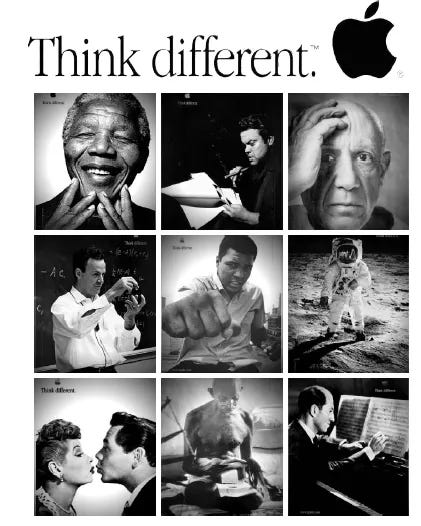
The answer became “Think Different.”
Base camp: Creative people who felt like misfits in the corporate computing world. Trapped. Unseen. Using tools built for spreadsheets when they wanted to change the world.
Summit: Creative people empowered to think differently—and actually make the dent in the universe they believed they could make.
“Here’s to the crazy ones,” the campaign said.
“The people who are crazy enough to think they can change the world are the ones who do.”
This wasn’t a tagline. It was a transformation story. Customer as hero. Apple as guide.
Here’s what most people miss about “Think Different.”
It didn’t just change Apple’s marketing. It changed Apple’s decision architecture.
Jobs cut 14 product lines down to four.
The $150 million Microsoft partnership? He took it—keeping Apple alive to serve the creative transformation mattered more than competitive optics.
The iMac design? Built “for people who think differently”—not for spec-sheet comparisons.
Every decision ran through the same filter. Not “what will sell?” Not “what do competitors offer?” But: Does this advance our customer’s transformation?
The result: Apple’s stock went from $0.12 per share in July 1997 to $30 by the end of 1999—a return that validated the transformation bet.
But the stock price isn’t the point.
The point is what “Think Different” made possible. When you own a transformation story, it compounds. The iMac led to the iPod, iPhone, iPad, and eventually the Apple ecosystem—each product serving the same transformation. Creative empowerment through intuitive technology.
Twenty-five years later, Apple still owns that territory. Competitors can copy features. They can match specs. They can undercut on price.
They can’t copy the transformation story. Because Apple got there first and never let go.
“Think Different was lightning in a bottle.”
Apple was 1997. Ancient history. Maybe Jobs was just a genius.
Except the same pattern is playing out right now.
In early 2024, Nike had a women’s problem. Women represented only 40% of their customer base. Their US women’s sportswear market share had slipped to 5.3%. Lululemon, Alo Yoga, and Vuori were eating their lunch—not by being more athletic, but by owning a different transformation story.
Nike’s transformation story—athletic performance, competitive greatness—didn’t resonate with women who wanted to feel strong AND stylish. Confident AND feminine. Nike was renting “athletic performance” territory and discovering it wasn’t enough.
SKIMS had the opposite problem. Kim Kardashian’s shapewear brand had built a $4 billion valuation on body confidence and inclusive sizing. But they were stuck in intimates and loungewear. They had no performance credibility. No athletic legitimacy.
Both brands owned valuable territory. Neither owned the territory women actually wanted.
The Transformation Story Nike x SKIMS Co-owned
In February 2025, Nike and SKIMS announced NikeSKIMS—a standalone brand, not just a collaboration.
The tagline: “Designed to sculpt. Engineered to perform.”

The transformation story: Women who want to be strong AND stylish. Competitive AND feminine. Athletic AND confident in their bodies.
Base camp: Women forced to choose between performance gear that ignores how they want to look and shapewear that can’t handle a workout.
Summit: Women who don’t have to choose. Integrated. Both.
Neither Nike nor SKIMS could credibly own this transformation alone. Nike couldn’t suddenly claim body-sculpting expertise. SKIMS couldn’t suddenly claim athletic performance technology. But together, they created territory that didn’t exist before.
Three signals validate that NikeSKIMS owns this transformation story rather than renting it.
Premium pricing accepted—customers pay more when they believe in the transformation, not when they’re comparing features.
New customers acquired—SKIMS customers who never bought serious performance wear, Nike customers who never considered shapewear. Both showed up because the transformation story spoke to something neither brand alone could address.
Competitors can’t respond. Lululemon can’t launch shapewear without diluting their yoga-lifestyle positioning. Traditional shapewear brands lack athletic credibility.
When competitors can’t respond, you’ve stopped renting. You own the territory.
Different industries. Different eras. Same pattern.
Find the transformation your customers are trying to achieve. Own the story of that transformation—base camp to summit. Let that story filter every decision. Build on territory competitors can’t copy because you got there first.
This isn’t visionary genius. It’s not about ignoring customers or drowning in market research. It’s transformation story ownership. And it’s available to any company willing to do the work.
Now here’s where most strategy content stops.
You now understand transformation story ownership. You can see how Apple used it. You can see how Nike x SKIMS is using it now. You might even be able to articulate your own customer’s base camp and summit.
But understanding isn’t enough.
Most leaders who grasp transformation story ownership still struggle to execute on it. They can describe the transformation. They can pass the “no competitor references” test. But their teams operate like they’re still renting positioning.
The gap isn’t understanding. It’s download.
Strategy lives in three places:
First, the whiteboard—what gets discussed at off-sites.
Second, leaders’ heads—the context that guides their decisions.
Third, teams’ daily work—the operating rhythm that determines outcomes.
Most strategies die between the second and third.
Why? Because wisdom trapped in heads doesn’t govern operating rhythm. You face a binary outcome. Either you become the decision bottleneck—every choice escalates to you. Or teams execute with 10% of the strategic context, missing 90% of the clarity that connects outputs to outcomes.
Neither works. Both create the ceiling you’re experiencing.
Discovering What Story You Actually Own
Before you can download a transformation story, you need to see it clearly. Five questions reveal whether you actually own one:
Who needs to move? Not your target market in demographic terms—the people experiencing the base camp frustration your business exists to resolve. Can you describe their stuck state without referencing your product?
How do you measure their movement? Not your internal KPIs—the progress markers that tell customers they’re advancing toward summit. What changes in their world when transformation is working?
How do you engineer their journey? The path from base camp to summit. What has to happen, in what sequence, for transformation to be real?
What activation moment matters? The point where customers commit to the journey. What shifts in them when they decide to move?
Where does this position you? The territory you occupy in the customer’s transformation story. Guide? Enabler? Something else entirely?
If you can answer these five questions clearly, you can see the story you own.
If you struggle with them, you’ve found exactly where the gap lives.
Here’s how you know if that story has actually downloaded:
Can someone three levels down from leadership articulate the customer’s transformation—base camp to summit—without referencing competitors?
Can they explain how their daily work advances that transformation?
Can they make a judgment call aligned with the transformation story without asking permission?
If not, you don’t own transformation territory. You understand it. There’s a difference.
Two camps argued about customers for decades. Both were right—about different things.
Customers know their present. They can’t articulate their future. Your job is to know both. Base camp and summit. Where they are and where they’re going.
When you own that transformation story, it becomes a strategic asset. Not a marketing message. Not a positioning statement. A decision filter that governs everything from product cuts to partnerships to pricing.
Apple used it to go from 90 days from bankruptcy to the most valuable company in the world. Nike and SKIMS are using it right now to create territory neither could own alone.
The pattern isn’t genius. It’s not luck. It’s transformation story ownership.
Companies that own their customer’s transformation story build equity with every decision. The story compounds. Products reinforce it. Partnerships extend it. Customers evangelize it. Competitors can’t copy it because they’d have to become you.
Companies that rent positioning pay tax with every decision. The coordination overhead. The strategy debates. The “what are we actually doing?” meetings. Execution feels harder than it should because teams don’t have a filter for what matters.
Same effort. Different trajectory. The gap between them is whether you own the transformation or rent space in someone else’s story.