
Your Operating Rhythm Is Your Strategy: The 4 Questions That Eliminate Coordination Overhead
Prime Positioning - Episode 4: Strategy that lives in documents is already dead.

Prime Positioning - Episode 4
The four questions that eliminate coordination overhead
James has 54 days to close a 30x gap with Amalakai. Today he learns the mechanism behind Decision Velocity - four simple questions that most companies never ask, and the formula that reveals why some teams make three decisions per meeting while others make less than one.
Customer Transformation Is Your Foundation
James couldn’t sleep. Last week he’d validated the hypothesis—eight customer calls, all saying the same thing: they needed decision systems, not dashboards. He’d seen the 30x gap with Amalakai. He’d tried to teach his team Decision Velocity and failed completely.
His phone buzzed at 6:30 AM. A text from Sarah, the board member who’d asked the question that started everything: “James - Hoping the transformation work is progressing.”
Sarah’s gentle reminder felt like a countdown timer.
Last week, James realized companies were making multiple per meeting while Dayanos made less than one. He’d tried to teach his team what he’d learned and watched their confusion prove he didn’t have the system yet.
Now he had 54 days left, and tomorrow he was bringing his leadership team a three-day workshop they weren’t expecting.
Sam was already at their corner table when James walked in at 7 AM. Two coffees waiting.
“You look terrible,” Sam said as James sat down.
“I kept thinking about today. My team’s expecting solutions. We’re starting three intensive days, and I need to understand what they’ll experience.” James wrapped his hands around the coffee cup. “Help me understand what they’ll actually go through.”
Sam pulled out a napkin—old habit. “Here’s what they don’t know yet. This isn’t about learning frameworks. It’s about installing the system that makes fast decisions automatic.”
He drew a simple progression:
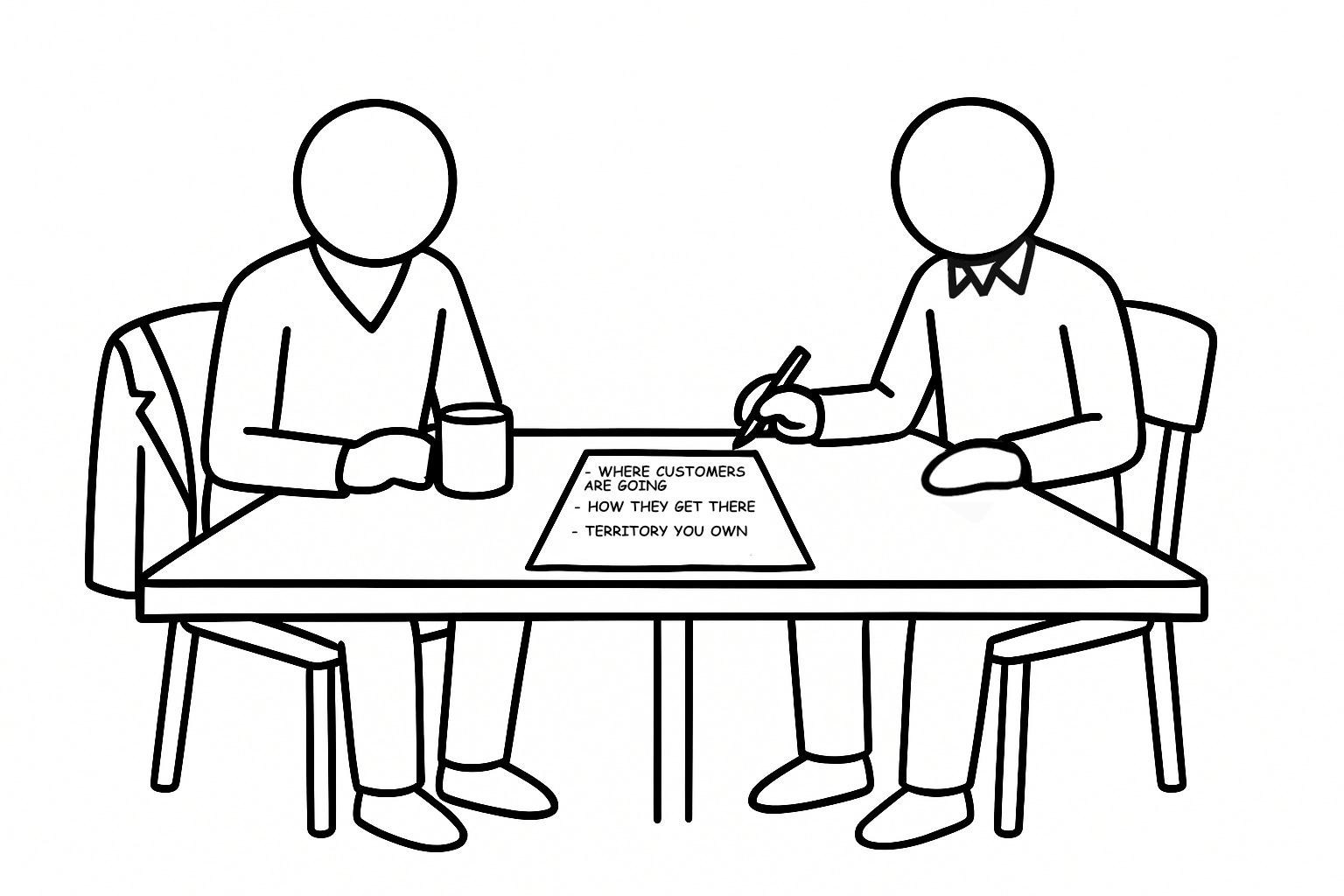
Day One: Where customers are going
Day Two: How they get there
Day Three: Territory you own
“We start with their transformation,” Sam said. “Not your coordination problems. Most companies try to fix meetings first—better processes, clearer handoffs, improved alignment. That’s rearranging deck chairs on the Titanic.”
James felt something click. “I did exactly that last week. Tried to restructure our meetings without knowing what we’re coordinating toward.”
“Right. You can’t align people around nothing.” Sam tapped the napkin. “But once everyone sees the same customer journey—base camp to summit—everything else organizes naturally. Context becomes obvious. Decisions flow from what customers need, not what feels comfortable internally.”
“And that’s what today sets up?”
“Today we lay the foundation. Then we build the system that makes fast decisions automatic.” Sam looked at James directly. “But first, they need to see what’s actually broken.”
More Context, Fewer Meetings
Two hours later, James stood in front of his leadership team. Product VP, Marketing VP, Engineering Director. The same group he’d confused last week with half-formed concepts.
This time, he had backup.
Thanks for clearing your calendars,” James said. “We’re starting three intensive days today. But first, Sam needs to level-set everyone on the foundation.”
Sam walked to the whiteboard. “Last week James tried to teach you Decision Velocity. You asked the right question: How do we actually DO this?” He looked around the room. “Here’s why you couldn’t answer it.”
He wrote on the board:
Your meetings do one of two things: Build context or make decisions
“Everything else is coordination theater,” Sam said. “Remember the Decision Velocity concept James mentioned last week? This is what kills it - meetings that don’t build context or make decisions.
The Engineering Director shifted in his chair. “Most of our meetings feel like theater. We talk, we align, we update each other. But we rarely decide anything.”
“Because you’re coordinating separate workstreams,” Sam said. “Reconciling different perspectives. That’s what happens when people don’t share context. You spend meeting time building understanding you should already have.”
James watched his team. He could see recognition dawning.
“Here’s the real question,” Sam turned back to the board. “What context do you actually need? Not ‘better alignment.’ Not ‘improved communication.’ Specific context that makes decisions obvious.”
He wrote four questions:
Where are customers stuck?
How do they know they’re progressing?
What path gets them unstuck?
What makes them move?
The room studied the board quietly.
The Product VP frowned. “These are all customer questions.”
“Everything starts there,” Sam said. “Internal coordination problems are symptoms. The disease is not knowing where customers are trying to go.”
He pointed to the questions. “If you don’t know what gets customers unstuck, you build features nobody urgently needs. If you don’t know how they measure progress, you can’t prove value until it’s too late. If you don’t know their path, you can’t guide the journey. If you don’t know what triggers movement, your product creates value that never gets captured.”
The Marketing VP was taking notes. “So when we make product decisions, we need all four perspectives?”
“Not just in the room,” Sam corrected. “Already integrated in how everyone thinks. That’s the gap between coordination and unified judgment.”
James saw his team processing this differently than before. Last week, he’d given them a concept. Sam was showing them the mechanism.
“Let me show you what this looks like,” Sam said.
Shared Context, Faster Decisions
Sam drew a timeline on the board. “Same problem. Two different approaches. Watch what happens.”
“Scenario One: How you decide now.” He wrote while talking. “Product team discovers users aren’t adopting a key feature. They spend a week analyzing usage data. They develop a hypothesis: need better onboarding.”
The Product VP nodded. They’d lived this.
“They bring it to a cross-functional meeting. Engineering asks about technical feasibility. Marketing asks about messaging implications. Everyone’s coming from their functional perspective.”
Sam drew arrows between different boxes. “Product defends the hypothesis. Engineering raises constraints. Marketing suggests alternatives. Three meetings later, you have a compromise nobody loves. Implementation takes six weeks because you’re still coordinating separate workstreams.”
The room was quiet.
“Scenario Two: Unified judgment.” Sam erased the board. “Same discovery: users aren’t adopting a key feature. But this time, the product person doesn’t just analyze usage data.”
He wrote the four questions again:
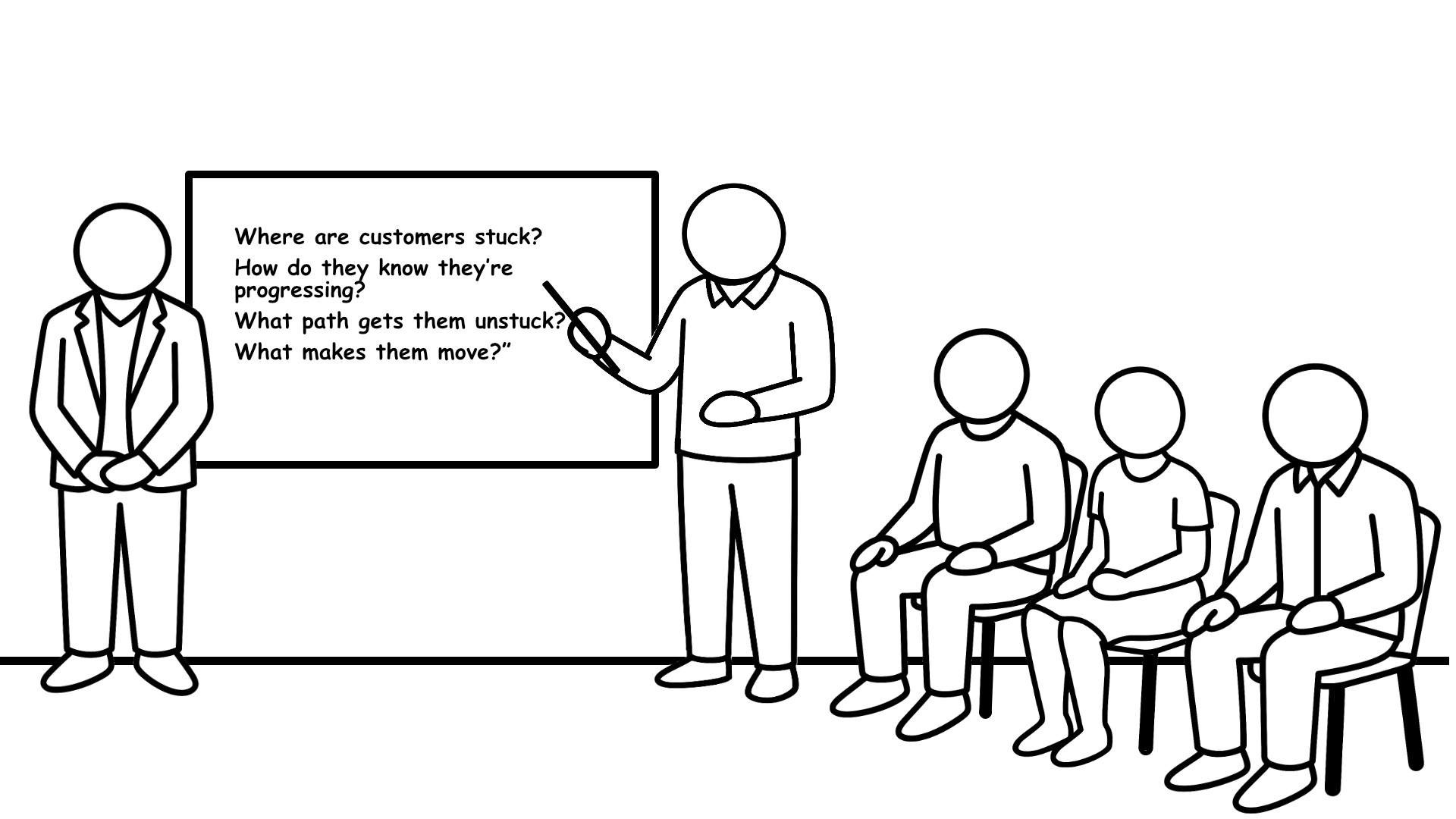
Where are customers stuck?
How do they know they’re progressing?
What path gets them unstuck?
What makes them move?
“They immediately consider all four angles. Is this feature solving something urgent? What would show users they’re making progress? Where does it fit in their journey? What would trigger engagement?”
The Engineering Director leaned forward. “So they bring integrated analysis to the meeting.”
“But here’s the key,” Sam said. “Engineering already shares context about customer transformation. Marketing already understands the journey. Nobody’s hearing about it for the first time.”
Sam drew a single arrow. “One meeting. Integrated decision. Implementation starts immediately because everyone’s already aligned.”
James stepped forward. “That’s Amalakai. They’re not faster at executing—they’re faster at deciding because they already have unified judgment.”
“And unified judgment comes from operating rhythm,” Sam said. “The system that builds these four context areas into how everyone thinks.”
Systems Beat Heroics Every Time
Sam pulled up the Decision Velocity formula:
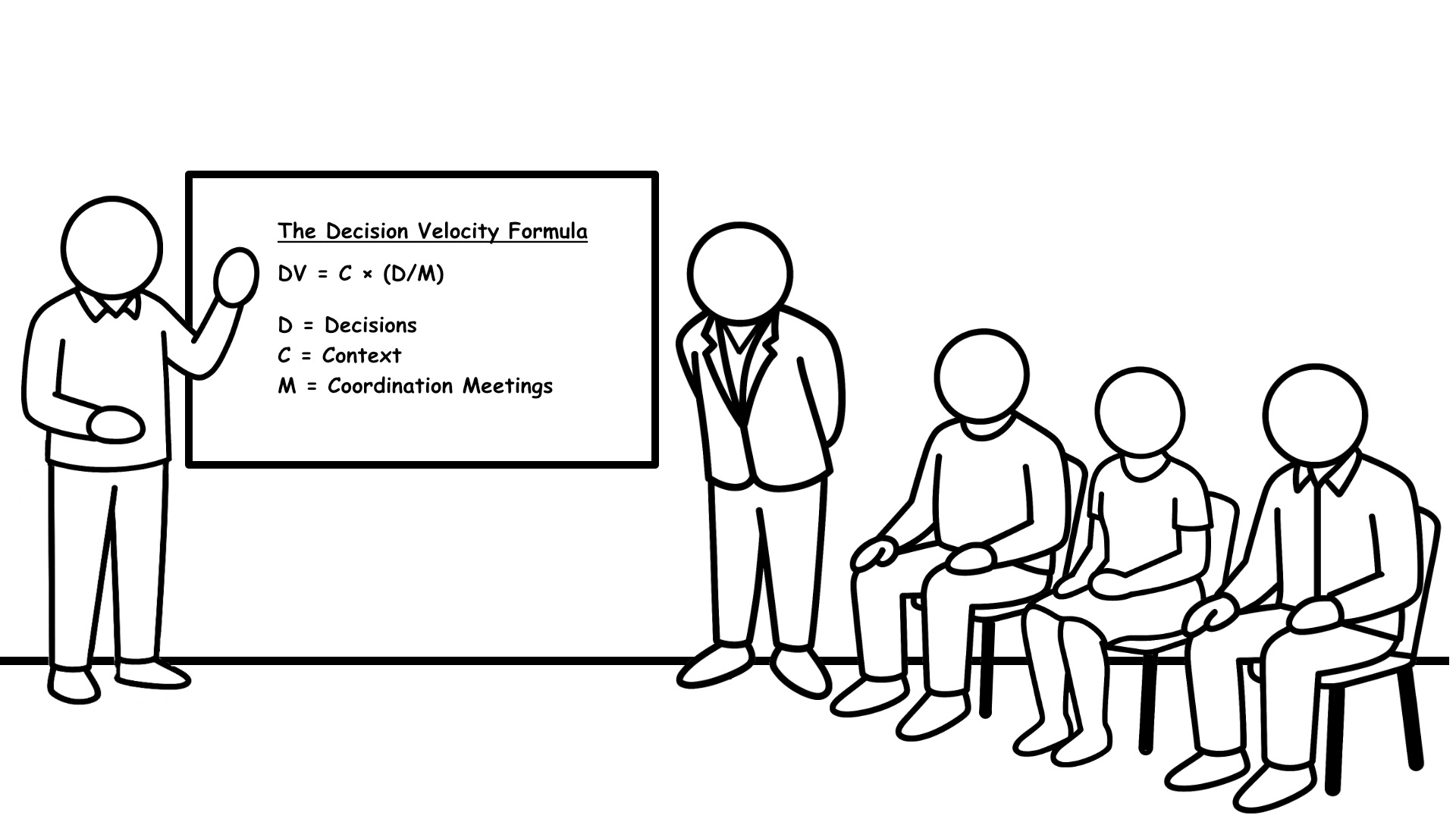
DV = C × (D / M)
“James mentioned this concept last week,” he said. “But now it means something specific.”
The Marketing VP stared at the equation. “What do those letters actually represent?”
Sam pointed to C. “Context isn’t just ‘more information’ or ‘better alignment.’ It’s the number of customer perspectives you integrate before each decision.”
He wrote examples on the board. “Most companies integrate two or three perspectives. Product requirements, maybe engineering constraints, possibly some customer feedback.”
“Companies like Amalakai?” Sam continued. “They integrate five to eight. All four transformation questions—where customers are stuck, how they measure progress, what path works, what triggers movement—plus competitive positioning, technical constraints, financial impact.”
The Engineering Director raised his hand. “How do you integrate eight perspectives without eight-hour meetings?”
“That’s where operating rhythm comes in,” Sam said. “You don’t integrate them during the meeting. You build them into how everyone already thinks. The meeting confirms what unified judgment already sees.”
He moved to D. “Decisions per meeting. High-velocity teams average three. Most companies average less than one. Actual decisions that move the business forward, not activities or alignments.”
James thought about last quarter. “We had tons of meetings. Lots of activity. But how many real decisions?”
“Exactly,” Sam said. “Most companies confuse motion with decisions. High-velocity companies make more decisions with less coordination because their context is already unified.”
Sam pointed to M. “Meetings that don’t increase context or produce decisions. Status updates. Alignment sessions that don’t align anything. Meetings to prep for meetings.”
He drew a comparison:
Dayanos Today:
Few context areas integrated
Lots of coordination meetings
Decisions per meeting: less than one
Amalakai:
Many context areas integrated
Minimal coordination overhead
Decisions per meeting: 3 or more
The room went quiet.
“That’s not a 10% gap,” the Product VP said slowly. “That’s a different game entirely.”
Foundation First, Speed Second
The Marketing VP looked at the formula. “So the workshop teaches us how to get to three decisions per meeting?”
“The workshop builds it,” Sam corrected. “We don’t just teach you the system. We install it.”
The Product VP frowned. “What does ‘install’ mean?”
“By the end of day three, you’ll have operating rhythm that enables unified judgment,” Sam said. “Then you spend the next fifty-one days practicing it, refining it, proving it works.”
James stepped forward. “We’re not learning about customer transformation. We’re mapping Dayanos’s specific customers. Their actual journey from where they are to where they want to be.”
“Exactly,” Sam said. “We start with your external anchor. What transformation do your customers actually need? Not what they say they want. What they need to reach their summit.”
The Engineering Director leaned back. “And once we know that?”
“We build the rhythm that keeps everyone aligned to it,” Sam said. “These four context areas become your natural way of thinking. Not a checklist you force yourself to use.”
James looked at his team. Last week, they’d asked how to actually implement Decision Velocity. Now they were about to find out.
“One more thing,” Sam said. “This only works if you’re ready to operate differently. Most companies understand frameworks. They just don’t change how they actually work.”
The Product VP exchanged a glance with Marketing. “What does ‘operate differently’ mean?”
“It means when you make a product decision, you automatically consider where customers are stuck, how they measure progress, what path works, and what triggers movement,” Sam said. “Not because you’re following a process. Because that’s how you think.”
The Marketing VP was quiet for a moment. “And that’s what creates the three decisions per meeting?”
“That’s what eliminates the coordination overhead,” Sam said. “When everyone already shares context, meetings become about confirming what unified judgment sees. Not building alignment from scratch.”
Build Your Operating Rhythm
Sam stepped back from the whiteboard. “Alright, that’s the foundation. You understand the mechanism behind Decision Velocity. You see why context matters. You know the four questions that enable unified judgment.”
He looked around the room. “But understanding the questions isn’t the same as having the answers. That’s what we tackle next.”
James watched his team. The Engineering Director was still studying the formula. The Product VP was reviewing her notes on the four context areas. The Marketing VP had drawn her own version of the coordination theater diagram.
“Here’s what we’re going to do,” Sam said. “We’re going to map the transformation you own. Not the future you hope they move toward—the movement that sits inside your territory. Where the customer is stuck today. The climb only you can lead. The markers that prove they’re advancing. Until we see that story cleanly, nothing else will hold.”
He wrote on a fresh section of the whiteboard:
Where customers are going
What summit are they trying to reach?
Where are they stuck right now?
“This is your external anchor,” Sam said. “Once this is crystal clear, everything else organizes around it. Your context areas become obvious. Your decisions align naturally. Your rhythm emerges from what customers need, not from what feels comfortable internally.”
The Product VP looked up from her notes. “So we’re mapping Dayanos’s specific customers? Their actual transformation journey?”
“Exactly,” Sam said. “Not customer personas. Not user stories. The transformation they’re seeking and currently can’t achieve.”
James felt the energy shift in the room. The foundation was set. Now came the real work.
“The four questions you just learned,” Sam said, “they’re not isolated concepts. They’re part of a larger system we’ll build over the next three days. When you practice the same diagnostic sequence enough times - where are they stuck, how do they measure progress, what path works, what triggers movement - it stops feeling like a checklist and starts feeling like how you naturally analyze any business challenge.”
“That’s when questions become operating rhythm. By the end of day three, these won’t be questions you ask. They’ll be how you naturally think.”
The Marketing VP tilted her head. “So we’re building the complete system? Not just learning the questions?”
“We’re installing it,” Sam said. “The questions are the foundation. Over three days, we’ll build the architecture that makes them automatic. Your team will share the same context naturally. Your decisions will integrate multiple perspectives without coordination overhead. Your operating rhythm will produce the fast decisions you saw in the Amalakai comparison.”
The Engineering Director spoke up. “And that’s what creates the three decisions per meeting?”
“That creates the system where three decisions per meeting becomes normal,” Sam corrected. “Not through effort. Through architecture.”
He gestured to the four questions on the board. “These questions are your foundation. Everything we build—your decision process, your priority framework, your competitive positioning—will organize around them. That’s how operating rhythm works. Not as separate practices you bolt together, but as an integrated system where each part reinforces the others.”
The Product VP was studying the whiteboard. “So tomorrow we start mapping where our customers are actually going?”
“We start in fifteen minutes,” Sam said. “This is day one. We’re not spreading this across weeks. We’re building the complete system in three intensive days.”
The room went quiet. The reality of what they were about to do was sinking in.
“Let’s take fifteen minutes,” Sam said. “When we come back, we map your customers’ transformation journey. The external anchor for everything else.”
The team dispersed. James stayed at the whiteboard, looking at the four questions Sam had written.
Where are customers stuck? How do they know they’re progressing? What path gets them unstuck? What makes them move?
Simple questions. But Dayanos didn’t have clear answers. They’d built features based on requests, not transformation. They’d measured usage, not progress toward summit. They’d optimized for adoption, not the journey itself.
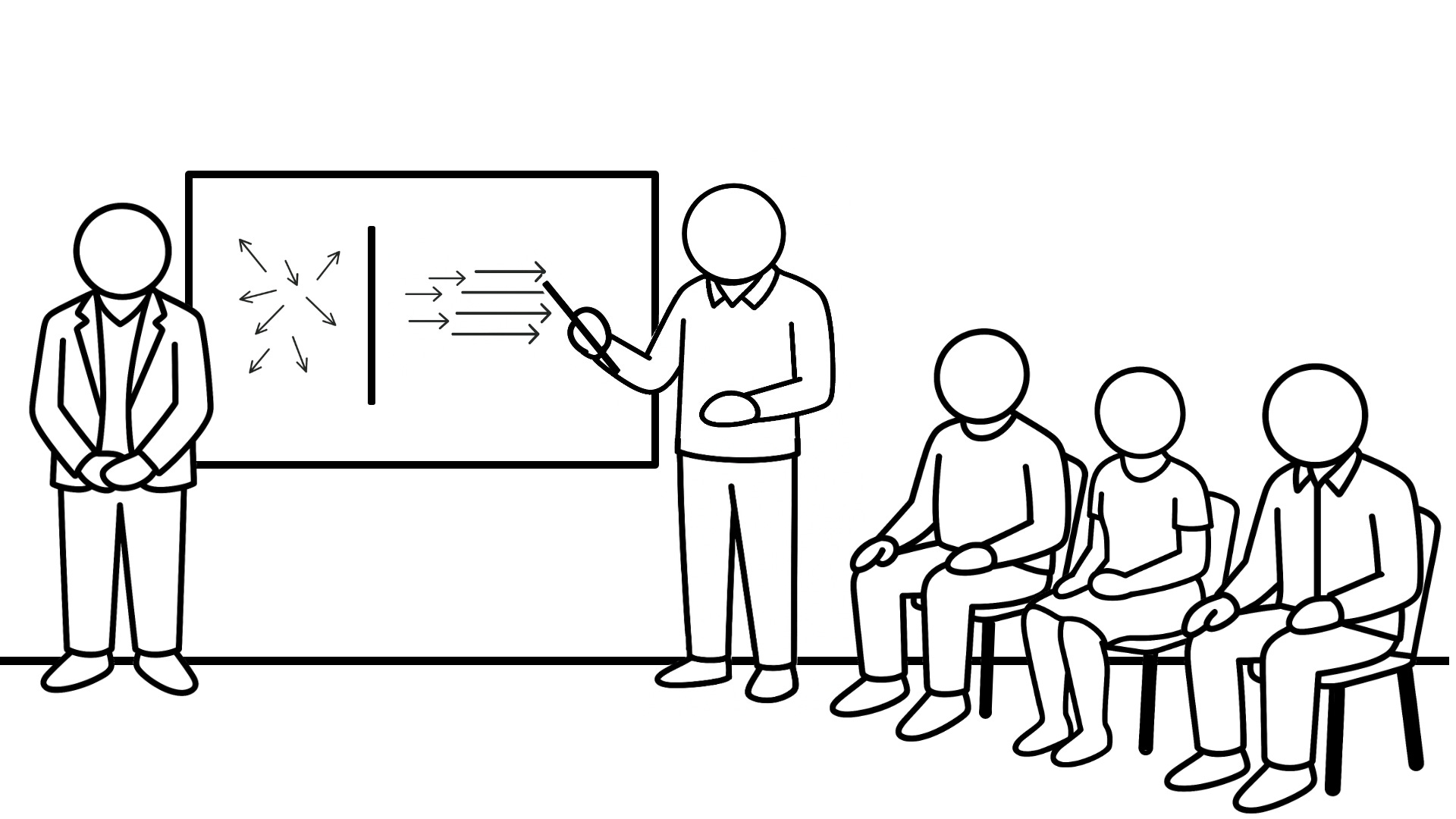
In fifteen minutes, that would change.
Fifty-four days to prove the system works. But first, three days to build it.
James pulled out his phone and texted Sarah: “Day one starts now. Building the system.”
Her response came immediately: “Rooting for you.”
He looked at his team taking their break. The Engineering Director was sketching something in his notebook. The Product VP was on her phone, probably checking customer data. The Marketing VP was reviewing the whiteboard photos she’d taken.
They were ready. The foundation was laid. The mechanism was clear. The formula made sense as a diagnostic, not just theory.
Now they’d build the operating rhythm that made unified judgment systematic.
Fifteen minutes. Then the real work begins.
PRACTICE: The Operating Rhythm Audit
Time: 2 minutes
Look at yesterday’s calendar. Pick the meeting that took the longest.
Ask yourself: Was this about making a decision or coordinating to make a decision?
Write one sentence about what your calendar reveals about your strategy.
AI Prompt:
The longest meeting yesterday was: [Meeting topic]

It was about: [Making a decision / Coordinating to make a decision]

What this reveals about my rhythm: [One sentence]

Based on this:
1. Is my operating rhythm enabling or blocking decision velocity?
2. What’s one change to my rhythm that would create the biggest shift?

Help me redesign this.
Next Episode: Your Company Moves as Your Customer Moves (Now Live)
James’s team maps their customers’ actual transformation journey - the foundation for everything else. And they discover the Strategy Flywheel that turns scattered coordination into unified judgment.
Subscribe to follow James’s transformation journey, and share with a leader who needs to escape coordination theater.