
Your Company Moves As Your Customer Moves: Why Strategy Starts With The Transformation You Own
Prime Positioning - Episode 5: Companies drift when they don't know what transformation they own.

Prime Positioning - Episode 5
Why strategy begins with the transformation you own
James has 53 days left and a team that finally understands the Decision Velocity formula. But before they can build the system, Sam reveals something more fundamental—the physics that explains why companies drift out of alignment even while executing brilliantly.
Move With Your Customer
The team returned from their fifteen-minute break with different energy. The Engineering Director had sketched the Decision Velocity formula in his notebook. The Product VP had pulled customer data on her phone. The Marketing VP was reviewing photos of every whiteboard like evidence.
They understood the mechanism now. Four questions. A formula. The 30x gap with Amalakai. They were ready for the real work.
Sam stood at a fresh whiteboard. “Before we map your customers’ transformation, we need to understand something more fundamental.”
He wrote a single sentence:
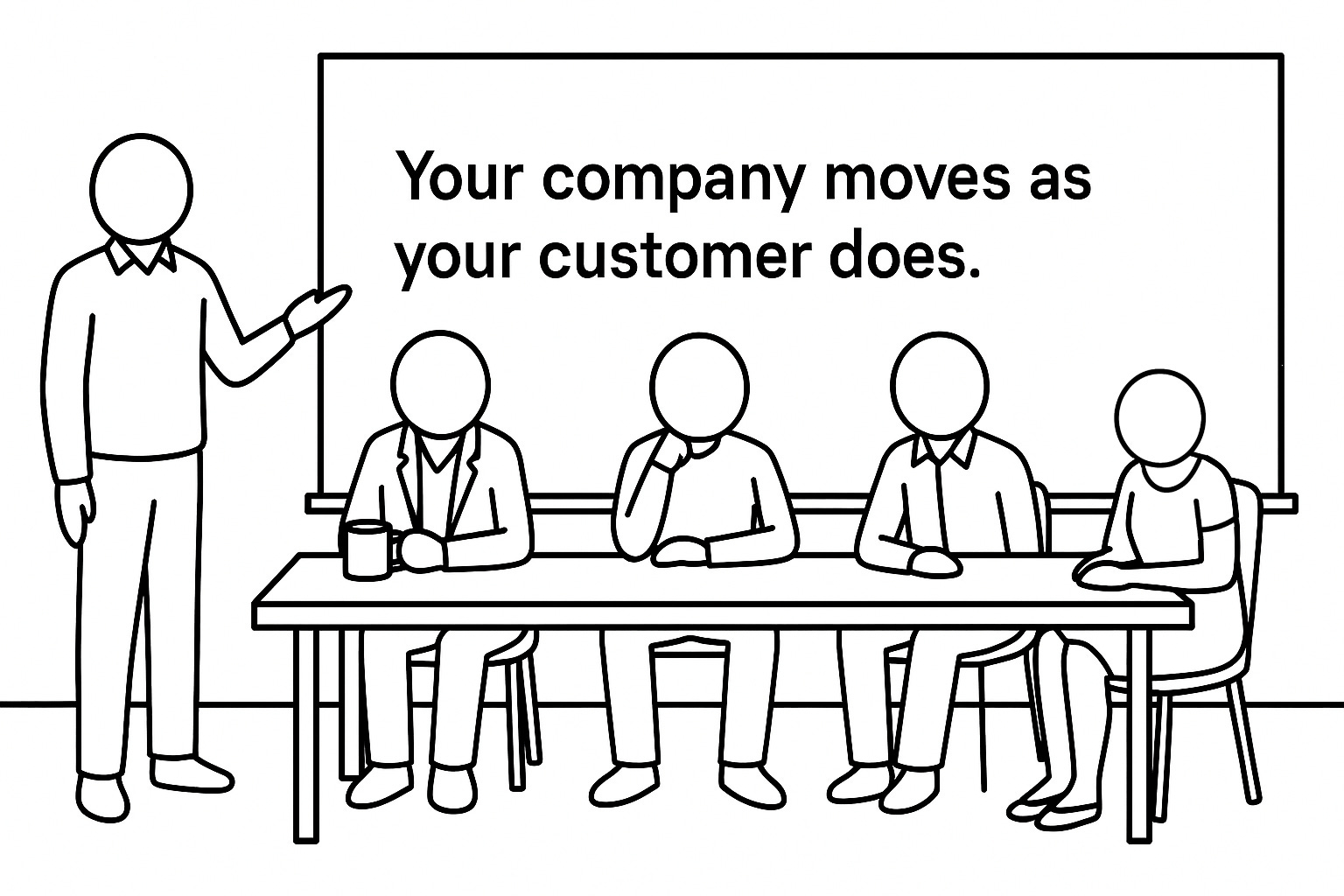
Your company moves as your customer moves.
The Marketing VP tilted her head. “That sounds like customer-centricity. We’ve done that training.”
“Customer-centricity puts the customer at the center of your business. Makes sense on paper.” Sam turned back to the board. “Except the customer lives in the present. They see where they are. As a guide, you have to live in the future—seeing where they need to go before they can see it themselves. You can’t guide someone to a future you can’t see.”
He tapped the whiteboard. “This isn’t about centering your business on customers. It’s about moving with their transformation. When you match their movement, you grow. When you don’t, you decline. When they need transformation you can’t deliver, they find guides who can.”
Sam let that settle for a moment.
“Here’s what happens to every company that starts aligned. It’s the same pattern, and almost nobody sees it until they’re deep in it.”
He wrote:
Stage 1: Initial Alignment
“When you started Dayanos, James, you knew exactly what transformation customers needed. You’d lived it. You built the company specifically to guide that transformation. Product, service, everything designed for transformation delivery. Perfect alignment.”
James nodded slowly. He remembered those early days. Every feature decision was obvious because he understood exactly what customers were trying to become.
Stage 2: Drift Begins
“Then you added people who didn’t build it. New team members who execute activities without transformation context. They’re good at their jobs—but they’re doing tasks, not guiding transformation. Coordination overhead increases as shared understanding decreases. Strategy stays trapped in the founder’s head.”
The Engineering Director shifted. “That’s exactly what happened when we scaled from ten to fifty.”
Stage 3: Misalignment Compounds
“Activities proliferate without transformation alignment checks. Metrics measure activity completion, not transformation progress. Teams optimize for what they can measure, not for customer transformation. Company moves—busy executing—but not with customers.”
The Product VP was staring at her notes. “We track feature adoption. Sprint velocity. NPS scores.” She looked up. “None of those measure whether customers are actually transforming.”
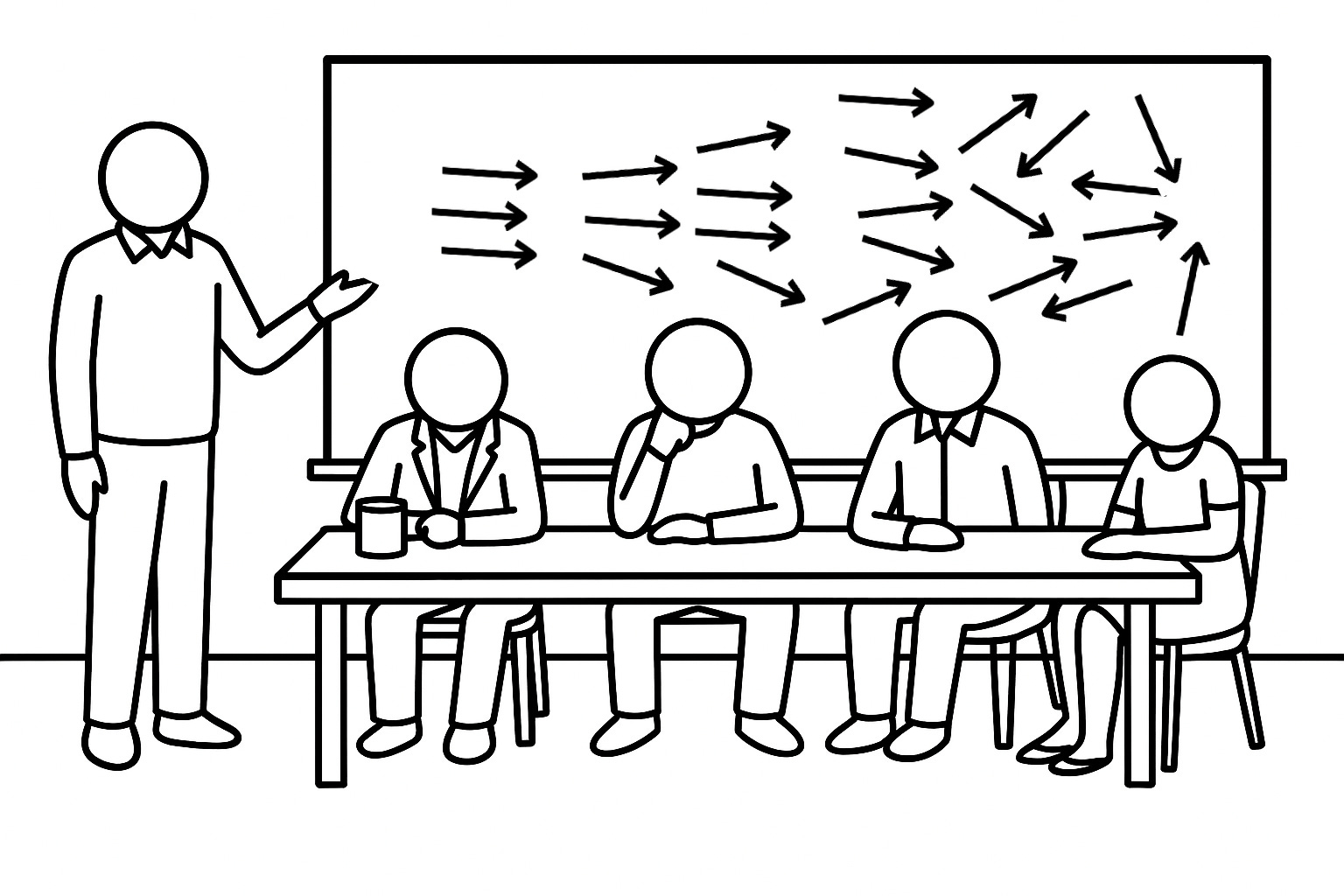
Stage 4: Relevance Loss
“Customers complete the original transformation and need the next one. Company’s still optimized for the original. Competitors guide what customers now need. Customer movement separates from company movement.”
He drew a circle around Stage 4.
“This is where Dayanos is right now.”
The room went silent.
Stage 5: Business Irrelevance
“This is where drift ends if uncorrected. Unable to acquire new customers because transformation is outdated. Unable to retain existing customers because they’ve outgrown you. Terminal decline.”
The Marketing VP spoke quietly. “Our messaging still talks about visibility. Helping companies see their operations. But they don’t need to see anymore. They need to decide.”
Strategy Must Move to Work
James was staring at the whiteboard, but he wasn’t seeing the five stages anymore. He was seeing a face. A specific customer.
“Ramorian,” he said.
The team turned to look at him.
“He needed us to own their transformation.” James spoke slowly, the recognition hitting with each word. “We were monitoring their operations while they needed transformation ownership. We were giving them dashboards while they needed decision systems. We lost alignment because...”
He looked at his leadership team.
“...because transformation understanding never downloaded from me to the organization.”
The weight of it settled over the room.
“I knew what Ramorian needed,” James continued. “I could see their transformation journey. But the team was executing the playbook I’d designed three years ago. When their needs evolved, we couldn’t adapt.”
The Engineering Director spoke carefully. “We built what was requested. Every ticket that came through, we delivered. But we never asked whether those requests would complete the transformation.”
“I couldn’t tell you today,” the Product VP said quietly, “what summit our customers are actually climbing toward. I know our features. I don’t know their transformation.”
Sam let the silence hold.
“That’s the root cause,” he said finally. “Transformation ownership never downloaded from leader to organization. Company executes activities the leader designs, but doesn’t own the transformation understanding that generated those activities. When the customer transformation evolves, the company can’t evolve with it—because they never owned the transformation. They just executed the playbook.”
Sam turned back to face the team. “Here’s how you know if transformation ownership has downloaded. Simple test.”
He wrote on the whiteboard:
Ask your newest team member:
What customer transformation does your company enable?
Why does that transformation matter to them?
What’s the basecamp-to-summit journey?
“If they can articulate it clearly, transformation ownership has downloaded. If they can’t—”
“They’d say we help companies see their operations better,” James interrupted. His voice was flat. “That’s what they’d say.”
The Marketing VP nodded slowly. “That’s what our onboarding materials say. That’s the language we give them.”
“That’s what I told my last three hires,” the Engineering Director added. “Word for word.”
The Product VP looked up. “None of them could articulate the actual transformation. Because we never gave it to them. We gave them job descriptions and feature roadmaps.”
“When transformation understanding stays trapped in leadership,” Sam said, “you’re renting your positioning from founder intuition. The moment the founder can’t personally touch every decision, drift begins. You’ve been paying strategic rent for three years—coordination overhead trying to align people who don’t share transformation context.”
James thought about the endless alignment meetings. The strategy decks that never quite stuck. The decisions that kept coming back to him because nobody else had the context to make them.
“All that coordination overhead,” he said slowly. “It wasn’t a process problem.”
“It was an ownership problem,” Sam confirmed. “You were spending meeting time building understanding that should have been universal. Reconciling perspectives that should have been aligned. Making decisions that teams should have been making themselves—because they didn’t share the transformation context that makes those decisions obvious.”
The team sat with it. The physics were clear. The drift pattern was diagnosed. The ownership gap was exposed.
The Five Questions Every Strategy Answers
“So how do you actually fix this?” James asked. “You can’t just tell people about customer transformation. We’ve tried that. Mission statements. Values workshops. All-hands meetings. None of it stuck.”
The Product VP nodded. “We have a slide deck called ‘Customer Transformation Journey.’ I’ve presented it four times. Last month I asked a product manager what transformation we enable. She said ‘operational visibility.’”
“Because telling isn’t downloading,” Sam said. “Information presented doesn’t become ownership internalized. You can understand something intellectually without it changing how you think.”
He stood and moved to the whiteboard.
“Let me ask you something. What does every good strategy need to answer?”
The Marketing VP spoke first. “Who we’re targeting. What we’re offering. How we’re different.”
“Market position,” the Engineering Director added. “Competitive advantage. Resource allocation.”
“Goals,” the Product VP said. “Metrics. Timeline.”
Sam let them continue for a moment, then held up his hand.
“You’re listing components. I’m asking about questions.” He wrote on the whiteboard:
Every good strategy answers five questions.
“First: Who are you mobilizing, and toward what transformation? It doesn’t matter what you put on paper or even what you execute—if it doesn’t mobilize customers toward a transformation they actually want, nothing happens.”
He wrote: 1. People
“Second: How do you know mobilization is working? Not vanity metrics. Not activity reports. Actual signals that customers are moving toward transformation. Sales calls. Conversion patterns. Behavior changes.”
He wrote: 2. Performance
“Third: What’s the architecture for designing and executing the work? How does your team stay aligned on what you’re building, how you’re measuring it, who owns what? The process that turns strategy into coordinated action.”
He wrote: 3. Process
“Fourth: What are you saying no to? Strategy is choice. Every yes requires a hundred nos. Where are you concentrating force instead of spreading thin?”
He wrote: 4. Prioritization
“Fifth: What territory are you claiming? Not your tagline. The strategic position that emerges when the other four align—the transformation space you own because you understand it better than anyone else.”
He wrote: 5. Positioning
The team studied the list. Nothing on it was unfamiliar. They’d seen versions of these questions in every strategy book, every planning framework, every consultant deck.
“We know these,” the Product VP said slowly. “We’ve answered versions of these in every strategic planning cycle.”
“I know you have,” Sam said. “So why didn’t it prevent the drift?”
The room went quiet.
“Two reasons.” Sam drew a vertical line between the five questions and a new section of whiteboard. “First: they exist on paper, not in your operating rhythm. You answer them once a year in planning sessions. Then you execute for twelve months without asking them again. The answers decay while customer transformation evolves.”
James thought about their annual strategy offsite. Two days of intensive work. Beautiful slides. Clear answers to exactly these kinds of questions. And then... execution mode. Heads down. Shipping features. Never revisiting whether the answers still held.
“Second reason,” Sam continued. “They’re disconnected. You answer them separately, in different meetings, by different teams, at different times. Product answers the process questions. Marketing answers the positioning questions. Finance answers the measurement questions. Nobody sees how the answers connect.”
He drew five separate boxes on the whiteboard, scattered across the space.
“This is what most strategies look like. Five good answers floating independently. No architecture connecting them. No mechanism ensuring they stay aligned as conditions change.”
The Engineering Director was frowning. “So the drift we diagnosed earlier—it happens because these questions get answered once and then ignored?”
“It happens because there’s no system keeping them connected and current,” Sam said. “You answered People Mobilization three years ago when you founded Dayanos. The answer was right then. But you never built the architecture that updates it as customers evolve. So the organization kept executing against an answer that was slowly becoming wrong.”
“And we couldn’t see it,” James said quietly, “because we were measuring activity, not mobilization.”
“Your Performance Measurement wasn’t connected to your People Mobilization,” Sam confirmed. “You were measuring feature adoption while customers were transforming beyond what your features addressed. Disconnected answers.”
The Marketing VP set down her pen. “So how do you keep them connected?”
Sam erased the five scattered boxes. In their place, he drew a circle. Then he divided it into five sections, labeling each with the questions he’d listed.
“You turn them into a flywheel.”
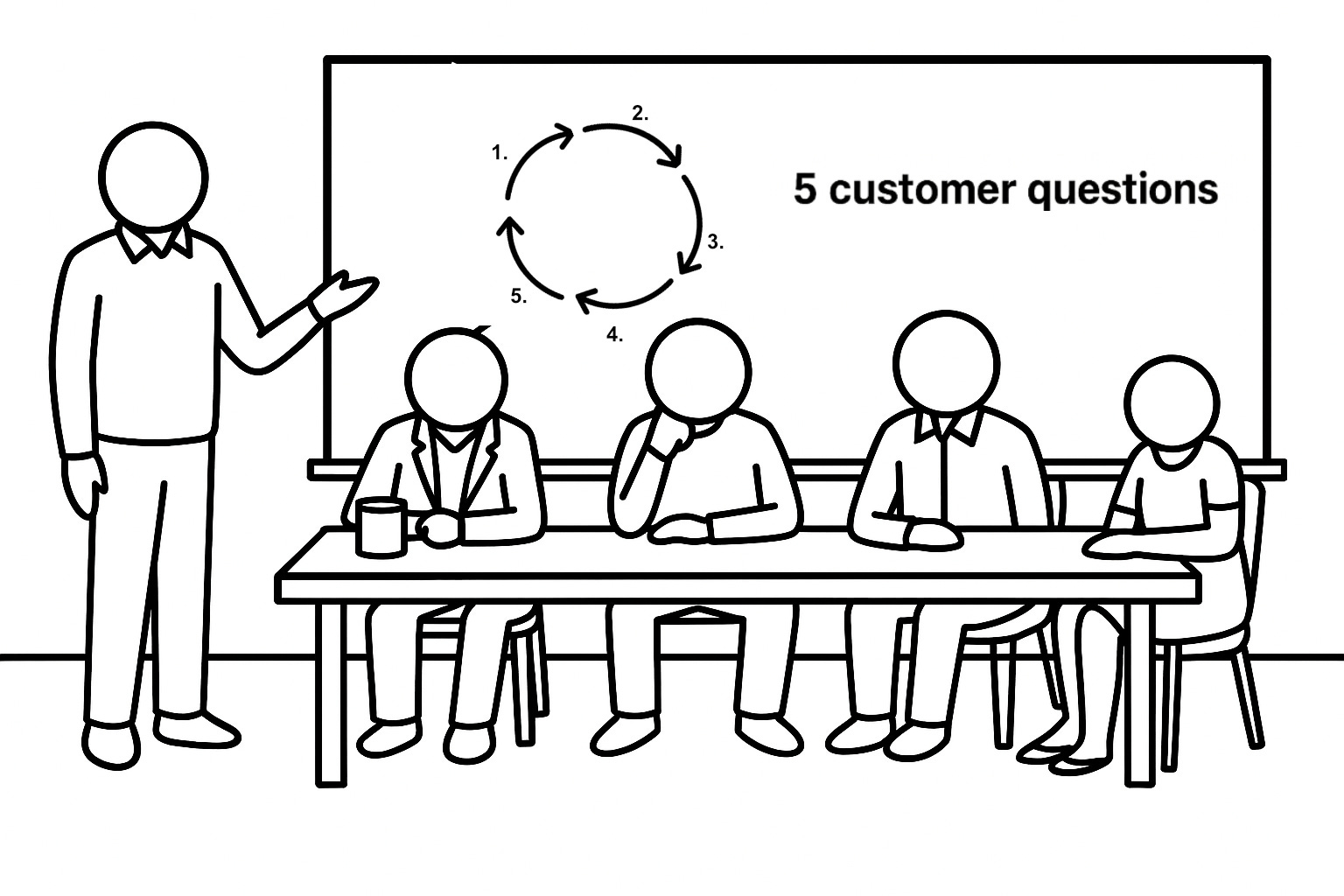
He drew arrows connecting each section to the next, clockwise around the circle.
“People feeds Performance—you can only measure what matters if you know what transformation you're enabling. Performance feeds Process—the signals tell you where your execution needs work. Process feeds Prioritization—seeing the full system reveals where concentration creates breakthrough. Prioritization feeds Positioning—disciplined execution on the right things earns you territory. And Positioning feeds People—owning territory deepens your understanding of the customers who occupy it.”
The team studied the diagram.
“It’s not five separate answers,” the Engineering Director said. “It’s one system where each answer shapes the others.”
“And here’s what makes it operational,” Sam said. He tapped the circle. “Every time you question your approach—any decision, any initiative, any resource allocation—you run it through this sequence. Not annually. Continuously. The flywheel becomes your operating rhythm, not a document you revisit once a year.”
Sam stepped back from the whiteboard. Let the diagram hold the room’s attention.
“One more thing about this.” He tapped the circle but didn’t continue.
James studied the connections. Something was forming.
“You can’t copy someone else’s flywheel,” James said slowly. “It’s built for their transformation story. Their customers.”
Sam waited.
“But the thinking...” James traced the connections with his finger. “How the elements relate. How each one shapes the next. That transfers.”
“Keep going.”
“This isn’t a template to fill out.” James looked at his team. “It’s a way of seeing strategic questions. Once we think in flywheel terms—” He stopped. Looked at Sam.
“Then what?”
“Then we build our own version. One that fits our transformation, our customers.”
Sam nodded once. “That’s when I know the capability transferred. Not when you can recite the five elements. When you can adapt them for problems I never anticipated.”
James was staring at the diagram. “The four questions from this morning. Where customers are stuck. How they measure progress. What path works. What triggers movement.” He looked up at Sam. “They map to this.”
“They’re entry points,” Sam said. “The diagnostic layer. The flywheel is the architecture that makes the answers operational across your entire organization—not trapped in whoever asked the questions.”
The Product VP was connecting pieces. “So when I make a product decision, I don’t just ask ‘what should we build?’ I ask how it connects to people, how we’ll measure it, how it fits the process, whether it’s a priority, how it strengthens our position.”
“And so does everyone else,” Sam said. “Same questions. Same sequence. Same understanding. That’s how ownership downloads. Not through telling—through a shared operating system that everyone runs.”
“This is why Amalakai moves at 30x,” James said. “They’re not just faster. They have architecture that keeps these answers connected and current. Their whole organization sees the same flywheel.”
“Their meetings aren’t about building alignment,” Sam confirmed. “They’re about confirming what the flywheel already reveals.”
The room was quiet for a moment. The Engineering Director was sketching the flywheel in his notebook. The Product VP was staring at the circle with an expression James recognized—the look of someone reorganizing everything they thought they knew.
“Tomorrow we go deep,” Sam said. “Each element. How it actually works. How you install it at Dayanos specifically—not as theory, but as operating system.” He looked around the room. “Today you learned the physics of why companies drift. You saw your own pattern. You understood why ownership never downloaded.”
He tapped the flywheel.
“Tomorrow you learn how to make this run.”
The team gathered their notes. Day one was complete. The physics were clear. The architecture was visible.
Tomorrow, they’d learn how to build it.
James sat in his car in the parking garage, engine off, staring at his phone.

His calendar for next week. The same calendar he’d wanted to reorganize two weeks ago before Sam stopped him. “Rearranging deck chairs instead of fixing the navigation system.”
Now he saw the drift.
Product roadmap review. Marketing campaign sync. Engineering sprint planning. Leadership alignment. Board prep.
Five meetings. All of them moving. None of them moving with customers.
They’d been so busy coordinating internally that they’d mistaken activity for alignment. Every meeting felt productive because things got decided, shipped, launched. But the flywheel elements were scattered across different rooms, different days, different teams—never connecting.
Product thought about customers. Marketing measured campaigns. Engineering built processes. Leadership set priorities. They even had positioning statements.
The pieces existed. They just floated independently. Drifting further apart each quarter while Dayanos congratulated itself on execution speed.
James started the car. 53 days left.
Tomorrow, they’d learn how to make the pieces turn together.
Good Strategy Mobilizes People
Day Two, the team arrived early. Nobody had to be reminded.
The Engineering Director was first, coffee in hand, notebook open to the flywheel sketch he’d been refining. The Product VP came with questions written in the margins of yesterday’s notes. The Marketing VP had crossed out and restarted her positioning summary three times.
Something had shifted overnight. The scattered boxes weren’t just a diagram anymore. They were a diagnosis everyone recognized.
Sam walked in and went straight to the whiteboard where yesterday’s flywheel still stood.
“Questions before we go deep?”
“The disconnection,” the Engineering Director said. “We have meetings for every element—product reviews, marketing syncs, engineering standups, leadership alignment. But they don’t connect. We’ve been running five separate processes.”
Sam nodded. “That’s the gap between having pieces and having a system. Today we close it.” He tapped the flywheel. “We build each element for Dayanos specifically. Not theory. Your customers. Your transformation.”
He circled People.
“We start where everything starts. Who are you actually mobilizing—and toward what?” He looked at James. “Those eight customer calls you made a few weeks ago. What did they tell you?”
James remembered the conversations. The VP who said they wanted to decide faster, not just see better. The feedback that kept echoing: visibility is incredible, but we’re still spending weeks aligning. Ramorian’s exit interview he’d finally understood too late.
“They didn’t need dashboards,” James said. “They needed to transform how they make decisions. We were showing them the mountain. They needed a guide to climb it.”
“That’s your People Mobilization,” Sam said. “That’s the transformation you own. Now let’s make sure everyone in this room can articulate it as clearly as you just did—and build the system that keeps it current.”
The whiteboard filled with customer language James had heard but never organized. Transformations customers described in their own words. The gaps between where they were and where they needed to be. The journey Dayanos had been adjacent to but never owned.
For the first time, the team was seeing the same mountain.
Day Two was just beginning. They had the flywheel. Now they had to build each element—People Mobilization first, then the architecture that connected measurement to process to priority to positioning.
52 days to prove the system worked. But the scattered boxes were starting to turn.
PRACTICE: The Ownership Test
Time: 5 minutes
Find your most recent hire. Ask them three questions:
What customer transformation does our company enable?
Why does that transformation matter to them?
What’s the basecamp-to-summit journey?
Write down their exact words. No coaching, no prompting.
What you hear reveals whether transformation ownership has downloaded—or whether you’ve been paying strategic rent.
AI Prompt:
My newest team member described our customer transformation as:
[Their exact words]

What we actually help customers become:
[Your understanding of the real transformation]

Based this ownership test:
1. Does their description reflect the actual transformation we enable, or the activities we perform?
2. Where is the gap between what they said and what our customers actually need to become?
3. What would transformation ownership sound like if it had fully downloaded?

Help me see the drift.
Next Episode: Clarity Is Velocity (Now Live)
James’s team goes deep on each flywheel element—building the architecture that turns disconnected strategy into operating rhythm. And they discover why most companies never make it past the first element.
Subscribe to follow James’s transformation journey, and share with a leader whose strategy lives on paper instead of in practice.