
Product-Market Fit Is a Trap. Here's What Replaces It.
The game has changed. But most companies are still playing the old one.

Product-market fit is the ultimate startup summit.
Every blog teaches it. Every accelerator preaches it. Every investor screens for it.
“Have you achieved PMF?” is the question that separates serious founders from dreamers.
The logic is clean: Build something. Find the people who want it. Iterate until the product fits the market.
Then magic happens - customers start pulling instead of you pushing. Retention curves flatten and growth compounds. The PMF unlock achieved.
The treadmill of early-stage uncertainty slows down enough to catch your breath. Now you can focus on systems, hiring, and growth loops.
You thought the view would last.
That was the game. Then the game changed.
The Product-Market Fit Treadmill
PMF used to be a purchase. You earned it once. Now it’s a subscription you keep renewing.
You achieve fit. Six months later, you’re re-earning it. A new model drops. Capabilities shift. Your differentiation evaporates. Sprint to rebuild.
Achieve fit again. Another model drops. Another reset. Another sprint.
The summit isn’t a summit anymore. It’s a treadmill at altitude.
Everyone is sprinting. Nobody is compounding.
The positioning that worked in January feels stale by April. Sales pitches age in dog years—what closed deals last month now gets blank stares. Product teams spend their time re-earning fit instead of expanding it. Engineering ships faster than ever, but the target keeps moving.
Teams can’t build durable systems because everything gets rewritten with each model cycle. You hire for scale, then reorganize for pivot, then restructure for the next capability shift.
The strategic foundation keeps cracking.
Your metrics might even look fine. But you can feel it—the exhaustion of running full speed just to stay in place. The wins that don’t compound. The growth that doesn’t stick.
The treadmill doesn’t care how fast you run.
So the ecosystem offered answers.
Three Smart Answers to the PMF Treadmill. All Incomplete.
Three smart people looked at this problem. Three partial answers emerged.
The YC thesis: Build faster.

Garry Tan has pointed to the data—startups growing 10% weekly, $10M revenue with teams under ten people, the majority of code written by AI. Execution is no longer the bottleneck. The implication: velocity wins. If building is cheap and fast, build more, ship more, iterate more.
The thesis is right that speed matters. It’s wrong that speed escapes the treadmill.
Building faster on rented territory just means paying rent faster. You’re sprinting efficiently in a category someone else owns. Every feature shipped, every update deployed, every capability added—all building equity for whoever defined the transformation you’re competing inside.
Speed without direction is just efficient lostness.
The Lean Startup defense: Validate better.
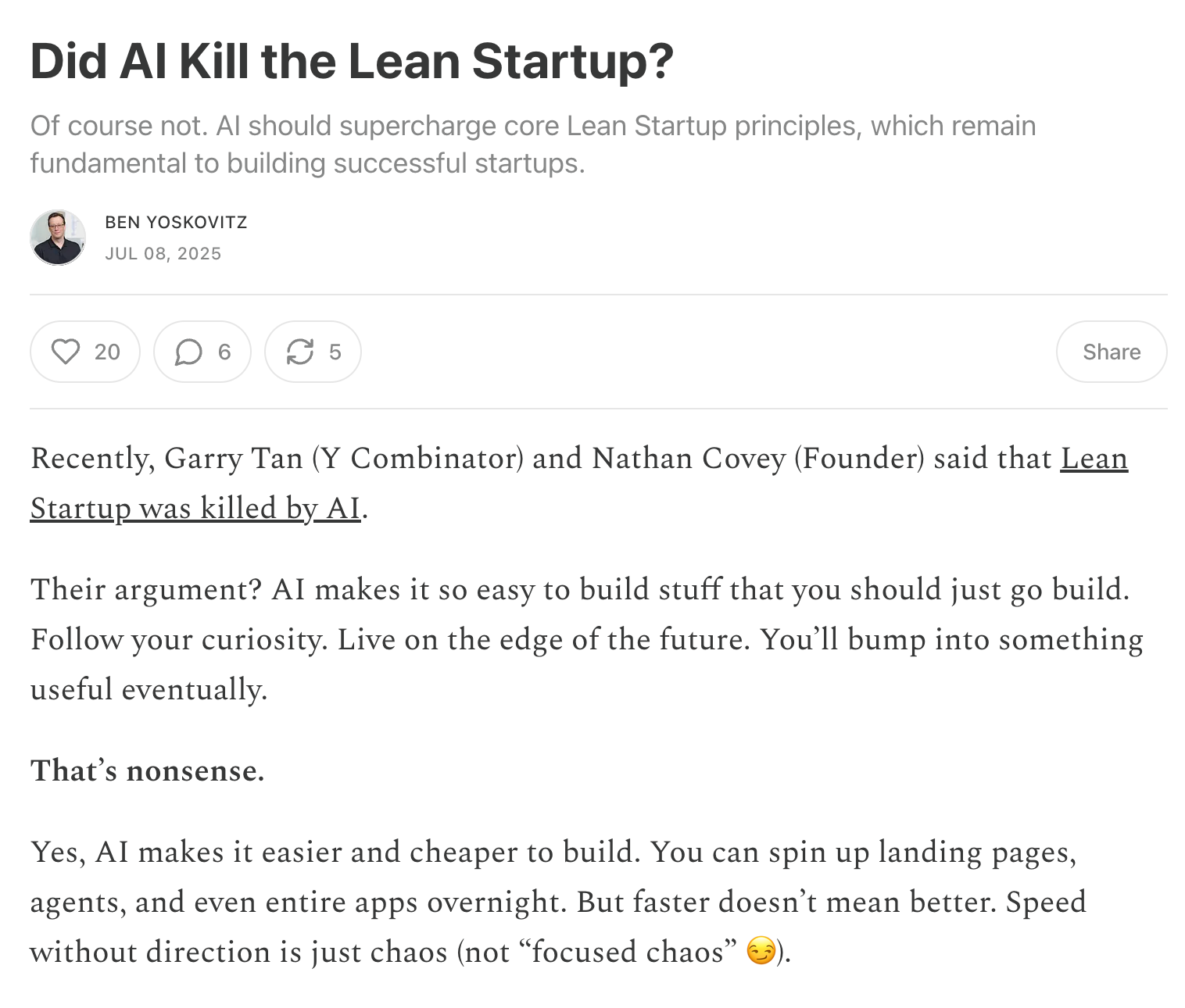
Ben Yoskovitz has argued that Lean Startup principles still apply—maybe more than ever. Build-Measure-Learn. Don’t skip the learning. AI should supercharge validation, not replace it. The fundamentals haven’t changed.
The defense is right that validation matters. It’s wrong that validation escapes the treadmill.
Validating fit in someone else’s category builds equity for them, not you. Lean Startup teaches you to optimize inside a market. It never asks whether you own that market’s transformation story or rent it. You’re learning faster, iterating smarter, perfecting your position—inside territory a competitor defined.
Efficient optimization of the wrong game is still the wrong game.
The diagnosis that got closest: Wait it out.
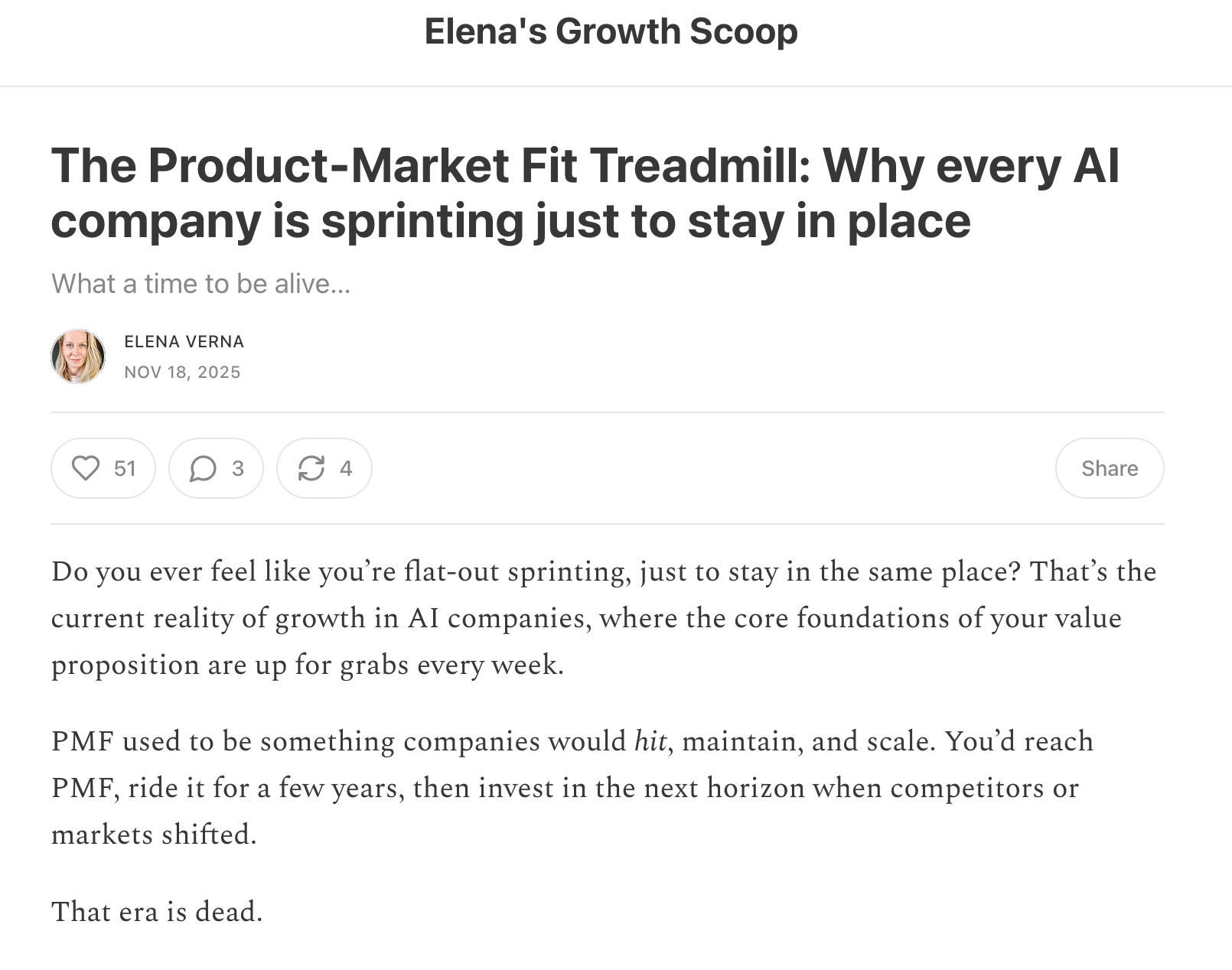
Elena Verna did something the others didn’t. She named the treadmill. She saw it clearly—PMF as subscription, not purchase. Companies cycling through all three horizons every quarter. Everyone sprinting, nobody compounding. The diagnosis is precise.
But diagnosis isn’t prescription.
Her answer: wait for AI to stabilize. When progress becomes incremental instead of exponential, when customers shift from capability shock to ROI proof, the treadmill slows. Then you can build durably.
This is the closest anyone has come to the real problem. And it still misses.
Five years? Ten years? Competitors won’t wait. Markets won’t wait. And more importantly—the treadmill isn’t caused by AI instability. AI instability just exposed it. The treadmill exists because of something deeper, something that was true before the current AI wave and will be true after it settles.
Waiting for stability is patience dressed as strategy. It’s surrender with a timeline.
Three answers. The first two miss the problem. The third names it correctly—then offers no escape.
All accepted because nothing better exists.
But what if they’re solving the wrong problem?
What if the problem is what Product-Market Fit assumes?
PMF has a hidden premise. It assumes you have a product. You insert it into a market. Fit is alignment between them.
Product is the thing you sell. Market is the people who buy it. Fit means they want what you’re selling. Find the fit, scale the product. That’s the model.
This made sense when products were durable. When building was hard and copying was slow. When a product that fit the market could own that fit for years before competitors caught up.
But products commoditize now. Faster than ever. AI accelerates this—what took eighteen months to build now takes six weeks. What took six weeks now takes a weekend. The capability moat fills in behind you almost as fast as you dig it.
Every model release reshuffles the deck. Features that differentiated you become table stakes. Capabilities you built get absorbed into platforms. The product you achieved fit with isn’t the product you have six months later—because the market’s expectations shifted underneath you.
The product isn’t the moat anymore.
So why is everyone still optimizing for product-market fit?
Because PMF is the water we swim in. It’s so foundational that questioning it feels like questioning gravity. Investors ask about it. Boards measure it. Team rituals center on it. The entire ecosystem assumes PMF is the goal.
But here’s what nobody’s saying out loud:
Product-Market Fit assumes products are the unit of competition.
That assumption is breaking.
Products commoditize. Capabilities converge. Features become table stakes. If products aren’t the unit of competition anymore, then optimizing for product-market fit is optimizing for the wrong game.
The treadmill isn’t a methodology problem. It’s a unit-of-measure problem. Everyone’s measuring fit between product and market when the product is no longer what creates durable advantage.
There’s a different question to ask.
The question isn’t “Does our product fit the market?”
The question is: Do you own the transformation, or rent it?
When you own the transformation:
You’re not selling a product. You’re selling a journey—a before and after. Customers aren’t buying features. They’re buying who they become.
And when you own that transformation, you own the entire territory around it.
You know where customers are going because you mapped the journey. You can see what comes before the transformation—the prequel, how they got ready, what they needed to believe first. You can see what comes after—the sequel, where they go next, what they’ll need once they’ve arrived.
You can expand modalities. The transformation isn’t trapped inside one product. It can be delivered through software, through education, through content, through services, through community. Same transformation, five different pathways to the summit.
Now multiply. Three stories—prequel, main transformation, sequel. Five modalities each. That’s fifteen revenue pathways from one transformation you own.
Every capability improvement strengthens your position. When AI gets better, your transformation gets more powerful. Model releases don’t threaten you—they’re tailwinds.
And here’s the inversion that changes everything: competitors entering your space validate your category. Their marketing explains why this transformation matters—which is your story. Their differentiation requires referencing you—which reinforces your position. They’re paying rent in territory you defined. Their effort builds your equity.
When you rent the transformation:
Products are the only thing you sell. One modality. Maybe two if you’ve bolted on services.
You’re competing alongside an increasing number of product competitors, all fighting for the same customers, all claiming similar features, all vulnerable to the same capability shifts.
Every model release threatens your positioning. The features that differentiated you get absorbed, replicated, or leapfrogged. You achieved fit with a product that’s already obsolete.
Every marketing dollar you spend builds equity for whoever owns the transformation category you’re competing inside. You’re generating demand for the transformation—but someone else owns that story. Your customer success stories validate their narrative.
You think you’re gaining ground. You’re building equity for someone else.
The math becomes obvious when you see it clearly:
Renters compete on one or two modalities. Owners deploy ten to fifteen.
Renters watch each model release with anxiety. Owners watch with anticipation.
Renters spend marketing dollars that validate competitor categories. Owners watch competitors spend marketing dollars that validate theirs.
Renters ask: “How do we get more customers for this product?”
Owners ask: “How many ways can we deliver this transformation?”
These aren’t variations of the same question. They’re entirely different games.
One game has you running on a treadmill, sprinting to maintain fit with a product that keeps commoditizing.
The other game has you expanding ownership of a transformation that compounds with every capability improvement, every new modality, every competitor who enters your space.
This is the game that replaced PMF.
This isn’t theory. The pattern shows up everywhere once you see it.
Airbnb: Transformation ownership survives product weakness.
Airbnb Experiences launched half-baked. The product wasn’t great. Reviews were mixed. Execution was uneven.
Then a pandemic hit. Travel stopped. The core product—home rentals—went to zero overnight.
Coming out of the pandemic, competitors do experiences better. Viator, GetYourGuide, countless local operators have superior product execution on tours and activities. They’ve had years to refine. By any product comparison, Airbnb Experiences should be an afterthought.
Doesn’t matter.
Airbnb owns “Belong Anywhere.” That transformation has multiple modalities—stays, experiences, monthly rentals, rooms. Same transformation, different pathways to the summit.
When they owned the transformation, a pandemic became an expansion opportunity. Experiences extended the story. Monthly stays extended the story. Each new modality serves the same transformation: you can belong anywhere in the world.
Competitors with better products are fighting for modality share. Airbnb owns the transformation they’re all serving.
Transformation ownership creates resilience. Product ownership creates fragility.
Apple Intelligence: Abandoning transformation you already own.
Apple had voice AI for thirteen years. Siri was first. They owned that transformation—talk to your device and it responds. Over a decade of category leadership.
All they had to do was say “Siri 2.0, powered by Apple Intelligence.”
Extend the transformation they already owned. Thirteen years of positioning, reinforced. The story continues.
Instead, they created a new brand—”Apple Intelligence”—that positioned inside the AI category OpenAI and Anthropic defined. They abandoned their transformation ownership to compete on product features in someone else’s territory.
Even if the product execution had been flawless, the positioning still loses. Beautiful AI features that train users to ask “Hey Siri, open ChatGPT.” Every demo building equity for the category leaders, not Apple.
They didn’t need to create new transformation ownership. They needed to extend what they already had.
$100B spent on product. Zero spent protecting transformation they’d owned for over a decade.
You can lose transformation ownership you already have. Product focus makes you forget what you own.
Salesforce: Where “killers” come to validate.
Count the Salesforce killers over the past fifteen years. Pipedrive. Freshsales. HubSpot CRM. Zoho. Close. Monday Sales CRM. Each one launched with a better-faster-cheaper thesis.
Salesforce hasn’t gone away. In fact, every “Salesforce killer” that enters the CRM space validates Salesforce’s transformation story.
Salesforce owns “No Software”—the on-premise to cloud transformation. They don’t just sell CRM. They own what CRM became. They defined the category shift that every competitor now operates inside.
When competitors enter, they’re operating inside Salesforce’s territory. Their marketing explains why cloud CRM matters—which is Salesforce’s story. Their differentiation requires referencing Salesforce—which reinforces Salesforce’s position.
Salesforce killers are Salesforce validators. They’re paying rent in a category Salesforce defined, generating demand for a transformation Salesforce owns.
When you own the transformation, competitors entering your space strengthen your position. Their marketing budget builds your equity.
Why scale isn’t the lesson.
It’s easy to dismiss household names. They have resources, brand recognition, market power. Of course they win.
But the key isn’t the modalities they’ve built. The key is the transformation story those modalities connect to.
That story is what allows modalities to hold—even when half-baked, not fully built, built wrong, or temporarily ignored.
A company putting everything into one modality is fragile. One product shift, one capability improvement, one new entrant—and they’re back on the treadmill.
A company that owns the transformation story has resilience. Not because of any single modality, but because of the story all modalities connect to.
The modalities can fail. The story survives.
That’s the difference between renting and owning.
There’s a name for it.
Transformation-Market Fit. The game that replaces Product-Market Fit.
PMF asks: Does our product fit what the market wants?
TMF asks: Do we own the transformation the market is buying?
One question optimizes a product. The other establishes a territory.
Product-Market Fit gives you one modality. Your product. That’s it. You’re competing alongside every other product in the category, fighting for fit, vulnerable to every capability shift.
Transformation-Market Fit gives you the entire territory. Prequels, sequels, multiple modalities. You’re not competing inside a category—you’re defining what the category means.
The treadmill exists because companies chase Product-Market Fit when the game changed to Transformation-Market Fit. They keep optimizing products while transformation ownership determines who wins.
When you own the transformation, fit becomes renewable. Every capability improvement strengthens your position. Every new modality compounds your advantage. Every competitor validates your category.
When you rent the transformation, fit is a subscription you keep paying. Every capability improvement threatens your position. Every modality is a new fight. Every competitor fragments your market share.
Prime Positioning is the discipline that achieves Transformation-Market Fit.
Not positioning in the traditional sense—not taglines and messaging frameworks. Prime Positioning establishes the transformation you own rather than the product you sell. It’s the strategic work of claiming territory that compounds instead of commoditizes.
Most positioning work asks: “How do we describe our product better?”
Prime Positioning asks: “What transformation do we own—and how do we extend that ownership across every modality, every customer stage, every market we enter?”
The law is simple:
Transformation owners collect rent. Product renters pay it.
Every company is one or the other. There’s no middle ground. You either own the transformation your customers are buying, or you’re paying rent to whoever does.
Here’s how you build it.
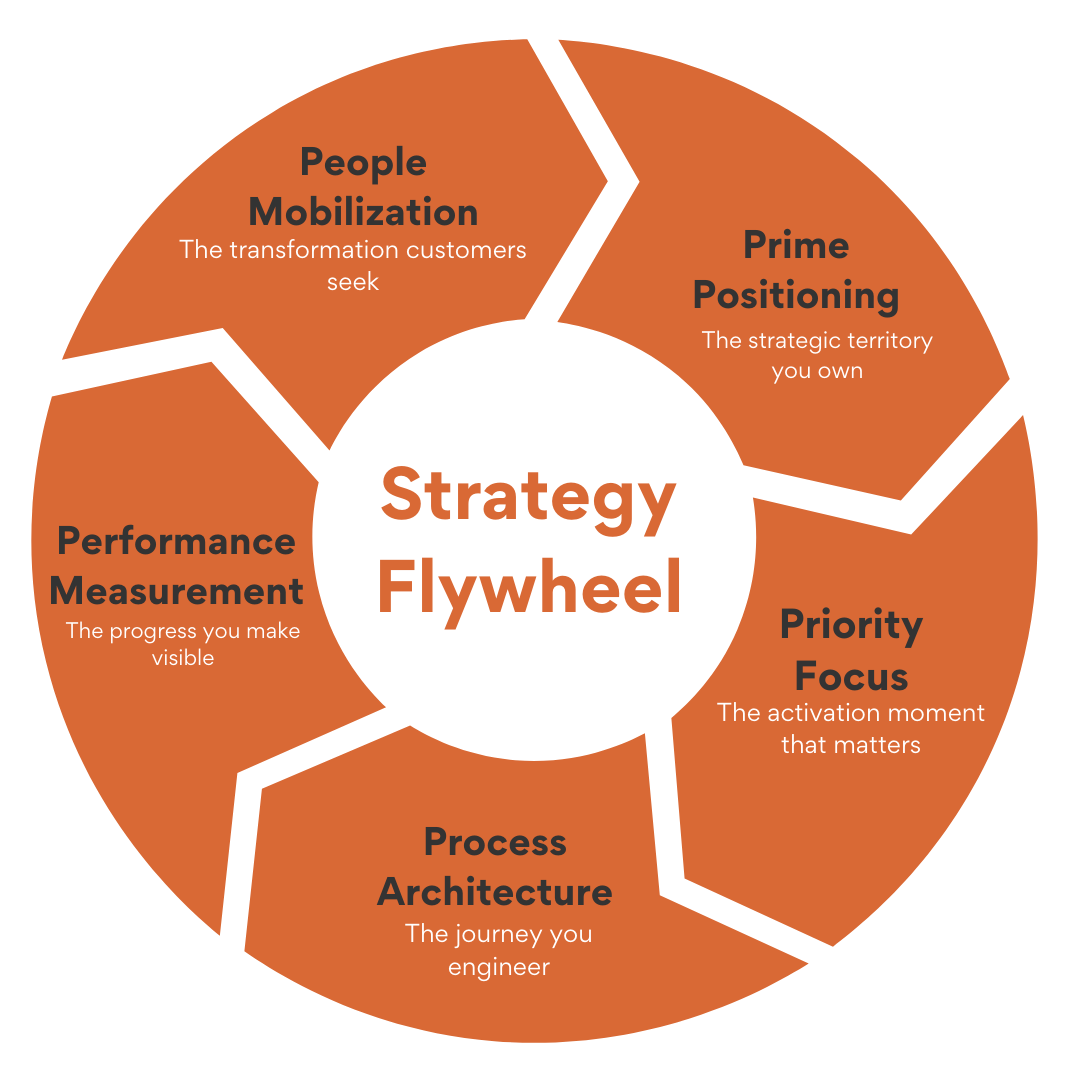
The Strategy Flywheel: the architecture for Transformation-Market Fit.
Five domains. Each one builds and protects transformation ownership.
Prime Positioning: What transformation do you own that competitors cannot claim?
This is the foundation. Not your product’s value proposition—the transformation your customers are buying. The before and after. The identity shift. Who they become, not what they get.
Most companies skip this. They assume the product is the positioning. That’s how you end up renting—competing on features inside a transformation someone else defined.
Prime Positioning asks: What territory, if we plant our flag there, forces everyone else to operate inside our frame?
Priority Focus: What are you saying no to?
Every shiny opportunity that doesn’t serve the transformation weakens your ownership. New features that fragment the story. Adjacent markets that blur the identity. Partnerships that confuse who you’re for.
Transformation ownership requires discipline. The ability to say no to good opportunities that don’t compound your territory. Priority Focus is the immune system that keeps the transformation clear.
Process Architecture: How many ways can you deliver the transformation?
One modality is a product. Multiple modalities is ownership.
This is where the math changes. Same transformation, delivered through SaaS, workshops, content, services, community. Each pathway reinforces the others. Each customer touchpoint strengthens ownership.
Airbnb didn’t stumble into stays, experiences, and monthly rentals. The transformation—belong anywhere—created permission for each modality. Process Architecture builds the systems that extend your transformation across every channel that serves it. That’s where fifteen revenue pathways come from.
Performance Measurement: Are customers becoming what you promised—or just using your tool?
Product metrics tell you if people use what you built. Transformation metrics tell you if you own what they’re becoming.
Are they using your language to describe their own journey? Do they identify with the transformation? When they talk about what changed, do they tell your story?
If customers describe a tool, you rent. If customers describe who they became, you own.
People Mobilization: Are you expanding the territory—or just defending the product?
Prequels bring people to the starting line—the transformation before the transformation. Sequels take them further—the next journey after they’ve arrived. Each expansion deepens your ownership of the customer’s entire arc.
This isn’t marketing. It’s strategic expansion of transformation territory. More stages of the journey. More modalities at each stage. More ownership of who your customers become—before they meet you, while they’re with you, and after they’ve arrived.
Five domains. One transformation. Multiple modalities. Compounding advantage.
This is how you achieve Transformation-Market Fit. This is how you get off the treadmill.
One question determines which game you’re playing.
Do you own your customers’ transformation?
It’s a simple question. The answer determines everything.
If you own the transformation, you know exactly what it is. You can articulate the before and after. You can name the identity shift. You can see the prequels and sequels. You can map the modalities. When capability shifts happen, you see tailwinds. When competitors enter, you see validation.
If you rent the transformation, you feel the treadmill. The constant repositioning. The messaging that ages in months. The product roadmap that chases capability instead of extending territory. The marketing spend that builds equity for someone else’s category. The growth that doesn’t compound.
There’s no middle ground here. You either own or you rent. You either collect or you pay.
The companies that escape the treadmill aren’t the ones that build faster, validate better, or wait longer. They’re the ones that stopped competing on products and started owning transformations.
They’re playing a different game.
Same market. Same customers. Same technology shifts. Completely different economics.
Renters compete on one or two modalities while owners deploy fifteen. Renters watch competitors fragment their market share while owners watch competitors validate their category. Renters sprint to maintain fit while owners expand territory.
The game changed.
Product-Market Fit was the right question for an era when products were durable and building was hard. That era is over. Capabilities commoditize in months. Features become table stakes in quarters. The product isn’t the moat.
Transformation-Market Fit is the question now. Not “does our product fit the market?” but “do we own the transformation the market is buying?”
Most companies are still playing the old game. Still optimizing products. Still measuring fit. Still running on a treadmill someone else designed, building equity for transformation owners while calling it growth.
You don’t have to play that game.
The treadmill isn’t inevitable. It’s a symptom of renting when you could own.
Own the transformation. Build the flywheel. Expand the territory.
Collect rent instead of paying it.
Prime Positioning: How To Win Your Market by Owning Your Customer’s Transformation releases March 2026.
Episode previews drop every Sunday here on Substack. Each one builds a piece of the flywheel..