
Prime Positioning: Owning The Customer Transformation That Defines Your Market
Why well-run companies stay on the treadmill.

You’re moving fast.
Revenue is growing. Team scaling. Board meetings going well.
You’ve got strategic initiatives in motion. New market expansion. Product roadmap addressing the gaps customers want. Marketing engine generating pipeline.
Your calendar is packed with meetings that feel like progress. Strategy sessions. Hiring decisions. Partner conversations.
Competitors are moving, but you’re keeping pace. Maybe gaining in some areas.
The company is stronger than a year ago. More capable. More focused.
But, market share numbers tell a different story.
You’re working harder, but the gap isn’t closing. In some quarters, it’s widening.
It’s like you’re on a treadmill, running fast, in place.

And there’s a competitor - one who seems slower than you - who keeps pulling ahead. They’re not outworking you. They don’t have a bigger team. Sometimes they barely seem to be trying.
Yet they set the prices. They define what “good” means in your market. Customers compare you to them, not the other way around.
Here’s the part that stings: the harder you go, the more they grow.
Every feature you ship. Every campaign you launch. Every customer you win. Somehow it builds their brand while you burn resources keeping up.
You’re building for now. They’re building what’s next.
You’ve made peace with it. This is how markets work.
Some companies got there first. They have the brand recognition. The distribution. The network effects. You have to out-execute just to stay relevant.
So you double down on what you can control. Hire better people. Tighten operations. Ship faster. Launch more campaigns. Grind harder than the next company.
Your pitch becomes your work ethic. “We’re hungrier. We’re more responsive. We care more.”
And every quarter, you pay a little more to stay in the same place.
Alignment meetings multiply. Strategy discussions circle the same questions. Decisions that should take one conversation take three. The team isn’t slow - they’re just never quite sure what the priority is.
You call it “the cost of doing business.” The price of competing against an entrenched player.
But there’s something you haven’t named yet:
“We try harder” tells customers your competitor works smarter. You’re competing on effort. They’re winning on positioning.
But what if effort was never the game?
What if the companies pulling ahead aren’t working smarter or harder - they’re playing on a different board entirely?
What if there are two fundamentally different economic paths, and you’ve been sprinting down the wrong one?
Not because you’re bad at execution. Because execution was never the variable that mattered.
There are two ways to operate a company.
1. Operate as a Category Tenant
Compete within territory someone else defined. Their positioning references the market leader. Their pricing responds to competitive benchmarks. Their roadmap chases features the leader already shipped.
Every “better than X” validates X’s category. Every comparison cements who owns the frame.
They build inside-out: product first, then find a market position. They assume the market is fixed - a board with established squares - and fight for a better square.
2. Operate as a Prime Mover
Prime Movers Own the transformation story customers use to describe their own journey. Their positioning defines the category. Their pricing reflects transformation value, not competitive parity. Their roadmap advances customer change, not competitive response.
Competitors reference them - validating their territory with every comparison.
They build outside-in: customer transformation first, then build the product that delivers it. They don’t assume the market is fixed. They define it.
The diagnostic is simple:
Can you describe what you do without mentioning a competitor? Do customers use your language when they describe their progress?
If not, you’re renting.
And renters pay compound interest.
Not just in margins. In the strategic options that close. In the talent that leaves. In the board meetings where you explain why that competitor - the one who barely tries - keeps pulling ahead.
Renters can build billion-dollar companies and still lose 96% of their value.
Take Yahoo for example Yahoo had everything. First-mover advantage. $125 billion valuation. The chance to buy Google for $1 million.
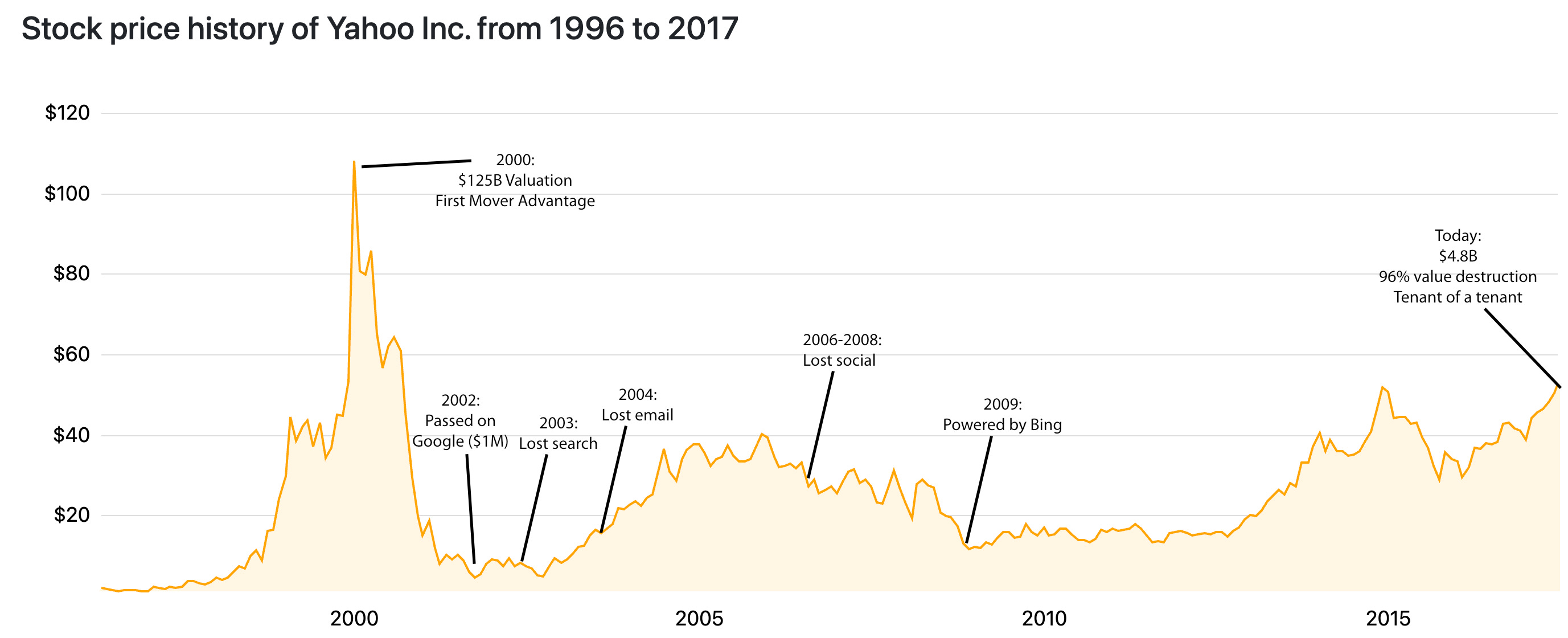
They lost search. Then email. Then social. Every category they once led.
Today: $4.8 billion. 96% value destruction. Their search results are powered by Bing - a tenant of a tenant.
Being first didn’t matter. Owning the transformation did. Google owned “answers fast.” Yahoo owned... a directory.
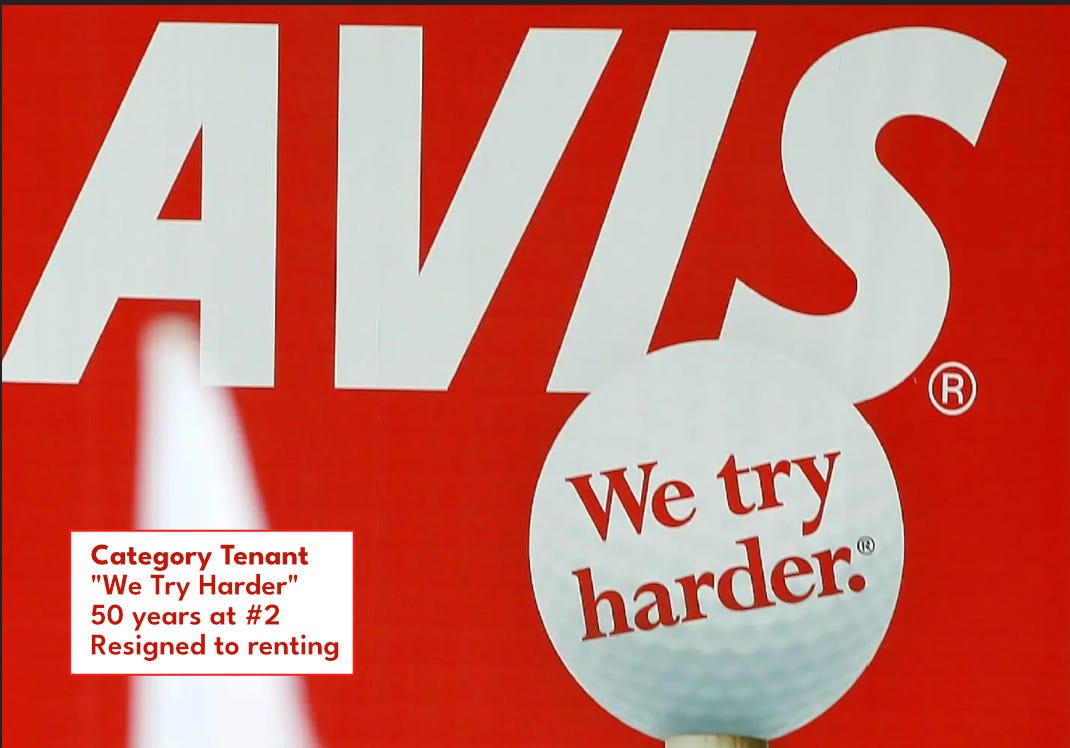
Avis ran “we try harder” for 50 years. Better service. Cleaner cars. Shorter wait times. Never caught Hertz. Enterprise passed both by owning different territory entirely.
Fifty years of effort. Still, Avis resigned themselves to rent at #2.
Meanwhile, DudeWipes reframed what #2 meant and defined the market for dudes who gave a damn about hygiene.
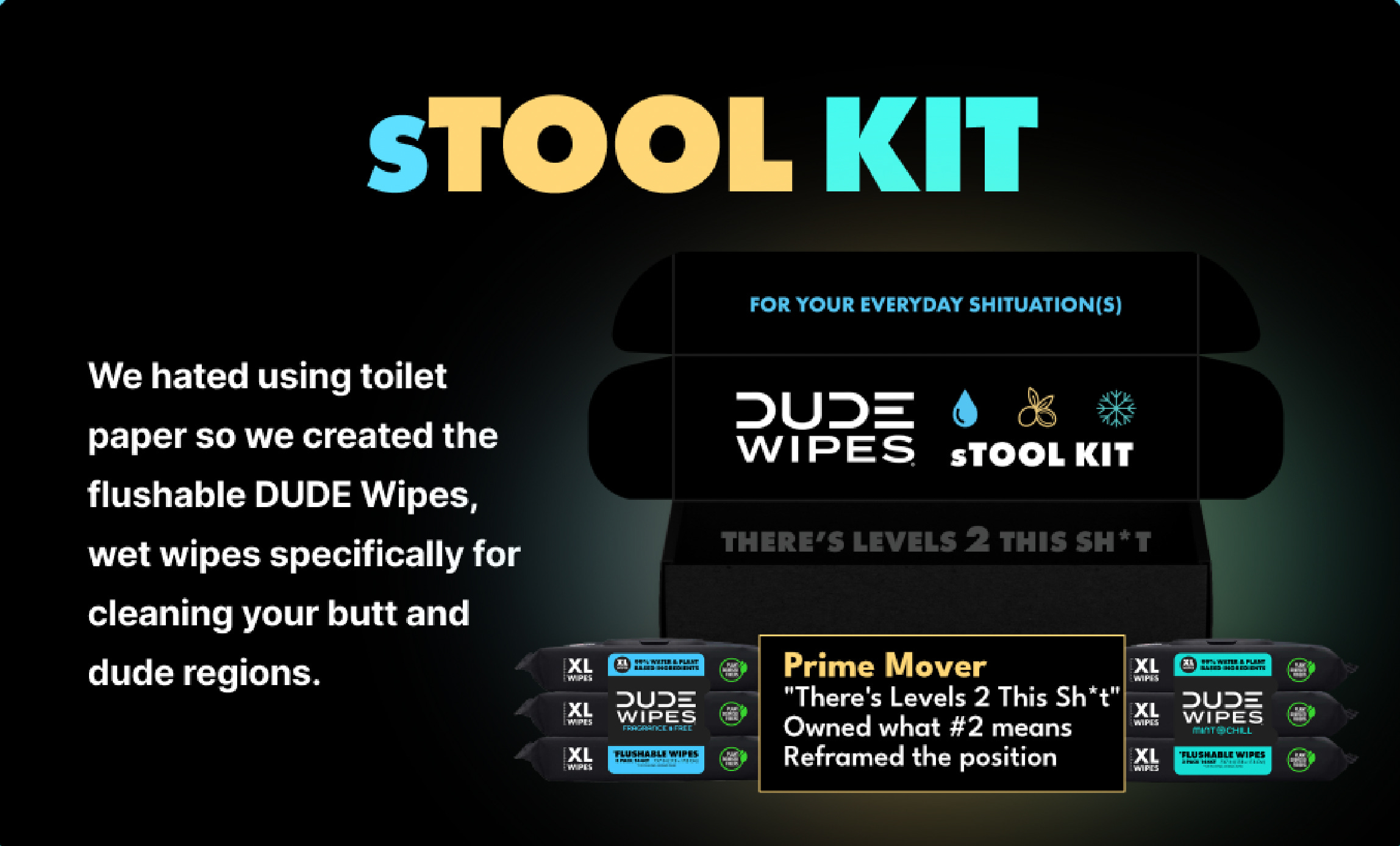
Same position. Different relationship to it.
DudeWipes didn’t fight Cottonelle for shelf space on Cottonelle’s terms. They owned a transformation: “guy who gives a damn his hygiene.” Crude? Sure. But the transformation was theirs. The language was theirs. The customer identity was theirs.
Or take Patagonia. They told customers “Don’t Buy This Jacket.”

The result: sales increased 30%.
You think they’re selling outdoor gear. They’re actually selling “I’m an environmentalist through what I buy.” That transformation belongs to them.
Customers use Patagonia’s language to describe their own identity. And that identity commands premium pricing.
When you own the transformation, even anti-consumerism grows revenue.
The pattern is the same in every case.
When you rent positioning, customers compare on price. Every effort compounds the category leader’s equity. One strategic move by the owner can make your position obsolete overnight.
When you own the transformation story, customers use your language. Your pricing reflects identity, not feature comparison. Every effort compounds your equity.
This is Prime Positioning:
Owning the transformation story your customer uses to describe their journey from problem to solution.
Not differentiation. Not positioning against competitors. Not category creation for its own sake.
Transformation ownership.
This is why Prime Movers can operate at their own pace. They’re not reacting to competitor moves. They’re not chasing market shifts. They define the transformation - so they set the tempo.
And that external strategic clarity - the transformation story customers use - doubles as internal decision velocity.
Every decision filters through the same question: Does this advance our customer’s transformation?
Product decisions. Hiring decisions. Partnership decisions. Marketing decisions. The same story that wins customers also aligns teams.
Prime Movers don’t coordinate through endless meetings. They coordinate through shared transformation clarity. The story that owns the market also governs the company.
That alignment is what eliminates coordination tax. That ownership is what compounds.
Here’s what this looks like when it’s working:
1. Both Customers and employees are mobilized.
The same transformation story that attracts customers attracts talent. People who believe in the transformation want to build it. Recruiting becomes filtering, not convincing. Customers evangelize. Teams align. Same story, both audiences.
2. Performance compounds internally and externally.
When the market responds to your transformation story, teams see it. Customer language validates the direction. Confidence compounds. The next decision gets easier because the last one worked. External proof becomes internal momentum.
3. Priorities become self-evident.
The transformation defines what matters. Teams don’t debate priorities - the customer’s journey tells them. Resources flow to what advances that journey. Everything else falls away. Focus isn’t enforced. It’s inherited.
4. Your Operating Rhythm aligns without effort.
The same words customers use externally become the words teams use internally. Alignment isn’t manufactured in meetings. It’s built into how people talk about the work. Coordination tax drops because everyone’s operating from the same story.
5. Clarity creates the expansion.
When you own the transformation, you own the destination. That means you can build multiple pathways to get there. New products. New services. New modalities - each one a route to the same transformation you already own.
You can also add milestones along the journey. Deeper relationship. More touchpoints. Each milestone an opportunity to deliver value - and capture it.
Category Tenants fight for market share in a fixed game. Prime Movers expand the game itself. Same transformation, infinite paths to deliver it.
So how do you become one?
The path from renter to owner isn’t about working harder. It’s about answering a different question.
Not: “How do we compete better?”
But: “What transformation do we own?”

Here’s how to find out where you stand:
Write down the transformation your customer undergoes.
Not what you sell, but what they become.
Then ask:
Can you describe it without mentioning a competitor?
Do customers use your language when they talk about their progress?
Could your team - any team member - articulate this transformation without preparation?
If the answer is no, you’re renting. And now you know the real problem.
If the answer is yes, you’re building equity. The question then becomes: how do you compound it?
That’s Prime Positioning. When you own your customer’s transformation, you own your market.