
When Intelligence Becomes Infinite: Playing To Win With AI
Prime Positioning - Episode 0: How to plan your winning moves when AI levels the playing field

Prime Positioning - Episode 0
The world just shifted. Most leaders can’t name what changed - they just know their advantages aren’t holding like they used to.
You feel it, even if you can’t name it yet.
The advantages you built—the ones that took years to establish—aren’t holding like they used to. Competitors are moving faster. Execution that once required armies now happens with a few engineers and the right prompts. Features you spent quarters building are replicated in weeks.
Something fundamental has shifted.
You’re a leader who knows how to win. You’ve competed on operational excellence, on product velocity, on scale. You’ve studied the playbooks. You’ve built the systems. But the game is changing faster than the frameworks can keep up.
You’re here because you sense the old rules are dying.
This isn’t about learning to “use AI better.” This is about understanding what happens after AI has already leveled the playing field—and recognizing the single arena where advantage can still compound.
By the end of this, you won’t just understand the strategic reordering. You’ll see the architecture for winning in it.
You’ll become the leader who moved first.
The Collapse of Business Moats
When intelligence becomes infinite, everything changes.
Not because intelligence is inherently dangerous, but because abundance inverts value. What was scarce becomes free. What was strategic becomes table stakes. What was a moat becomes a commodity.
For decades, competitive strategy rested on a stable hierarchy:
Operational excellence won on efficiency and scale.
Product leadership won on innovation and features.
Customer intimacy mattered—but it was often the consolation prize for companies that couldn’t compete on the other two.
That hierarchy is collapsing.
Fast. Unpredictably. Completely.
Here’s what’s different about this wave. AI makes intelligence abundant—and abundance changes everything.
Process mastery? Once a multi-decade investment. Now replicated in months.
Scale economies? Once the domain of giants. Now accessible to startups with the right models.
Product velocity? Once constrained by engineering capacity. Now accelerating beyond human rhythm.
What took years to build—supply chains, data pipelines, features—AI turns into commodities. The companies that believed their advantage came from doing things faster, cheaper, or better are discovering that “better” has a new baseline.
And it rises every quarter.
This isn’t coming. It’s here.
The firms that invested in product differentiation are watching features they spent years building become replicable in weeks. The operations teams that perfected their processes are finding that AI can design better ones overnight. The scale that once created unassailable moats is now available to anyone with access to cloud infrastructure and foundation models.
Operational excellence is no longer a moat. It is table stakes.
Product leadership, unless anchored by a cornered resource or brand trust built over decades, will meet the same fate.
When intelligence becomes abundant and execution gets easier, only one arena remains where sustainable competitive advantage can compound.
Not customer intimacy as most companies practice it.
But something deeper: Prime Positioning.
The Inversion: Your Advantage Is Now Table Stakes
Here’s what most leaders miss:
The problem isn’t that AI makes everything easier. It’s that AI makes the wrong things easier.
It’s easier to optimize. Easier to scale. Easier to ship features. Easier to analyze data. Easier to execute on what you already know how to measure.
What AI doesn’t make easier—what it can’t replicate, can’t commoditize, can’t compress—is knowing what transformation your customer is actually seeking.
Not the problem they came to solve. The person they’re trying to become.
Joseph Pine saw this coming. In The Experience Economy and his later work on the transformation economy, he identified what customers truly value in a world beyond commodities: not products, not services, not even experiences—but identity change. The opportunity to become who they want to be.
Transformation creates competitive dynamics that other strategies cannot replicate.
When a company guides a customer’s transformation, it generates switching costs organically. The customer doesn’t leave because you were part of their becoming. You didn’t just solve a problem—you helped them change who they are. That relationship isn’t transactional. It’s foundational.
Transformation also generates network economies. People don’t casually mention products that work well. They evangelize transformations. Identity change is inherently social. When someone becomes something new—a runner, a founder, a skilled practitioner—they tell others. They recruit. They create movements.
This is prime positioning: claiming unique territory in your customers’ transformation journey that no competitor can replicate because you understand the journey better than anyone else.
It is the only strategic position that compounds durably when AI has leveled everything else.
Startups have always understood this intuitively. They win by seeing customers clearly, moving with them, building what others forgot to feel. Incumbents, by contrast, scaled themselves away from understanding—replacing empathy with efficiency, connection with process.
For a long time, that worked. Scale outperformed understanding.
But when AI levels scale, the advantage evaporates.
The coming strategic divide will not be between those who adopt AI and those who don’t.
It will be between those who achieve prime positioning and those who don’t.
The Problem: Prime Positioning At Scale
Here is where most companies stall.
They understand, intellectually, that customer transformation matters. They know it’s valuable. They talk about “putting customers first” and “creating amazing experiences.”
But they have no system for achieving prime positioning.
Most companies treat understanding as culture, not strategy. It lives in mission statements, not operating models. Leaders exhort teams to “be customer-obsessed,” but offer no architecture for translating empathy into position, no way to ensure understanding compounds rather than diffuses.
The result is predictable.
Companies conduct surveys, collect feedback, and nod earnestly—then return to optimizing what they already know how to measure. Efficiency. Output. Growth at all costs.
This is the failure mode.
Not a lack of intention. A lack of architecture.
You can’t scale what you can’t systematize. And without a system, prime positioning remains an accident—something that happens to lucky companies with the right insight, at the right moment, under the right conditions.
It cannot scale. It cannot compound. It cannot become a source of strategic power.
This is the question the AI era forces:
How do you achieve prime positioning—and then maintain it?
Most leaders experience this shift as three separate crises: positioning that won’t hold, decisions that take too long, and AI initiatives that fragment rather than focus. They hire positioning consultants. They redesign decision processes. They bring in AI governance experts. Three problems, three solutions, three budgets.
But they’re not three problems. They’re one problem—lack of strategic decision architecture—creating three symptoms. Solve the architecture, and positioning clarifies, decisions accelerate, and AI integrates coherently. This is the insight the Strategy Flywheel operationalizes.
The Architecture for Prime Positioning
The Strategy Flywheel answers that question.
It is a strategy framework—one that reorients competitive advantage around customer transformation—and an operational architecture for making that strategy executable and repeatable.
The flywheel works backwards from transformation itself.
It begins not with how you want to be seen, but with why anyone moves and who they become.
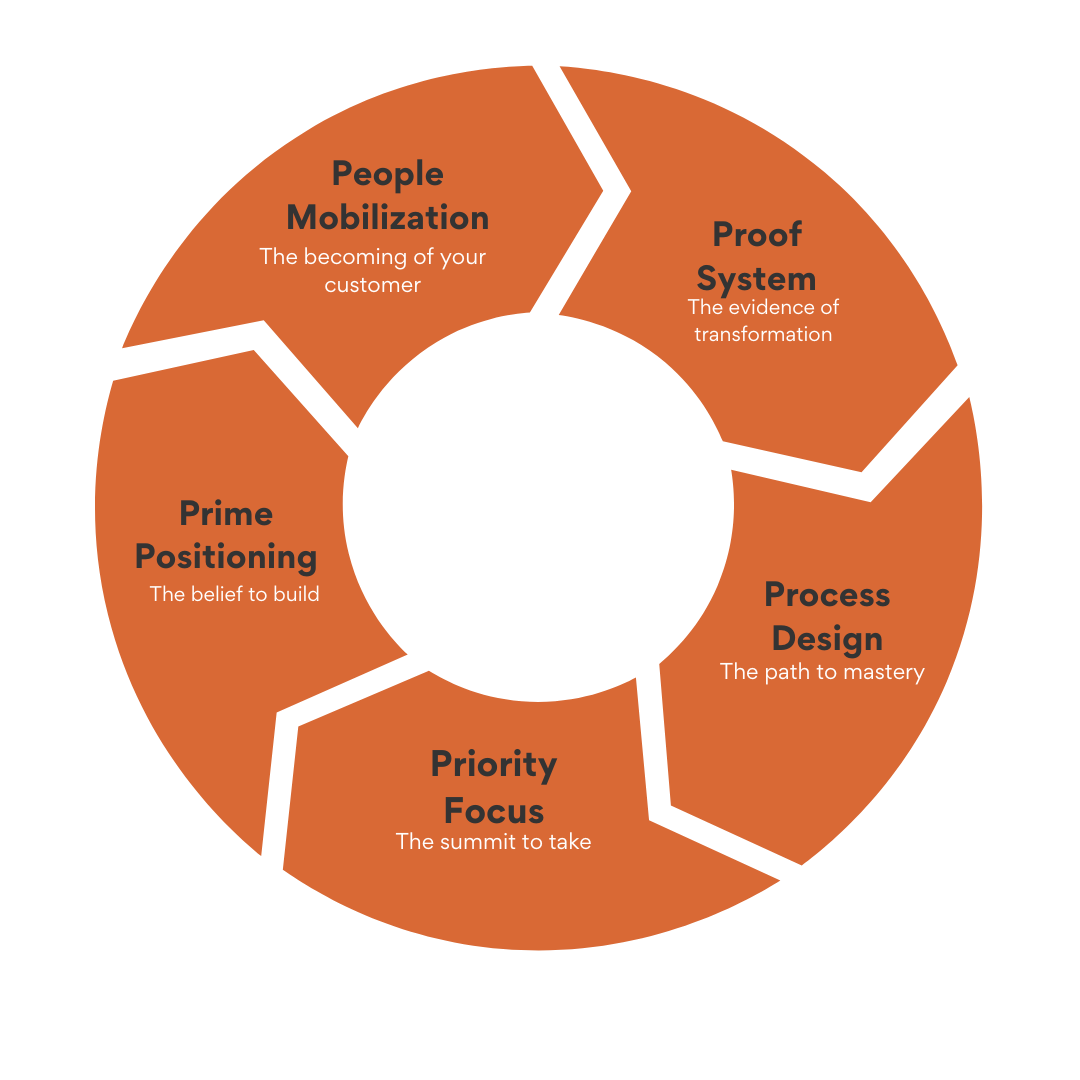
Start with people mobilization.
Before anything else, understand the transformation your customer seeks. Not the problem you solve - the identity change they’re pursuing.
Once you understand the transformation, make it visible.
The Proof System takes the abstract destination and breaks it into concrete stages—the ascension path from where someone is to who they want to become.
Now engineer the journey.
How does someone actually move through those stages? What support, friction, or ritual is required at each step?
With the journey mapped, find the activation moment.
Transformation doesn’t happen gradually - it happens when someone decides, commits, takes the first irreversible step.
When intelligence becomes abundant, attention becomes scarce. Concentrate force at the moment that matters most.
Only now can you position effectively.
With understanding of the transformation, the stages of becoming, the engineered journey, and the activation moment, you can answer: What unique territory can you claim that no competitor can replicate?
Only now can you position effectively.
This is the lynchpin. It’s the strategic position you get by understanding your customer’s transformation better than anyone else.
The Flywheel Dynamic: Why Context Compounds
These elements don’t work in isolation. They form a flywheel.
Each loop through the system deepens understanding, widens differentiation, and accelerates momentum.
People mobilization clarifies the transformation. Proof system makes it legible. Process design engineers the path. Priority focus identifies the moment of activation. Prime positioning claims unique territory.
But here’s the key: Each time you complete a revolution, you’re not starting from zero. You’re operating from the context of your prime positioning. And that context makes everything sharper:
People Mobilization becomes more precise (you know your people better)
Proof System becomes more refined (stages get clearer)
Process Design becomes more elegant (the journey smooths out)
PriorityFocus becomes tighter (you know exactly where to concentrate)
Prime Positioning strengthens (your grip on territory deepens)
This is how understanding scales.
This is how advantage compounds.
This is the architecture that turns empathy into power.
With prime positioning as your governing context, you can build decision systems that maintain what you’ve achieved. You can organize your company around customer journey stages. You can move at opportunity speed because everyone operates from the same strategic clarity.
This is how you build traction—the ability to help customers transform faster than competitors can, creating market grip that compounds on itself.
Understanding the architecture Isn’t the same as building It.
The flywheel looks elegant on paper. Five elements. Clear relationships. Logical flow. But most companies will read this, nod in agreement, and return to optimizing what they already measure. They’ll treat prime positioning as an aspiration, not a discipline. They’ll wait for more clarity, more proof, more certainty.
That hesitation is the gap where competitors slip through.
The Strategic Reordering isn’t coming—it’s here.
Companies that continue to compete on operational excellence or product leadership—without recognizing that these advantages are being compressed by AI—will find themselves in a game they cannot win.
Not because they lack talent or resources, but because they are playing by rules that no longer apply.
The firms that recognize this shift, and achieve prime positioning through systematic customer transformation, will not merely survive. They will thrive. They will become the category leaders, the companies customers cannot imagine leaving, the organizations that define what it means to win in their space.
When intelligence becomes infinite, strategic clarity becomes the ultimate scarce resource.
The question is: Can you achieve prime positioning before someone else does?
Next: How Fast Execution Slows Growth
James built exactly what his customers asked for. 95% adoption. Record engagement. His board should be celebrating.
Instead, churn is up 15% - and he has 60 days to figure out why customers love using his product but leave anyway.