
Own The Narrative That Can't Be Copied: The 9-Part Framework for Positioning
Build yours with the Narrative Builder Flywheel Prompt

Your website is where you publish your story.
Positioning is the version customers retell.
When something truly changes for them, they don’t reach for taglines. They describe the transformation: what life looked like before, what changed, and what they’d never go back to.
Most companies never extract that story. They settle for shared phrases:
“Empowering customers.”
“Driving outcomes.”
“Making a difference.”
None of it is wrong. It’s just easy to copy.
What can’t be copied is the specific change your customers lived through.
That’s where positioning comes from.
Why stories work (and what that means for positioning)
Ask anyone to describe a meaningful change and they’ll tell it in three stages.
First, where they were before: the situation, the assumptions, what they accepted as normal.
Then what happened: the shift, the new approach, the capability that emerged.
Finally, what stuck: what they learned and what they’d never go back to.
Hollywood calls it Setup, Confrontation, Resolution. Business presentations call it Problem, Solution, Outcome.
In reality, it’s how humans process change.
Here’s what that means for positioning:
Every customer who’s genuinely transformed by your product will describe that transformation in three parts. The structure already exists in their heads. Your job is to extract it.
If you know how to listen, they’ll hand you your positioning.
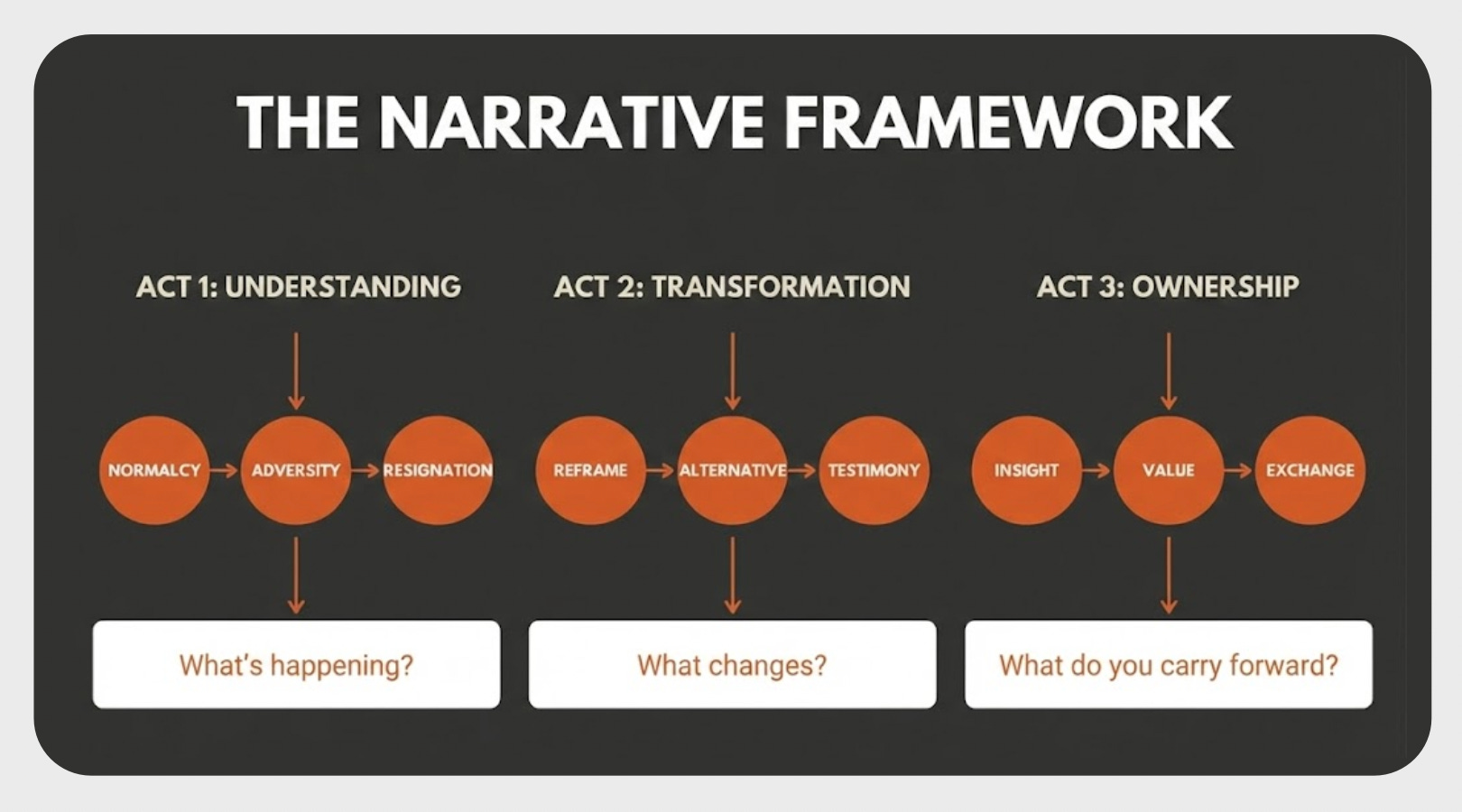
Act 1: Understanding
Where they were before. What was normal. What broke. What they tried first.
The question:“What’s happening?”
Act 2: Transformation
What shifted. The new capability. The proof it worked.
The question: “What changes?”
Act 3: Ownership
What they learned. What they protect. What they’d never give up.
The question: “What do you carry forward?”
Those three questions get you started.
But each act has layers underneath. To capture the full transformation (the kind that becomes owned positioning) you need to go deeper. Each act breaks into three specific elements. Nine elements total. When I mapped these out, I realized they spell NARRATIVE.
Normalcy, Adversity, Resignation, Reframe, Alternative, Testimony, Insight, Value, Exchange.
That wasn’t intentional at first.
But it makes sense. These nine elements are what narrative actually is. They’re the bones of every transformation story your customers will tell you.
Let me show you how it works through a real story.
Act 1: Understanding (N-A-R)
Sandy runs a nonprofit focused on disability advocacy.
When I interviewed her, she described the world before transformation with precision that no category research could have produced. She knew the language, the assumptions, the invisible walls. She’d lived inside them for years.
Here’s what she told me.
Normalcy: Where they lived before
Sandy’s organization existed in the nonprofit “echo chamber.”
Everyone used the same language: making a difference, helping those in need, providing support. This was her normalcy. The water she swam in without questioning it.
“We help disabled people” is what every disability nonprofit says.
Sandy was competing in a category defined by compassion.
And compassion is a commodity when everyone claims it.
She didn’t know it yet, but the language was the problem.
Adversity: What broke the status quo
The wrong funders kept showing up.
People who wanted to give charity. People whose identity as helpers depended on recipients staying helpless. Sandy wanted partners who believed in advocacy, independence, and systematic empowerment.
Her positioning language attracted the opposite.
She kept attracting funders who needed recipients to stay dependent.
They’d show up at events, checkbooks ready, wanting to feel good about helping. They didn’t want to fund systems that made their help unnecessary. Sandy’s borrowed language (the echo chamber phrases) signaled “charity opportunity” when she meant “advocacy partnership.” The gap between intention and result forced her to question everything.
Something had to change.
Resignation: What they tried first
Sandy tried what most organizations try.
More marketing. Clearer messaging. Better fundraising events. She hired consultants who optimized her existing approach. She refined the language without questioning the category. None of it worked because the problem was borrowed territory. She was competing for attention on variables the nonprofit echo chamber had defined.
Variables that attracted charity seekers.
This is where most companies stop.
They understand the problem. They’ve tried solutions. They assume the next solution needs to be a better version of what they’ve already done.
But understanding the problem is the starting point.
Act 2: Transformation (R-A-T)
This is where AI can’t follow.
The transformation requires capturing actual mental model shifts.
The moment their thinking changed.
Reframe: The conceptual shift
Sandy’s breakthrough came from a consultant who spent four months educating her organization before any messaging work happened.
Four months of stakeholder interviews. Community conversations. Category analysis. No quick fixes or surface-level repositioning. The consultant understood that the problem wasn’t the words. The problem was the category the words pointed to. What emerged was a fundamental shift in how Sandy’s organization saw itself.
The reframe: Charity → Advocacy.

A rejection of the premise that disabled people need help.
A shift to the premise that disabled people need systems that enable independence. “We really hesitate to be seen as a charitable model,” Sandy told me. “Society feels like people with disabilities need charity. We want to bring a different image.”
This reframe changed everything because it changed the category.
Sandy was no longer competing with compassion-based nonprofits.
She was creating territory in systematic advocacy.
A space most funders didn’t know existed until she named it.
Alternative: New capabilities now possible
Once the reframe landed, new capabilities became available.
Sandy could articulate what made her organization different without borrowed language. She could describe outcomes in terms of independence achieved. She could screen funders for advocacy alignment before wasting time on charity-seekers.
The messaging that emerged was specific.
“We enable systematic independence through advocacy frameworks.”
Notice what’s missing.
Making a difference. Helping those in need. Supporting the community.
The echo chamber language disappeared.
It disappeared because the category shifted. Sandy wasn’t trying to sound different. She was operating from a different premise entirely.
The language followed the thinking.
Testimony: Proof the transformation repeats
Transformation that happens once is luck.
Transformation that repeats is a system.
Sandy’s testimony emerged in the outcomes.
The numbers told part of the story.
60+ fundable attendees at a single event (the right funders). $15,000 revenue increase from that event alone. Reach and engagement climbed across every channel.
The metrics:
60+ qualified funders at one event
$15,000 revenue increase from that event
40% increase in social media reach
25% increase in email engagement
But the deeper testimony was qualitative.
Funders started using Sandy’s language. They described her organization as “advocacy-focused” before she positioned it that way in conversations. The category she created became the category they used to understand her.
Testimony captures both: the transformation worked, and it transferred.
Act 3: Ownership (I-V-E)
Transformation and ownership are different.
Transformation is what happened.
Ownership is what you defend.
Insight: The transferable principle
The insight Sandy carries forward: borrowed language attracts borrowed customers.
If you compete on variables your category defined, you’ll attract people who value those variables. Even if they’re not the people you want. The language signals what kind of relationship you’re offering.
Sandy learned that positioning requires claiming a different game entirely.
Value: What they’d never give up
Ask any customer who’s experienced real transformation: what would you fight to keep?
For Sandy, it’s category clarity. The ability to filter every opportunity through the advocacy/charity distinction. The confidence to say no to funders who want to feel good about helping, because she knows they’re not the right partners for systematic change. This value didn’t exist before transformation. Sandy couldn’t have articulated it because she didn’t know the alternative.
Now it’s the thing she protects most aggressively.
Exchange: What they invest to protect it
Ownership requires ongoing investment.
Sandy invests in language discipline: every piece of content, every conversation, every event gets filtered through the advocacy framing. She invests in partner education, because new funders need to understand the category before they can join it.
Exchange is the moat.
It separates systematic advantage from tactical wins.
Companies that transform but don’t invest in protecting it slide back.
Within months, they’re renting again.
The complete narrative
Here’s Sandy’s transformation in one paragraph.
Nine elements across three acts. The complete architecture of her positioning shift. Every sentence maps to a specific element in the NARRATIVE framework.
Read it and notice how the story moves.
Sandy’s organization existed in the nonprofit echo chamber, using the same “making a difference” language as everyone else (N). Wrong funders kept showing up, charity seekers instead of advocacy partners, despite increasingly sophisticated marketing (A). Every attempted solution optimized existing approaches without questioning the category (R). Then the Charity → Advocacy reframe shifted everything (R), enabling specific messaging about systematic independence that the echo chamber couldn’t replicate (A). Funders started using her language before she positioned it, proving the category had transferred (T). She learned that borrowed language attracts borrowed customers (I), and now protects category clarity as her most valuable strategic asset (V) through disciplined messaging and partner education (E).
That narrative required interviews that captured mental model shifts.
Only Sandy could describe them.
And it becomes the source material for everything else.
Pro-Tip: While this helps you extract past stories, it also serves as a pitch framework. Instead of broadcasting at a prospect, use these three acts to invite them into a transformation.
Here’s how to apply this to your own positioning.
The NARRATIVE builder
Copy the prompt below into ChatGPT or Claude.
