
Judgment Speed Is the New Advantage: The Frame That Redefines How Teams Move
Prime Positioning - Episode 2: Your calendar reveals whether you're building strategy or coordinating chaos

Prime Positioning - Episode 2
The frame that redefines how teams move
James meets with an old colleague to understand his 60-day crisis - why his biggest customer left despite loving the product.
The email was still open on James’s screen.
“We’ve decided to move in a different direction.”
Ramorian. Half his revenue. Gone.
The questions weren’t helping. He needed someone who could see what he couldn’t.
His phone buzzed. A text from an old colleague, Sam.

“Heard through the grapevine your board meeting got interesting. Coffee?”
Sam was the early hire who steadied the company through its first messy stretch. He’d left to build his own practice, but he and James stayed in each other’s orbit.
James typed back: “Interesting is one word for it. You at the usual place?”
“Already here. Figured you might need it.”
Twenty minutes later, James walked into the coffee shop where he and Sam had mapped out Dayanos’s early strategy on napkins. Sam was at their corner table, same spot they’d always taken.
“How bad?” Sam asked as James sat down.
No preamble. That was Sam. Direct. Always had been.
“We lost Ramorian.”
Sam knew what that meant—he’d been there when they’d landed Ramorian, celebrated it as the validation that Dayanos could serve enterprise customers.
“When?”
“Yesterday. During my board presentation. Email came in twenty minutes before I was about to celebrate how well everything was going.”
“Half your revenue,” Sam said quietly.
“And the name we drop in every sales call.” James pulled up the metrics on his phone. “Look at this. They’re using the product more than any other customer. Near-universal adoption. Climbing usage every quarter.”
“They’re using it and leaving anyway,” Sam said.
“Exactly.” James put his phone down. “Six months of work. Fast execution. Shipped everything on time. Built what customers said they wanted. And we lost our biggest account.”
Sam was quiet for a moment. James recognized that pause—Sam thinking through patterns, connecting dots.
“So it’s not the product,” Sam said finally.
“Then what is it?”
“Wrong question.” Sam leaned forward. “The question is: what summit are you climbing?”
James felt something tighten in his chest. “My board member said the same thing. Almost exactly those words. She said we were optimizing for the wrong summit.”
“Smart board member.”
“Sarah. She’s been with us from the beginning. Believed when others didn’t.” James paused. “She gave me sixty days. If we lose another major customer, we’re looking at a major correction to guidance.”
“Sixty days,” Sam repeated. “That’s tight.”
“Yep. And I pulled up the industry report last night. Companies that were struggling six months ago are suddenly pulling ahead. Something shifted.”
“I’ve seen that report,” Sam said. “I worked with one of those companies.”
James turned back sharply. “Which one?”
The Meeting About Meetings Problem
“Can’t say—client confidentiality. But I can tell you what they figured out.” Sam pulled out a napkin, old habit from their early days. “Can I ask you something first? How many meetings did you have last quarter? Product, marketing, engineering alignment sessions?”
The question caught James off guard. “A lot. We were scrambling to ship before quarter end.”
“How many decisions did you actually make in those meetings?”
“I don’t know. Dozens?”
“How many meetings per decision? What’s your decision throughput?”
James paused. He’d never thought about it that way. “More than we should have needed.”
Sam nodded. “The client I worked with had the same pattern. Tons of meetings. Tons of activity. But when we actually tracked it, they were making maybe three or four real decisions per month. Everything else was coordination theater—meetings to prep for meetings, alignment sessions before the alignment sessions, reviews of the pre-reviews.”
“That sounds painfully familiar.”
“Here’s what we noticed,” Sam continued. “Almost every meeting existed for the same reason: because people didn’t have enough context to decide without getting everyone in a room. Product couldn’t decide without marketing’s input. Marketing couldn’t move without engineering’s timeline. Engineering couldn’t commit without product’s priorities.”
James felt something click into place.
“So we asked a different question,” Sam said. “What if we gave people the context they needed up front? What if product and marketing didn’t need separate meetings because they were already seeing the same picture?”
“Did it work?”
“They went from twelve major coordination meetings per decision to three. And the decisions got better, not worse. Faster, but with more perspective. It allowed them to move at opportunity speed.”
James leaned back. “That’s what I saw in the industry report. Like they could see something we couldn’t.”
“They can,” Sam said. “They can see the same summit. When everyone on your team is looking at the same mountain, you don’t need constant meetings to align. You’re already aligned.”
“But we had alignment meetings every week.”
“Exactly. You were trying to create alignment through meetings. They created alignment through context, then used meetings to decide and execute.”
Sam wrote on the napkin:
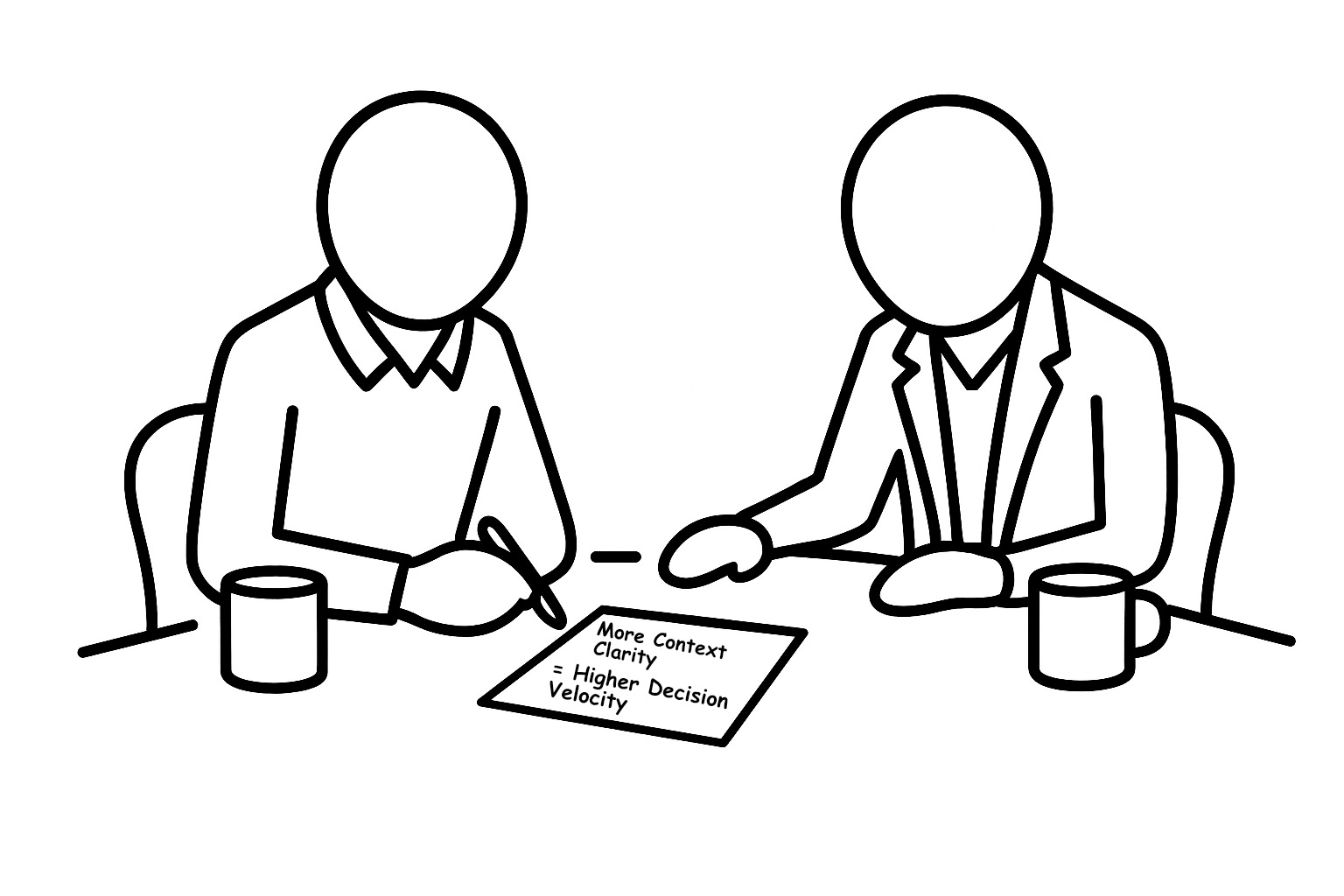
More context clarity = Higher Decision Velocity
“I call it decision velocity,” he continued. “How fast can you make quality decisions? Most companies optimize for execution speed—how fast can we ship, how many features can we deliver, how quickly can we respond to customers. But if you can’t decide what to ship, execution speed just means building the wrong thing faster.”
Understanding Judgment Speed
The words hit James like a physical blow. “That’s exactly what happened to us. Six months of fast execution. We built exactly what we thought customers wanted. And it was the wrong summit.”
“Fast execution without the right context doesn’t accelerate growth,” Sam said. “It accelerates moving in the wrong direction.”
James looked down at the napkin. The formula stared back at him. Simple. Damning.
“Six months,” he said quietly. “We spent six months proving that.”
“You’re not alone,” Sam said. “Most companies do.”
James thought about the board meeting. Sarah’s disappointed face. The adoption metrics still glowing on the screen while his biggest customer walked away.
“So how do you build that context?” James asked. “How do you get everyone seeing the same picture?”
“That’s the work,” Sam said. “And it’s not one thing. It’s a system. But here’s what I can tell you: the companies that figure this out? They’re not just faster. They’re moving in a direction everyone can see. That’s what gives them precision.”
James thought about the industry report. Companies moving with a kind of precision Dayanos had never achieved.
“The early days,” James said slowly. “When we first started Dayanos. We had that. The three of us in one room. We all saw the same picture.”
“You did,” Sam agreed. “You didn’t need alignment meetings because you were already aligned. You shared context constantly. You made decisions in hours, not weeks.”
“But we grew. More people. More teams. More—”
“More coordination overhead,” Sam finished. “And instead of building systems to maintain shared context at scale, you built systems to coordinate people who didn’t have shared context. Meetings became the architecture instead of the foundation.”
James felt the weight of it. Every sprint planning session. Every roadmap review. Every alignment meeting that felt necessary because people were working in different directions.
“You taught me to look at systems, not just outputs,” Sam said. “Remember? Early days, when we were scrambling to ship and you kept asking: are we building what matters, or just what’s next?”
James did remember. He’d been teaching Sam how to think strategically, how to see patterns in chaos.
“I stopped asking that question,” James said quietly.
“I know.” Sam’s voice was calming. “That’s why I’m here.”
They sat in silence for a moment. The coffee shop hummed around them—conversations, espresso machines, the familiar rhythm of a place they’d spent countless hours.
“I need help,” James said finally. “I have sixty days to figure out how to win back Ramorian and prove we’re not just building the wrong thing faster. And I don’t know where to start.”
“You start with the summit,” Sam said. “You start by figuring out what transformation your customers actually need. Not what they say they want. Not what’s easy to build. What they actually need to reach their summit.”
“And once we know that?”
“Then you build the context that lets everyone see it. That’s when decisions get faster. That’s when execution actually accelerates growth instead of accelerating motion.”
James looked at the napkin. More context clarity = Higher Decision Velocity. It was elegant. Simple. And completely different from how Dayanos operated.
“Sarah said we were optimizing for visibility,” James said. “She’s right. That’s what Dayanos does—we help teams see what’s happening. But Ramorian didn’t need to see more. They needed to decide faster.”
“Visibility is tool,” Sam said. “Transformation is summit. You built a tool for the wrong summit.”
The phrase landed hard. Not because it was harsh, but because it was true.
“So we need to figure out the right summit,” James said.
“Yes.”
“And then build the context that lets everyone see it.”
“Yes.”
“And that’s what creates decision velocity.”
“That’s what creates the conditions for decision velocity,” Sam corrected. “The velocity comes from having context. But you need to build the context first.”
James pulled out his phone and opened a new note. “Okay. Walk me through this. What does ‘building context’ actually mean?”
Sam smiled. “That’s going to take more than one coffee.”
“How much more?”
“Honestly? If you want to do this right, if you want to transform how Dayanos makes decisions in sixty days?” Sam paused. “I’d need to work with you and your leadership team. Not just you. Everyone who influences decisions.”
“You’d do that?”
“I’d take it on as a project, yes. I’d have to move some other clients around, but—” Sam met James’s eyes. “You gave me my start. Taught me how to think about building companies. When I heard you were in trouble, of course I’m going to help.”
James felt something loosen in his chest. Not relief exactly—the problem was still there, massive and urgent. But for the first time since the board meeting, he didn’t feel alone in it.
“What would that look like?” James asked. “Working together on this?”
“We’d start with understanding your customers’ actual summit. Not visibility. What transformation do they need? Then we’d figure out what context your team needs to see that summit clearly. Then we’d design how to build and maintain that context—not through more meetings, through better systems.”
“How long would that take?”
“The initial work? We could do it in a few intensive sessions with your leadership team. Maybe a week of full days. Then it’s about implementation—actually changing how you operate.”
“A week,” James said. “Out of sixty days.”
“The week isn’t the hard part,” Sam said. “The hard part is doing something different with the other fifty-three days. Most companies understand the frameworks. They just don’t change how they operate.”
James thought about his leadership team. The VP of Product who’d been with them since year two. The Marketing VP who’d built their entire go-to-market engine. The Engineering Director who’d scaled their tech stack through three order-of-magnitude growth spurts.
They were good. They worked hard. And they were stuck in the same coordination overhead that had trapped James.
“They need to hear this,” James said. “My team. Not just from me. From someone who can show them the pattern.”
“I can do that,” Sam said. “But James—this only works if you’re ready to question some things you’ve been treating as given.”
“Like what?”
“Like whether visibility is actually the summit your customers need. Like whether your current organizational structure serves the decisions you need to make. Like whether moving fast is actually the same as making progress.”
James thought about the board meeting. Sarah’s question: “So why are they leaving?” He’d had no answer then. He might have one now.
“I’m ready,” James said. “What do we do first?”
“First, you tell me about Ramorian. Not the metrics. The actual humans. What were they trying to achieve? What transformation were they hoping Dayanos would enable?”
James opened his laptop. “I have their exit interview notes. And some emails from their VP of Operations.”
“Perfect. Let’s start there.”
They spent the next hour going through Ramorian’s feedback. Sam asked questions James hadn’t thought to ask. About the problems Ramorian was trying to solve. About the decisions they struggled to make. About what they hoped would be different six months after implementing Dayanos.
The picture that emerged was clear: Ramorian didn’t need better visibility into their operations. They needed to transform how they made decisions. They needed to move faster from insight to action. They needed coordination without the coordination tax.
Dayanos had given them a dashboard. They’d needed a decision system.
“This is what we’re missing,” James said, looking at his notes. “This is the summit.”
“That’s your hypothesis,” Sam said. “Now we need to validate it.”
The Calendar Audit
“Okay.” James pulled out his phone to check the time, and his calendar app opened automatically. He stared at the screen.

“Board prep meeting. Board debrief meeting.” He looked up at Sam. “These are scheduled three hours apart.”
“Separate meetings?”
“My assistant scheduled them that way. I never questioned it.” James scrolled through the week. “Marketing alignment Monday. Product sync Wednesday. Engineering check-in Friday. We’re literally scheduling the coordination theater you’re talking about.”
Sam nodded. “See how easy it is to optimize for the wrong thing? You’re not scheduling decisions. You’re scheduling reconciliation. That’s coordination tax”
James tapped his calendar. “These two board meetings could be one conversation. Actually think about the decision instead of just processing the information.”
“That’s the pattern,” Sam said. “But James—”
“I could probably combine half of these.” James was scrolling faster now, seeing his calendar differently. “If everyone had the same context going in, we wouldn’t need—”
“Slow down.” Sam’s voice was gentle but firm. “Combining meetings isn’t the same as building shared context. That’s like rearranging deck chairs instead of fixing the navigation system.”
James looked up from his phone. “Right. I need to understand the transformation first.”
“Then figure out what context enables everyone to see it,” Sam said. “Then—and only then—you’ll know which meetings actually serve decisions and which ones are just coordination overhead.”
James felt something click. “Ramorian’s VP of Operations had said something in their exit call: ‘We loved seeing what was happening, but we still couldn’t decide what to do about it fast enough.’”
James had focused on the first part—the visibility win. He’d completely missed the second part.
“They needed decision velocity,” James said slowly. “Not more dashboards.”
“Now you’re seeing it,” Sam said.
James felt the urge to do something. Fix it now. Schedule a new meeting structure. Get everyone aligned.
“But I can’t just sit here,” James said. “I need to start somewhere.”
“You are starting,” Sam said. “Talk to customers. Not about features. About transformation. About what they’re actually trying to achieve. Validate your hypothesis that they need decision systems, not dashboards.”
“And then?”
“Then look at that industry report again—but differently this time. Don’t just look at who’s pulling ahead. Look at HOW they’re moving. Look at the gap between companies that have traction and companies that are just spinning faster.”
“And then I’ll know what to do?”
Sam smiled. “Then you’ll see what I can’t explain to you yet. And when you do—when you really see it—call me. We’ll figure out what comes next.”
“That’s it? Just research and wait?”
“Not wait. See.” Sam stood to leave. “James, you taught me something important in the early days. You said: ‘Don’t solve a problem you don’t fully understand.’ You taught me to sit with the question until the answer became obvious.”
James nodded slowly. He had said that. More than once.
“Right now, you understand there’s a problem. You have a concept—Decision Velocity. You even have a hypothesis about the summit. But you don’t see the full pattern yet. And until you do, any framework I give you will just be another template to fill out.”
“So I need to see it myself.”
“You need to see it yourself,” Sam confirmed. “Don’t just combine meetings and hope for the best. Understand what transformation looks like, then build the context that enables it.”
They walked out together. At the door, Sam turned back one more time.
“One more thing. When you look at that report? Don’t just look at what those companies are doing differently. Look at what they’re NOT doing. Sometimes the absence reveals more than the presence.”
Sam left. James stood outside the coffee shop, napkin in hand.
More context clarity = Higher Decision Velocity
Simple concept. But how did you actually build that at scale? How did you create shared context across teams that had different priorities, different timelines, different definitions of success?
He looked at his calendar again. All those meetings. Board prep and board debrief. Marketing alignment. Product sync. Engineering check-in.
They weren’t coordination meetings. They were reconciliation meetings. Not preventing misalignment—fixing it.
Sam was right—combining them wouldn’t fix the problem. He’d just have fewer meetings where people still weren’t seeing the same picture.
James walked back to the office. His leadership team would still be there—they always were, grinding through coordination meetings, trying to align on next quarter’s roadmap.
He passed the main conference room. Through the glass, he could see them: Product VP presenting slides. Marketing VP checking her phone. Engineering Director taking notes. Everyone in the same room, supposedly aligned.
But were they seeing the same picture? Or just attending the same meeting?
James kept walking. He had work to do. Real work. The kind that didn’t happen in meetings.
He pulled out his phone and started drafting emails to customers. Not the usual check-in emails. Different questions this time.
“What transformation were you hoping Dayanos would enable?”
“Six months after implementing, what did you expect would be different about how your team operates?”
“When you think about the summit you’re trying to reach, what does success actually look like?”
He sent ten emails before he reached his office. Then he opened the industry report Sam had mentioned.
This time, he wasn’t looking for who was winning. He was looking for how they moved.
And more importantly—what they’d stopped doing that created the difference.
The work had started.
59 days left.
PRACTICE: The Coordination Tax Audit
Time: 2 minutes
Think of the last decision that required multiple meetings to make—a product choice, strategic pivot, resource allocation, or go-to-market shift.
Ask yourself: What context was missing that made coordination necessary?
Write one sentence about what you see.
James discovered that coordination overhead signals missing context, not poor execution. His team held dozens of meetings per decision while high-velocity companies made multiple decisions per meeting. What looked like alignment was actually reconciliation—fixing misalignment instead of preventing it through shared context.
AI Prompt:
The decision that required multiple meetings was: [Your decision]

We needed multiple meetings because: [What was missing - context, clarity, decision rights, etc.]

If we had that from the start: [One sentence on what would have changed]

Based on this:
1. Where am I treating coordination as decision-making?
2. What context, shared upfront, would eliminate most coordination overhead?

Help me see the pattern.
Next Episode: The 30x Effect (Now Live)
James now sees why his team moved fast but lost ground - they were optimizing for execution speed instead of judgment speed. Next, he’ll try to move fast in a different way. But understanding the problem isn’t the same as solving it systematically.
James will need it, running against the clock.
Subscribe to follow James’s journey from understanding the problem to seeing what’s possible.