
"I Found You On ChatGPT": The Conversational Commerce Revolution
The buying process is being rewritten—one conversation at a time.

For the past twenty years, we’ve been speaking like machines.
“Best running shoes flat feet.”
“Hotels near me.”
“Marketing strategy template.”
The internet trained us to talk in commands, not conversations.
But conversation is our natural state. It’s how we’ve built tribes, solved problems, and raised civilizations.
For millennia, progress began with a dialogue.
Then came search. And for two decades, we stopped speaking like humans and started thinking like algorithms.
Now, that spell is breaking.
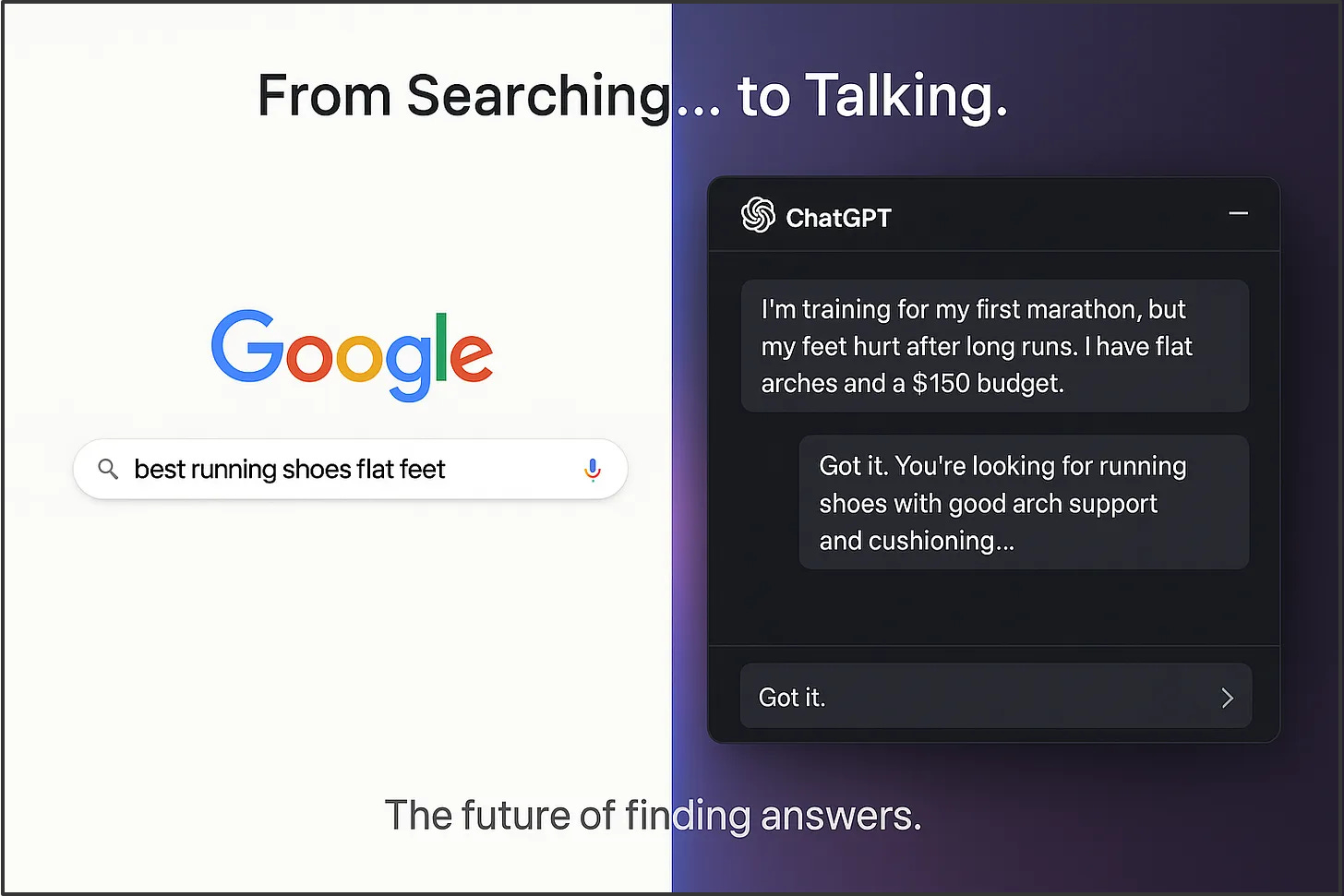
“I found you on ChatGPT.”
The machine finally learned to speak like us. And that changes everything.
What ChatGPT Is Really Building
I can already hear the skepticism:
“Okay—conversation is great for discovery. But how do I actually buy things? ChatGPT is just a chat box. Shopping needs payment, delivery, images, trust.”
Exactly. And that’s what everyone’s missing.
Chat wasn’t the end. It was technology coming full circle—back to conversation, back to context, back to us.
Phase 1: Better Search (2022-2023):
Conversational questions. Smarter answers. Still just information.
Phase 2: Integrated Features (2023-2024):
Images, research synthesis, contextual recommendations.
But you still had to leave the chat to act.
Phase 3: Commerce Infrastructure (2024-2025):
The scattered announcements were actually infrastructure:
Stripe — Payments
Instacart — Fulfillment
Sora — visualization and pre-purchase confidence
Review synthesis — Trust layer from collective experiences
Phase 4: Conversational Shopping (The destination)
Conversation → Recommendation → Visualization → Transaction.
No app switching. No checkout flow. Shopping is handled in the same natural conversation where you ask about anything else.
How Conversational Commerce Actually Works
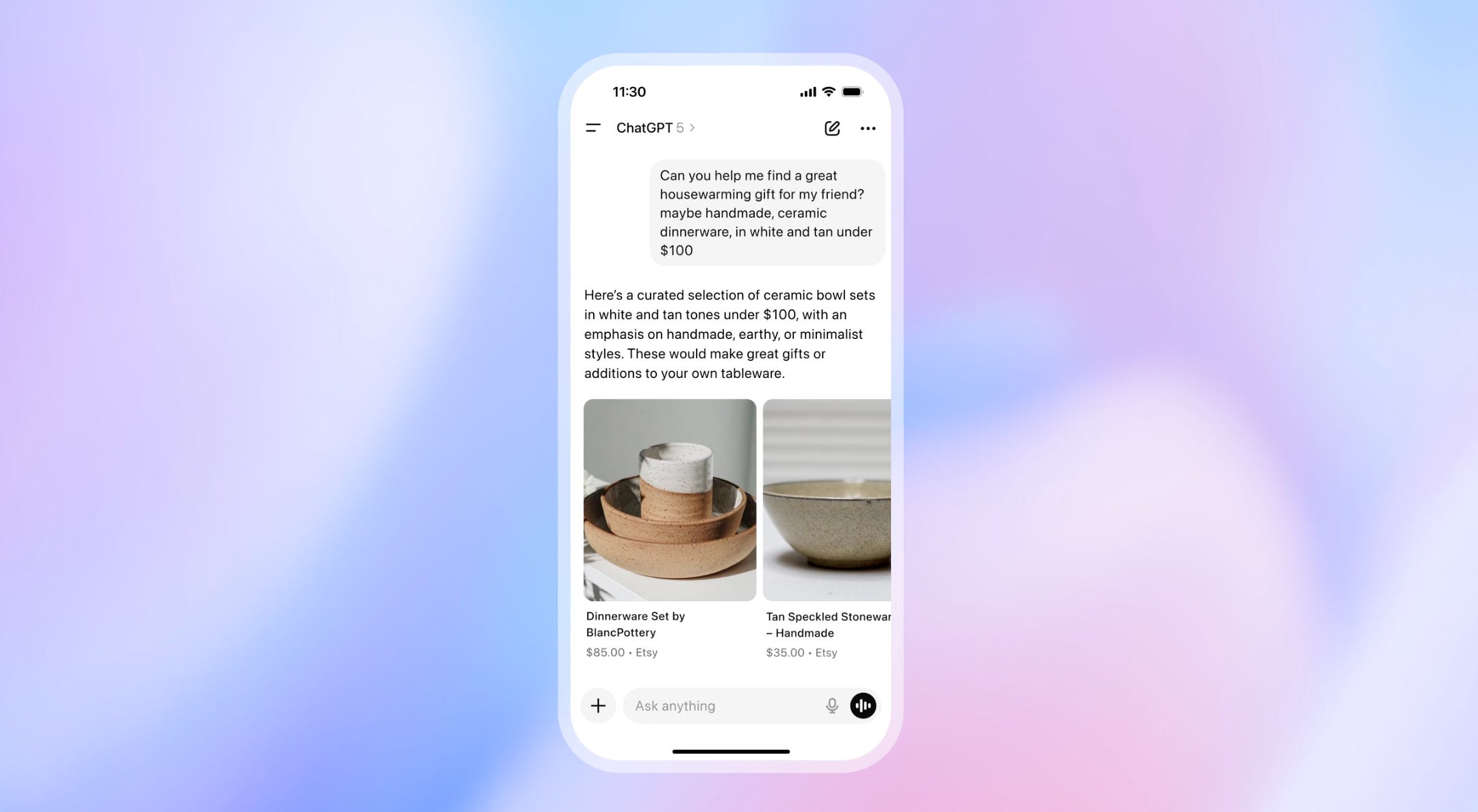
You might be thinking: “The tech integrations sound slick. But can you trust AI’s recommendations more than your own research?
The answer—in many ways—is that you already do. If you’ve ever:
Bought a product on Amazon that was “recommended for you,”
Subscribed to a creator on social media from your feed, or
Seen a movie, playlist, or ad tailored “just for you,”
You trusted an algorithm.
Most of us just stopped noticing. For digital natives, AI as curator feels natural.
If it still feels like a leap, remember—you’re still the one approving purchases. It’s discovery and reasoning that are quietly moving behind the curtain.
And the interface is changing too. Typing will fade as voice becomes the natural way in.
That’s why Apple is racing to evolve Siri through Apple Intelligence, and why every AI company is betting on voice interaction.
Typing feels too much like search; speaking feels like conversation.
And commerce always follows comfort.
Solving The Physical Product Problem
Digital products are simple enough: AI recommends, you download.
No friction, no fuss.
Physical products are different. You need to see and believe before you buy.
And then—Sora enters the chat.
While many call Sora a “social network,” it’s something deeper.
It’s giving us sight—the ability to see before we believe.
To bring imagination back into buying.
The same instinct that made us pick things up, try them on, picture them in our space—now returns digitally.
Not to replace trust, but to restore it.
Sora: The Secret Weapon Hiding In Plain Sight
If you thought Sora was the next TikTok, that’s exactly what OpenAI wanted you to think.
Let me explain.
Imagine you’re chatting with ChatGPT about clothes—or just shopping online the old way.
AI recommends a dress. You ask, “Will it fit me?”
Without Sora:
“Based on reviews, it runs true to size. Check the size chart.”
And you know how that goes.
You buy it. It arrives. It doesn’t fit.
You exchange, or return it. Hope the next one fits better. Repeat.
Some brands have virtual try-on tools, most don’t—and every store uses its own system.
Now imagine this instead:
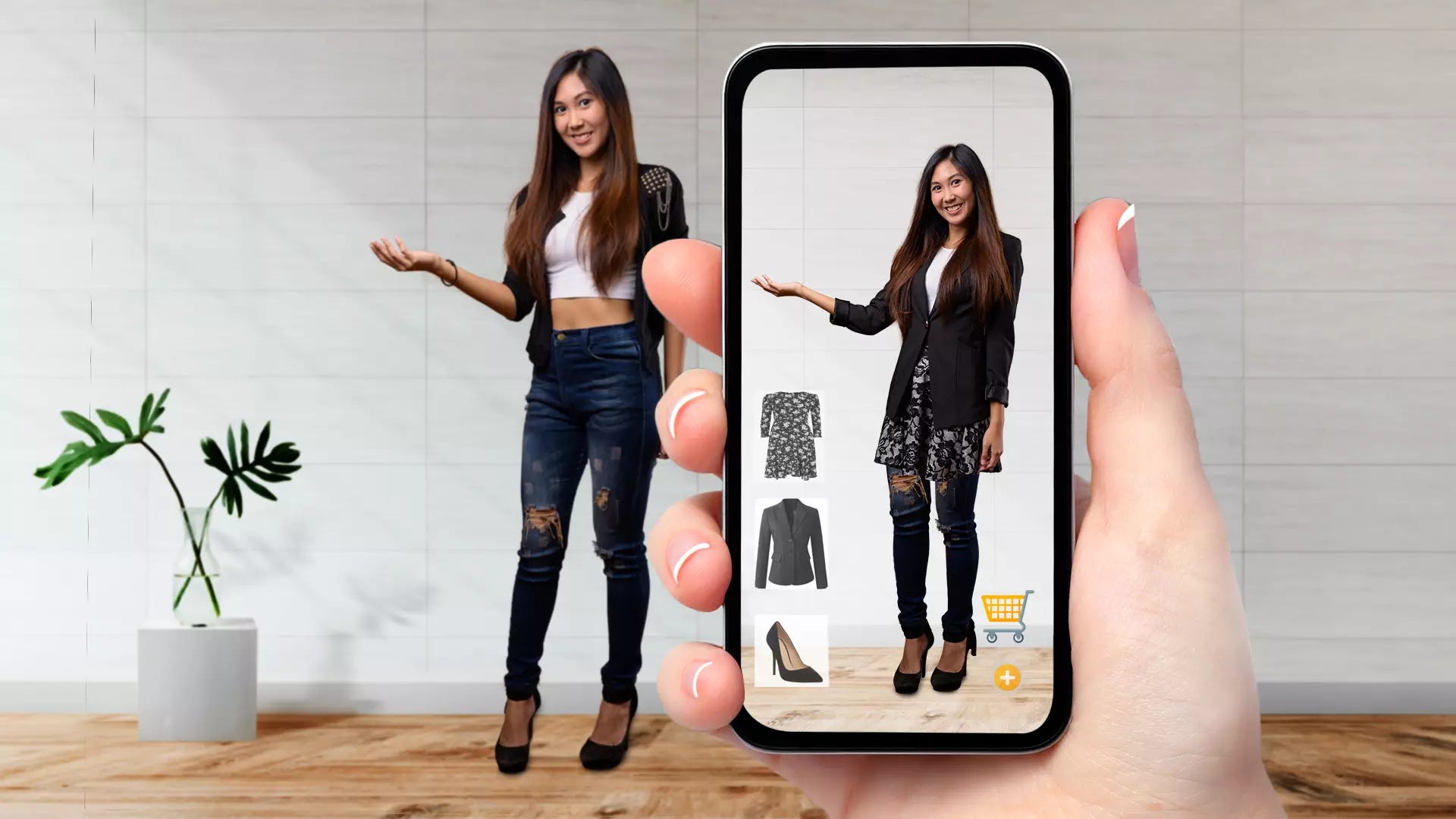
Your measurements and body type are stored once—securely, privately—and every retailer you interact with can show you exactly how something fits on you.
No guessing. No measuring tape. No returns.
That’s the power of Sora.
It lets you see what AI recommends before you buy—on your avatar, in your space, under your conditions.
Here’s what that looks like in action:
You: “I need an outfit for a June wedding. Outdoor, garden theme. Polished but not overdressed.”
AI: “Based on your style and fit preferences, here are three options.” [Shows dresses on your avatar]
You: “I like the second one, but not the neckline.”
AI: “Here’s how it looks with a different neckline.”
You: “Perfect. Add matching shoes.”
AI: “These four pairs complement the dress and work for grass venues.” [Shows shoes on your avatar]
You: “The third pair. Total?”
AI: “$217. Arrives May 30. Confirm?”
You: “Confirmed.”
Full transaction. No site. No cart. No doubt.
What looks like social fun—creating avatars, sharing clips, posting outfits—is really consumer training for trust.
Trust through digital proof before physical experience.
That’s why it’s the secret weapon hiding in plain sight.
The Revolution Is Real
You might still hesitate to dive in headfirst. That’s natural.
But take a closer look at your own behavior over the past few months.
Have you:
Asked ChatGPT for a restaurant or product suggestion before opening Google?
Trusted an AI summary without cross-checking sources?
Used ChatGPT to compare, plan, or even decide what to buy?
If any of that sounds like you, you’re already practicing conversational commerce.
And OpenAI has read the tea leaves. That’s why they’ve gone full steam ahead activating these capabilities:
Instacart ordering and Stripe payments — live inside ChatGPT.
Voice interactions — working across web and mobile.
Sora — active, giving users a first taste of product visualization.
To smooth the path, expect ChatGPT to start showing examples and subtle interface cues that make shopping feel effortless—one conversation at a time.
More Than Just Buying Differently, You Become Different
For twenty years, we’ve shopped like machines—searching, comparing, optimizing.
Now, we’re learning to shop like humans again. Through dialogue, through trust, through context.
The way things were always meant to be.
Right now you stand at a fork:
Wait it out. “I don’t trust AI. I need to see and touch.”
Keep the familiar rituals—more effort, more time, full control.Try it out. “I’ll test it on low-stakes purchases.”
Let AI handle the tedious parts and keep judgment for the big ones.Go all in. “I trust the synthesis. I want my routines automated.”
Live inside the future others are still debating.
Whatever you choose, understand this: your family, friends, and colleagues will use these tools.
Even if you never delegate fully, you’ll need fluency—to keep up, and to help those who do.
Prepare For The Revolution
The next tech revolution won’t happen in factories or codebases.
It will happen in conversation.
For individuals, it’s liberating—technology finally speaking like a human.
For businesses, it’s something else entirely.
Because when the conversation becomes the storefront, the rules of competition change overnight.
How will you prepare?
This is Part 1 of the Conversational Commerce Series — how conversation is replacing search as the new discovery engine.
👉 Read Part 2 - How to Get Physical Products Recommended by ChatGPT
👉 Then read Part 3 - How to Get Digital Products Recommended by ChatGPT