
How To Get Your Digital Products Recommended by ChatGPT
When customers stop searching, here’s how to be found

New to the series?
👉 Start with Part 1 - “I found you on ChatGPT”
👉 Then read Part 2 - How to Get Physical Products Recommended by ChatGPT
For twenty years, search engines made us talk like machines.
We wrote “best project management software remote teams” instead of “help your team work better together.”
We optimized for algorithms, not humans.
But as a digital creator, you got it worst.
You start with authentic expertise—helping founders build their first sales process or making complex ideas accessible. You wrote from genuine insight, using natural language that connected with real problems.
Then came SEO.
Suddenly every sentence needed “SaaS marketing strategies 2024.” “Best,” “top,” and dates everywhere because that’s what got traffic.
You publish “10 Best Project-Management Tools for Remote Teams (Updated 2025)” when what you really want to say is that most teams don’t have a tool problem—they have a decision-making problem. But “decision-making frameworks for distributed teams” gets forty searches a month.
You even considered titling a post “project managment” because 800 people misspelled it each month.
You’re fluent in algorithm, but your real expertise—the part that could transform someone’s business—sits buried under keyword optimization.
Then ChatGPT flipped the game. Traffic stopped being about information and started being about conversation.
After twenty years trapped in machine language, there’s finally an escape hatch—
but only if you understand what’s changing.
ChatGPT didn’t just change how we search—it changed how digital products get found.
The shift isn’t that people now ask ChatGPT for recommendations instead of googling “best X for Y.”
It’s that they speak differently when they’re in conversation than when they’re searching.
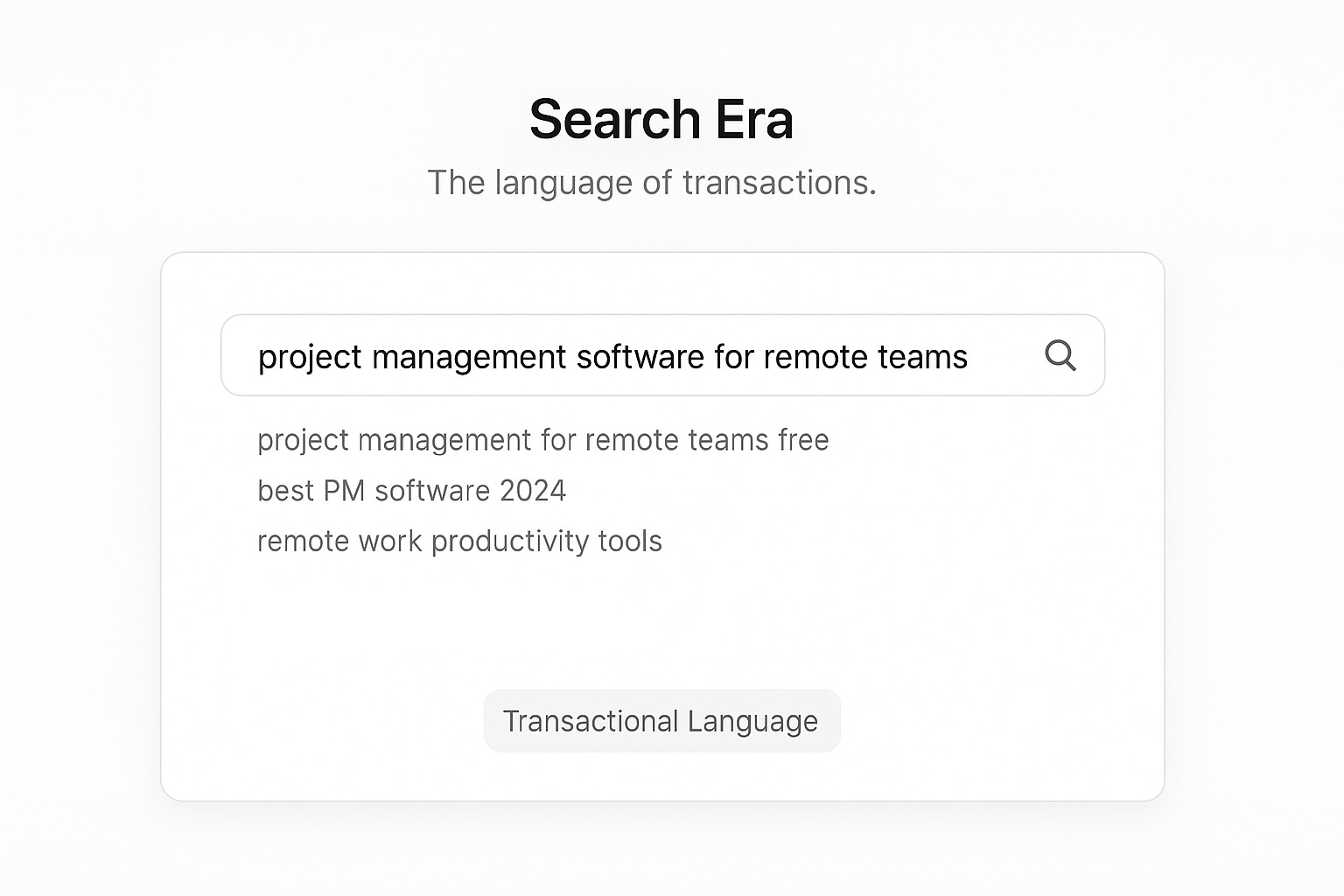
Search language is transactional:
“Project-management software for remote teams.”
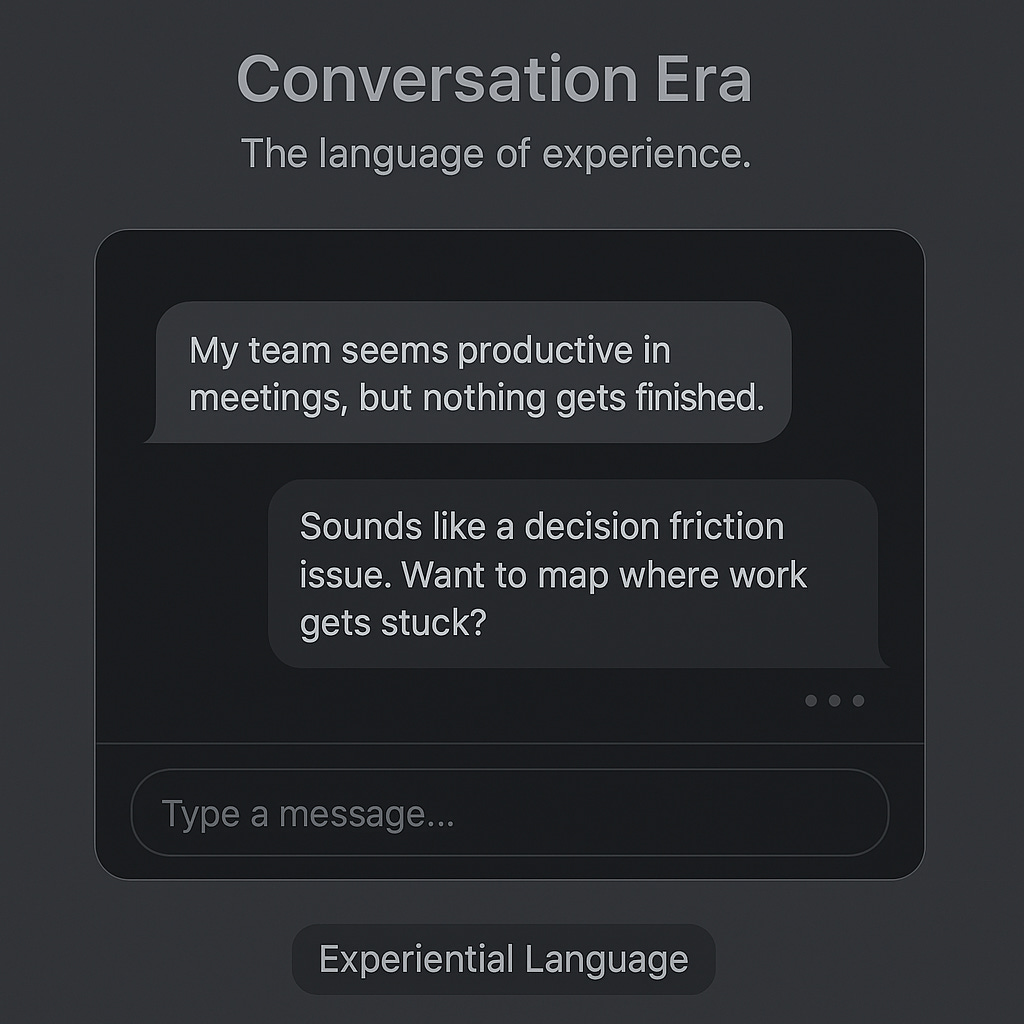
Conversational language is experiential:
“My team seems productive in meetings, but nothing gets finished.”
Two entry points. Same solution space.
You already know how to help someone who says “nothing gets finished.” You’ve just had to disguise that help under search-friendly packaging—because that’s what ranked.
Not anymore.
You can now optimize for these conversational entry points, catalogue how customers naturally describe their stuck points, and build discovery infrastructure of the next era.
The Conversational Shift Is Already Underway
We’re already seeing early signs of the conversational commerce revolution.
“Headphones for long flights that won’t hurt my ears” now outperforms “wireless Bluetooth headphones.”
Every query like that trains algorithms to listen for human nuance. Especially as voice become the default for queries compared to typing.
That’s why when OpenAI partnered with Etsy for its commerce launch, it wasn’t random—it was recognition. Etsy’s product catalogs was already conversation-ready.

“Vintage ceramic bowl, perfect for bread making, reminds me of my grandmother’s kitchen.”
That’s discovery through story, not SKU.
Walmart read the tea leaves, and went all in. Today, nearly 20% of its traffic flows from ChatGPT queries, not search bars.
Meanwhile, Amazon blocked ChatGPT from crawling six hundred million listings—building its internal AI, Rufus, to compete.
Across physical retail, the pattern is clear:
Conversation is the new storefront.
Context is the new keyword.
Fluency in human language is the new distribution advantage.
And digital creators are next.
What’s happening to physical products will soon happen to courses, apps, and consulting offers.
The platforms that already speak human are quietly winning—while the ones that still speak database are becoming invisible infrastructure.
Reporting From The Trenches
I’m not writing this as an expert.
I’m writing as a field reporter—documenting what I’m discovering while living the same transition you are.
I followed all the content creation rules:
Keyword research → outline → optimize → publish → track rankings.
Then I noticed something. The people finding the most value weren’t coming through search—they were coming through conversation.
Someone would mention a strategic challenge, I’d share an insight, and they’d say,
“I never thought about it that way.”
I started taking what I learned from those moments and turning them into content—
whether it ranked or not.
More conversations followed.
That’s when it clicked: we’re moving from search-engine entry points to conversational entry points.
People don’t say,
“best project management framework for remote teams.”
They say,
“We spend three weeks debating everything.”
“Every choice feels like it could kill the company.”
“My team wants more direction, but I don’t want to micromanage.”
The breakthrough wasn’t in SEO tactics.
It was in returning to how people actually articulate problems.
The Five Conversation Patterns I Started Tracking
I wanted to see if the same conversational dynamics shaping product discovery could also shape how people talk about strategic challenges inside their companies.
I’d been working with founders on decision-making issues for a while, but I wasn’t systematically tracking how they described their problems. Then, while preparing for a conversation with a founder struggling with “decision paralysis,” I tried something different.
Before the call, I pulled up every conversation we’d had and started categorizing his statements.
That’s when I saw the pattern:
He wasn’t having one conversation about strategy—he was having five distinct conversations, each addressing a different layer of his challenge.
The Five Layers I Keep Seeing
This founder was cycling through five distinct types of conversations—each aligned to a different part of the flywheel:
Identity questions: “The team wants more direction, but I don’t want to micromanage.”
Who they are as leaders—and who they’re becoming.Measurement questions: “How do we know if this is actually working?”
How they define and track progress.Methodology questions: “We have frameworks for everything, but nothing connects.”
How they move through stages of transformation.Activation questions: “Everything feels urgent, but nothing feels essential.”
What finally gets them moving.Foundation questions: “We keep debating what business we’re actually in.”
What level of belief makes the transformation possible.
These conversations moved from surface symptoms—who we are, what we’re measuring—toward root cause—what we actually believe about our transformation.
The breakthrough wasn’t discovering a framework.
It was realizing these five conversation types map every stage of how someone articulates their transformation journey.
Which means they also map every conversational entry point to your expertise.
Applying This To My Own Work
When I mapped my own client conversations against these five patterns, everything clicked.
Instead of optimizing for keywords like “strategic thinking frameworks,” I started writing to match how clients naturally moved from symptom to root cause.
So I rewrote my content strategy around these five conversation types:
So I rewrote my content strategy.
Identity: How To Be The Strategic Leader Everyone Wants To Work For
Measurement: Early Warning Signs Your Strategy Is Gaining Traction
Methodology: How to Set Up Decision-Making Systems Without Becoming Bureaucratic
Activation: The Difference Between Busy and Building Momentum
Foundation: Why A 5-Person Team Outperforms a 50-Person Department
Each piece became an entry point into a different stage of the transformation conversation.
With it came more DMs. More inquiries. More opportunities to make a difference.
The message I kept hearing:
“This article describes exactly what we’re experiencing.”
People weren’t finding me through keywords. They were finding me through context alignment.
Once I saw how the flywheel mapped real customer dialogue, I began testing it across different types of digital products.
Testing Conversations Across Product Types
Patterns started emerging as I tested this approach with different founders.
Each type of digital product revealed its own conversational fingerprint—but the underlying structure stayed the same.
Information Products (Courses, Frameworks, Educational Content)
Paul builds online courses for project managers. When we mapped his customer conversations, they clustered around one gap—knowing versus applying.
Identity: “I know the theory but can’t apply it in practice.”
Measurement: “How do I know if I’m actually getting better at this?”
Methodology: “The framework makes sense in examples, but my situation is different.”
Activation: “I understand what to do but can’t get my team to follow through.”
Foundation: “I feel like a fraud calling myself a project manager.”
Information-product conversations center on the gap between understanding and application.
People aren’t buying knowledge—they’re buying confidence that they can turn knowledge into results.
Software Products (SaaS, Apps, Platforms)
Sara builds workflow automation software. Her customers voiced a different pattern—capability versus adoption.
Identity: “We want to be efficient, but we don’t know how to change our habits.”
Measurement: “The tool works, but are we actually saving time or just being busy differently?”
Methodology: “This doesn’t integrate with how we actually work.”
Activation: “The software is powerful, but we’re only using 10% of its features.”
Foundation: “Every solution we try creates new problems.”
Software conversations center on the gap between capability and adoption.
People aren’t buying tools—they’re buying transformation from inefficient to systematic operations.
Services (Coaching, Consulting, Done-for-You)
Chris runs a strategic-planning consultancy. His clients reveal a third pattern—ambition versus capability.
Identity: “We need to think more strategically, but we don’t have the expertise internally.”
Measurement: “How do we know if this strategic plan will actually work?”
Methodology: “We’ve tried planning before, but execution always breaks down.”
Activation: “We know we need help, but we’re not sure what kind.”
Foundation: “We’re successful but feel like we’re missing opportunities.”
Service conversations center on the gap between ambition and capability.
People aren’t buying expertise—they’re buying transformation from confused to clear.
How To Test for Transformation in Your Digital Products
After seeing these patterns repeat across creators, I built a simple test to know whether a product truly facilitates transformation—or just delivers information.
If your product passes all three steps, it doesn’t just get discovered through conversation.
It drives conversation.
Step 1 – Identify the Transformation (Identity Shift Test)
Ask: Who does this help someone become?
Information products → from learner to practitioner
Software products → from chaotic to systematic
Services → from uncertain to strategically clear
If you can’t articulate that “from → to” identity in a single sentence, you’re selling information, not transformation.
Step 2 – Map the Conversation (Alignment Test)
Ask: How do people describe this gap in their own words?
Collect verbatim phrases from real interactions or prompts:
“I feel like a fraud.”
“We want to be efficient but don’t know how.”
“We need to think more strategically.”
Your marketing language should echo these phrases exactly. If it doesn’t, discovery will depend on algorithms instead of human conversation.
Step 3 – Architect the Capability (System Test)
Ask: What repeatable capability does this install?
Define the systematic function—decision velocity, clarity loops, execution rhythm.
Frameworks transfer information; architectures build capability. Design for the latter.
When a product passes all three tests, it becomes part of a living discovery system that scales through conversation itself.
And here’s the payoff: once your product is architected around transformation language, ChatGPT already knows how to talk about you.
Because conversational AI doesn’t crawl web pages the way Google did.
It listens for context.
It recommends what matches how people describe their struggles, not what matches a keyword string.
If your product narrative mirrors those natural phrases—the “I feel like a frauds,” the “we want to be efficient but don’t know hows”—you’ve effectively trained the model without spending a single ad dollar.
That’s the secret.
You don’t optimize for ChatGPT.
You optimize through it—by architecting transformation conversations that the system already recognizes as human truth.
Prepping For The Conversational OS
Once you realize ChatGPT already knows how to talk about you, the real question becomes:
Is your business ready to talk back—systematically—whenever customers are ready to listen?
Because conversation isn’t just a new channel.
It’s a new operating layer.
Twenty years ago, search engines mechanized how we communicated.
They taught us to speak like machines.
Then social platforms digitized attention.
They trained us to perform for algorithms.
Now the AI era is conversation-ifying business itself.
We’re no longer optimizing content for discovery. We’re architecting systems for transformation.
Information products that turn learners into confident practitioners.
Software that transforms chaotic teams into systematic operators.
Services that develop strategically clear organizations.
Each one is a module in a larger design—an emerging Conversational OS where every product, service, and message functions as a node in a transformation network.
A new infrastructure for how human judgment and machine intelligence learn to think together.
The Next Playbook
The creators who recognize this shift first—who connect their information, software, and service layers into coherent transformation systems—won’t just adapt to conversational commerce.
They’ll define it.
Because once you see the pattern, it’s irreversible:
Conversation is teaching us how to build for humans again.
Next up: Building the Conversational OS
Part 1: Map the layers of the Conversational OS—identity, proof, process, priority, positioning.
Part 2: Design transformation systems that interlock across AI and human interfaces.
Part 3: Build the discovery infrastructure that scales through conversation itself.
The future of digital business isn’t about products being found.
It’s about systems that join the right conversation, at the right moment, with human clarity and machine speed.