
Early Wins Create Breakthrough Momentum: How Traction Fuels Your Flywheel
Prime Positioning - Episode 10: Your first wins spark momentum—and reveal the architecture that makes it all work.

Prime Positioning Episode 10
Your first wins spark momentum—and reveal the architecture that makes it all work.
Ramorian is officially gone—signed with Amalakai. But the market is noticing what Dayanos is building. The Engineering Director sees a pattern no one else has seen: the decision architecture that transformed the team could transform the platform. And Kedaris proves that transformation transfers—not by following a framework, but by owning one.
New Readers: Start here at Episode 1 here.
Market Validation Reveals the Path Worth Owning
Three weeks until board meeting.
James arrived early, preparing for his leadership meetings and monitoring Lightning Strike progress.
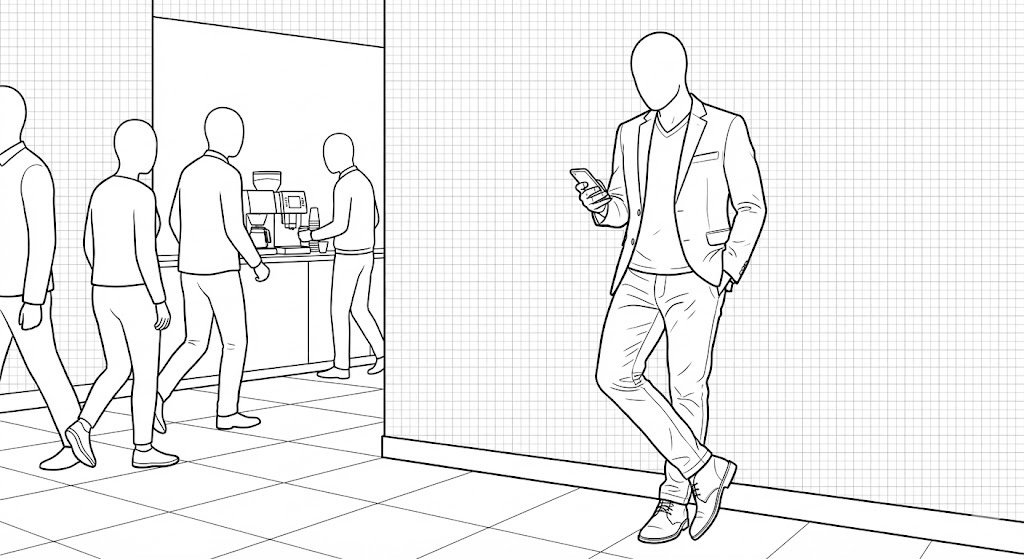
While grabbing coffee, phone buzzed. Email notification from Ramorian.
James stopped in his tracks. His thumb hovered over the notification. This may be the final piece of the turnaround he’d been hoping for. Winning back what was lost.
He found a quiet corner of the lobby and opened it.
James,
Thanks for reaching out. I appreciate the honesty about what happened, and I can tell something’s shifted in how you’re thinking about this.
I need to be direct with you: we finalized our partnership with Amalakai last week, and are in implementation.
That said - a few people in our network have mentioned Dayanos in conversations recently. Different context than before. Something about decision architecture? One of our board members asked if we’d talked to you lately.
I’m not in a position to reconsider right now. We’ve made our commitment and we’re going to see it through. But I wanted you to know that whatever you’re building, it’s creating some noise.
Maybe we’ll talk again down the road.
David
Vice President of Operations, Ramorian
Ramorian was gone. Officially. Not “considering other options” or “evaluating alternatives”—signed, sealed, implementing with Amalakai.
While processing the news, the lobby was filling with morning arrivals—engineers heading to standups, the marketing team clustering near the coffee station. Normal Monday motion.
James looked back at his phone, saw different words this time.
Whatever you’re building, it’s creating some noise.
Something about decision architecture.
Decision architecture. Someone was using that phrase. Their phrase. In conversations with Ramorian’s network.
Months ago, this email would have sent him into crisis mode. Emergency leadership meeting. Strategy pivot discussion. How fast can we ship something competitive.
Now, he was resolved to his path.
Ramorian had chosen Amalakai. That was their decision. And Amalakai would give them exactly what they’d asked for—intelligent decision support. Better tools. Faster data.
But tools weren’t transformation. And Ramorian’s email proved something James hadn’t expected this early: the market was starting to notice the difference.
James pocketed his phone and headed to his office.
The Marketing VP caught him in the hallway.
“You saw Kedaris’s Friday numbers? Three decisions per meeting for Lisa’s team. Her Product team’s pilot is looking good too.”
“Good.” James kept walking. “Leadership sync in thirty. I need everyone there.”
She matched his pace. “Something happen?”
“Ramorian signed with Amalakai.”
The Marketing VP stopped. James turned back.
“They’re gone,” he said. “But, they mentioned something. People in their network are talking about us. Using our language. ‘Decision architecture.’”
“The market’s noticing. Before we’ve published anything.”
“Before Kedaris is even complete.” James started walking again. “I’m sharing this with the team. They should see the full picture.”
“Including that we lost Ramorian?”
“Including that we’re no longer chasing them.”
The Marketing VP caught up. “The James from two months ago would have called an emergency meeting by now.”
“The James from two months ago didn’t know what we were building.”
Advantage Emerges When Patterns Align Across Contexts
The Engineering Director noticed it first in the Thursday cross-functional sync.
Product was walking through the mobile notification feature—the one they’d reframed around customer transformation two weeks ago. The Product VP pulled up the flywheel on screen, pointed to Positioning.
“We’re designing for judgment-level alerts. Customers catching opportunities before they close. That’s the transformation we’re enabling.”
Marketing nodded. “Which means the messaging isn’t ‘better notifications.’ It’s ‘decisions at opportunity speed.’”
“And Engineering?” The Product VP turned to him.
“Latency over elegance. We talked about this.” The Engineering Director checked his notes. “Authentication refactor prioritizes speed of the flow itself. Same principle applies here—notification delivery has to match the promise.”
The Product VP made a note. “So we’re aligned. Transformation story drives the technical requirements.”
The meeting moved on. Four minutes. Three functions. Decision made.
He noted: Context present before meeting. Decision happened inside meeting.
Friday context refresh. The whole leadership team around the table.
The Engineering Director listened as each person shared their piece. Marketing on Kedaris expansion momentum. Product on the two new companies moving through baselines. James on Ramorian—the loss, the market signal, the decision not to chase.
But he was watching the handoffs.
When Marketing finished, Product picked up naturally. “Lisa’s pattern matches what we’re seeing in the fintech baseline. Same recognition sequence—awareness that something’s broken, then alignment around the diagnosis.”
When Product finished, Engineering connected. “Which means the platform requirements stay consistent. We’re not building different systems for different customers. The transformation architecture scales.”
When Engineering finished, James synthesized. “So we have a repeatable pattern. Kedaris proves it, the new companies validate it, and the market’s already noticing before we’ve published anything.”
Each person added their piece. The picture assembled itself.
The Engineering Director had seen this pattern before. Not in leadership meetings.
In platform architecture.
Saturday morning. The Engineering Director was reviewing platform documentation—keeping the technical architecture fresh.
He stopped on the context distribution module.
The Dayanos platform handled information flow between functions. When Product made a decision, that context propagated to Engineering queues. When Engineering shipped, Marketing received deployment notifications. When Marketing launched, Product saw adoption signals.
The documentation called it “systematic context transfer.”
He read that phrase three times.
Then he thought about Thursday’s meeting. Product arriving with transformation context. Marketing arriving with messaging context. Engineering arriving with technical context. No one rebuilding. Everyone building on.
The platform did the same thing. Automated. Context traveling between functions so decisions could happen at each node without bottlenecks.
He opened a new document and started typing.
Platform architecture = context distribution between system functions
Team architecture = context distribution between human functions
Same pattern. Different starting point.
Sunday. The Engineering Director went for a run, trying to clear his head.
The pattern kept surfacing.
The flywheel. The five elements. Positioning, Prioritization, Process, Performance, People.
He’d been thinking of them as a coordination framework. Something for humans. A way to align teams.
But what if they were governance architecture?
He slowed to a walk.
Governance isn’t policy. It’s where decisions stop needing permission.
The flywheel was doing exactly that for the team. Positioning determined what mattered. Prioritization determined what happened first. Process determined how work flowed. Performance determined what counted. People determined who could move. Each element embedded in how the team operated—system-held, not leader-held—so individuals didn’t have to rebuild context every meeting.
He stopped walking entirely.
The flywheel isn’t just a coordination tool. It’s a governance architecture.
And if it governs human decisions...
He pulled out his phone.
Can it govern platform decisions too?
The Right Architecture Coordinates Humans and Systems
Monday morning. The Engineering Director arrived early, the connections now sharp enough to articulate.
Two architectures. One for systems. One for humans. Same underlying structure.
He knew what he wanted to say. The question was whether it would land.
James was in his office, reviewing something on his laptop. The Engineering Director knocked on the doorframe.
“Got a minute?”

James looked up. “What’s on your mind?”
“I’ve been watching how the team coordinates using the flywheel.” The Engineering Director stepped inside but didn’t sit. “The decision architecture we’re teaching Kedaris—it’s the same structure that governs platform decisions.”
James leaned back. “Say more.”
“Context distribution. The platform moves information between functions so each node can make autonomous decisions. The flywheel does the same thing for humans. Same pattern, different starting point.”
James was quiet for a moment. Processing.
“You’re saying the flywheel isn’t just a coordination tool.”
“I’m saying it’s governance architecture. And if it works for human coordination, it can work for platform coordination.” The Engineering Director paused. “I think there’s something here. But I need to walk through it with the team.”
“Cross-functional pilot meets in an hour.” James checked his calendar. “Bring it there. Let’s see what they see.”
The team gathered in the main conference room. Product VP, Marketing VP, Engineering Director, James. The rhythm established three weeks ago—daily syncs during the pilot, quick and focused.
“Before we get into the agenda,” James said, “We have an update from Engineering. I request we lead with that.”
The Engineering Director stood but didn’t move to the whiteboard. No slides. Just the pattern he’d been sitting with.
“I’ve been watching how we coordinate,” he said. “The flywheel. How context moves between us so decisions happen without rebuilding everything each meeting.”
The room was listening. They’d all felt it—the acceleration, the handoffs that just worked now.
“Our platform does the same thing.” He looked at the Product VP. “When Product makes a decision, context propagates to Engineering. When Engineering ships, Marketing gets deployment signals. Information traveling between functions so each node can act.”
“Systematic context transfer,” the Product VP said. “That’s in the architecture docs.”
“Right. And that’s what the flywheel does for us. Context traveling between humans so each person can decide without waiting for alignment.”
The Marketing VP leaned forward. “You’re saying the same architecture governs both.”
“Yes, just a different starting point.” The Engineering Director paused. “What Sam taught us—the flywheel, Strategic Decision Architecture—it’s not just a coordination framework. It’s governance. Rules for how decisions get made. And governance that works for humans can work for systems.”
Silence. The team processing.
The Product VP spoke first. “The transformation stages we mapped for Kedaris. Awareness, Alignment, Adoption, Advocacy.” He was connecting it. “That’s a decision architecture too. Each stage has clear context, clear triggers, clear handoffs.”
“And it’s not just for customers.” The Marketing VP saw it now. “It’s how we rebuilt internally. Same stages. Same architecture.”
“Same foundation,” the Engineering Director said. “What we practice internally is what we teach customers. And it’s also the blueprint for how the platform should work.”
James had been quiet. Now he leaned forward.
“Say that again.”
“The platform we’re selling—it helps customers make decisions at opportunity speed. But right now, it’s tooling for visibility.” The Engineering Director look at James. “What if the platform itself ran on Strategic Decision Architecture? Context traveling through the system the same way it travels through teams. Same governance. Same handoffs. Sync or async.”
“We’d be selling what we practice,” the Marketing VP said slowly.
“We’d be practicing what we sell,” the Product VP added. “No gap between the methodology and the platform.”
The Engineering Director nodded. “Two offerings become one. Not consulting plus software. Integrated transformation—human coordination and platform coordination unified.”
The room was quiet again. But different now. Not processing. Recognizing.
James stood up. Walked to the window. Turned back.
“So we’d architect how decisions happen in the first place. Human and system.”
The Marketing VP connected the final piece. “And when we go to market—it’s not platform versus platform. It’s category versus category. They compete on decision support. We own decision architecture.”
James looked at the Engineering Director.
“Can we build this?”
“The requirements exist. The context framework exists. It’s integration, not invention.” The Engineering Director paused. “I need to validate with my team. But the architecture makes sense.”
“How long to validate?”
“Give me the day. I’ll have an answer by end of tomorrow.”
James nodded. Then said it out loud—what everyone in the room was starting to see.
“If we can build this, we own category territory no one else can claim.”
“Not without validating us,” the Product VP said. “Amalakai would be validating us if they did.”
“And they think they’re winning.” James almost smiled. “You don’t mention the competition when you’re winning.”
The Engineering Director gathered his team in the smaller conference room. No slides. No formal presentation. Just the whiteboard and the pattern he needed them to see.
“I want to walk you through something,” he said. “Tell me if I’m crazy.”
His team leaned in. They’d worked together long enough to know when he had something real.
He drew the flywheel on the board. Five elements. The same diagram they’d seen in leadership meetings for the past three weeks.
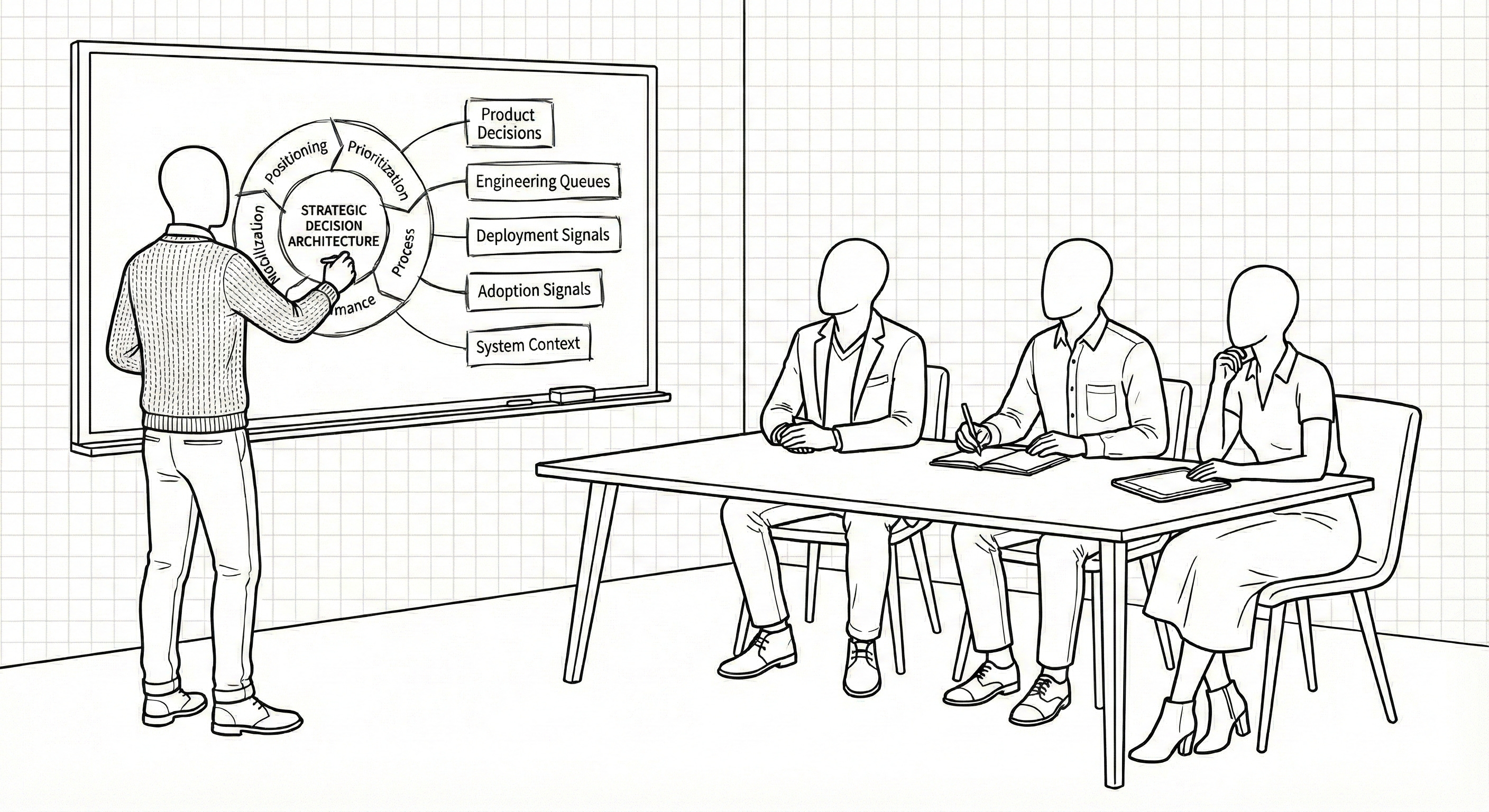
“This is how we coordinate now. Each element stays fixed as a guardrail. But the context inside them modulates based on what we’re working on.”
The tech lead nodded slowly. “Same architecture as the platform.”
“Exactly.” The Engineering Director turned back to the board. “The flywheel isn’t just a coordination framework. It’s governance architecture. And if it governs human decisions—”
“It can govern platform decisions,” another engineer finished.
The room was quiet. Processing.
“What would that look like technically?” the tech lead asked.
“We already have the context distribution module. Information flows between functions—Product decisions propagate to Engineering, Engineering deployments signal to Marketing.” The Engineering Director drew lines between the flywheel elements. “We’d be formalizing what’s already implicit. Translating the flywheel into system language.”
“So the elements become platform architecture.”
“The foundation stays fixed. The context flows through.” The Engineering Director stepped back from the board. “Same reason the flywheel works for teams. Structure that doesn’t break when conditions change.”
The tech lead was already thinking through implementation. “We have the requirements from the platform work. The architecture docs cover most of this. It’s integration, not invention.”
“How long?”
The team exchanged glances. Mental calculations happening.
“Couple weeks for the core integration,” the tech lead said. “We’d have something demonstrable by the board meeting. Not production-ready, but enough to show the architecture works.”
“And the approach makes sense?”
The tech lead almost smiled. “It makes more sense than what we were building before. We were trying to optimize features. This gives us a foundation. Everything else builds on it.”
The Engineering Director looked around the room. No objections. No major concerns. Just the quiet focus of a team that saw something worth building.
“Alright,” he said. “I’ll take it to James.”
James was still in his office when the Engineering Director knocked.
“Team confirms,” the Engineering Director said from the doorway. “The architecture makes sense. We translate the flywheel elements into system language—fixed architecture, flexible context. Foundation already exists from the platform work.”
“Timeline?”
“Couple weeks. We’d have something demonstrable by the board meeting.”
James leaned back. The Engineering Director could see him connecting it—the Kedaris transformation, the new companies in baseline, the market already noticing, and now this.
“Do it.” James paused. “This changes everything we bring to the board.”
The Engineering Director nodded and turned to leave.
“One more thing.”
He stopped.
“What you brought today—the pattern you saw, the connection you made.” James met his eyes. “That’s not just engineering. That’s strategic thinking.”
The Engineering Director didn’t know how to respond to that. So he just nodded again and headed back to his team.
They had two weeks to build what no one else had.
Transformation Lasts When the Framework Is Owned
End of Kedaris 4-Week Pilot
Something was different from their first Kedaris call four weeks ago. The tension that had marked every interaction with Lisa was gone. In its place, something James recognized. The look of someone who’d stopped fighting their organization and started leading it.
“Final numbers,” Lisa said. “Three point two decisions per meeting. Up from point four when we started.”
The Marketing VP leaned forward. “That’s an 8x improvement.”
“It’s not the number that matters.” Lisa pulled up something on her screen. “Watch this.”
She shared her screen. “My calendar looks a lot less crazy than it did last month. With clearer context across meetings, we spend more time building opportunities instead of debating them. We are now working one as we speak.”
“That’s the flywheel,” James said.

“That’s our flywheel.” Lisa corrected James. “We adapted it. Changed some of the language to fit how we talk. Added a sixth element—regulatory context. That’s our reality.”
“The architecture held.”
James felt something shift. This wasn’t teaching a methodology. This was watching a company own it.
“Your team isn’t using our framework,” he said slowly. “They’re using theirs.”
“Exactly.” Lisa leaned forward. “That’s when I knew we’d actually transformed. My VP of Product suggested the regulatory addition. Didn’t ask me. Didn’t check if it was allowed.” She paused. “He was thinking in flywheel terms and saw what was missing for our context.”
“You didn’t give us a framework, James. You gave us a way of thinking. We built from there.”
The Marketing VP caught James’s eye. This is what we’re selling.
“So,” Lisa said. “Let’s talk about what’s next.”
The contract conversation took fifteen minutes. Ongoing Strategic Decision Architecture engagement. Quarterly capability reviews. Access to the governance integration the Engineering Director’s team was building.
Lisa signed before the call ended.
“One more thing,” she said. “I’ve already recommended you to two companies in my network. They’re experiencing what we were experiencing. I told them you don’t sell software. You transfer capability.”
“What did they say?”
“They said they’d never heard it described that way before.” Lisa paused. “That’s how I knew you owned something different.”
James sat in his office, door closed. The week’s momentum still visible on his whiteboard—Engineering Director’s governance framework sketch, Kedaris completion notes, the two new companies moving through their transformations.
One week until the board meeting.
He pulled out his phone. Typed a message to Sarah.
Looking forward to next week. Good news to report.
Her response came thirty seconds later.
I had a feeling. See you next week.
Sarah didn’t know about Ramorian. She assumed he’d won them back. The old James would have corrected her, managed expectations, prepared her for disappointment.
But there was no disappointment to prepare for.
Kedaris signed. The fintech company closed earlier this week. The healthcare SaaS was finalizing terms. The Engineering Director’s team was building something Amalakai couldn’t touch.
He wasn’t bringing Sarah a recovered customer.
He was bringing her a different company.
James pocketed his phone and looked at the whiteboard one more time. The Strategy Flywheel. The governance integration. The transformation that had started with his own team and was now spreading to customers who owned it themselves.
One week until the board meeting.
PRACTICE: The Governance Mirror
Time: 2 minutes
Think about how your team makes decisions—the context they share, the handoffs between functions, the rhythm of coordination.
Now think about your primary platform or system. Does it follow the same architecture? Or does it operate on different rules?
Ask yourself: If someone studied how your tools coordinate information, would they recognize your team’s decision architecture?
Write one sentence about what the gap reveals.
James discovered: The flywheel that governed team decisions could govern platform decisions too. Human coordination and system coordination weren't separate problems. They were the same architecture applied at different layers.
AI Prompt:
How my team coordinates decisions:
[Describe context flow, handoffs between functions, decision rhythm]

How our primary systems/platforms coordinate information:
[What they enable, what they force, how information moves]

Based on this:

1. Where do human coordination principles and system governance align?
   - What handoffs work the same way?
   - Where does context travel consistently across both layers?

2. Where are they fragmented?
   - What context do teams build that systems don't carry?
   - What do platforms force that contradicts how teams think?

3. What would unified governance look like?
   - If my systems operated the way my team coordinates, what changes?
   - What decisions get faster? What friction disappears?

4. What's the integration opportunity?
   - What would I build if human and system architecture were the same?
   - What becomes possible that's currently blocked?

Show me what unified governance could enable.
Next Episode: Becoming a Prime Mover
James prepares for the final board meeting. Sarah expects Ramorian back, he brings something different—a transformed company, a platform Amalakai can’t replicate, and a leadership team that sees what he sees.
Will Sarah accept this new direction from Dayanos?
Subscribe to follow the transformation journey, and share with a leader ready to stop renting strategy and start owning territory.
PS - If you are new to the series, start with Episode 1 here.