
Bridging Generations Without Blending Them: The Dove x Crumbl Strategy
How Dove and Crumbl created "Everyday Indulgence" by connecting mothers and daughters through parallel private moments—without forcing them together.

There are things that belong to your generation. And things that belong to theirs.
You don’t really think about it. The music that’s “yours.” The brands that feel like home. The small rituals that define how you move through your day.
And then there are the things that belong to them—the generation before you, or the one after. The products they use. The places they go. The habits that signal “this is their thing, not mine.”
You don’t reject these things out of spite. You just... don’t see yourself there. They occupy different territory in your life. Different rooms, moments, identities.
Until something shifts.
Until two brands—each firmly planted in separate generational territory—do something that makes you realize: we were always in the same house, just different rooms.
When Dove and Crumbl Cookies announced cookie-scented body wash, the headlines called it “unexpected.” Marketing analysts labeled it “quirky.” The internet had opinions.
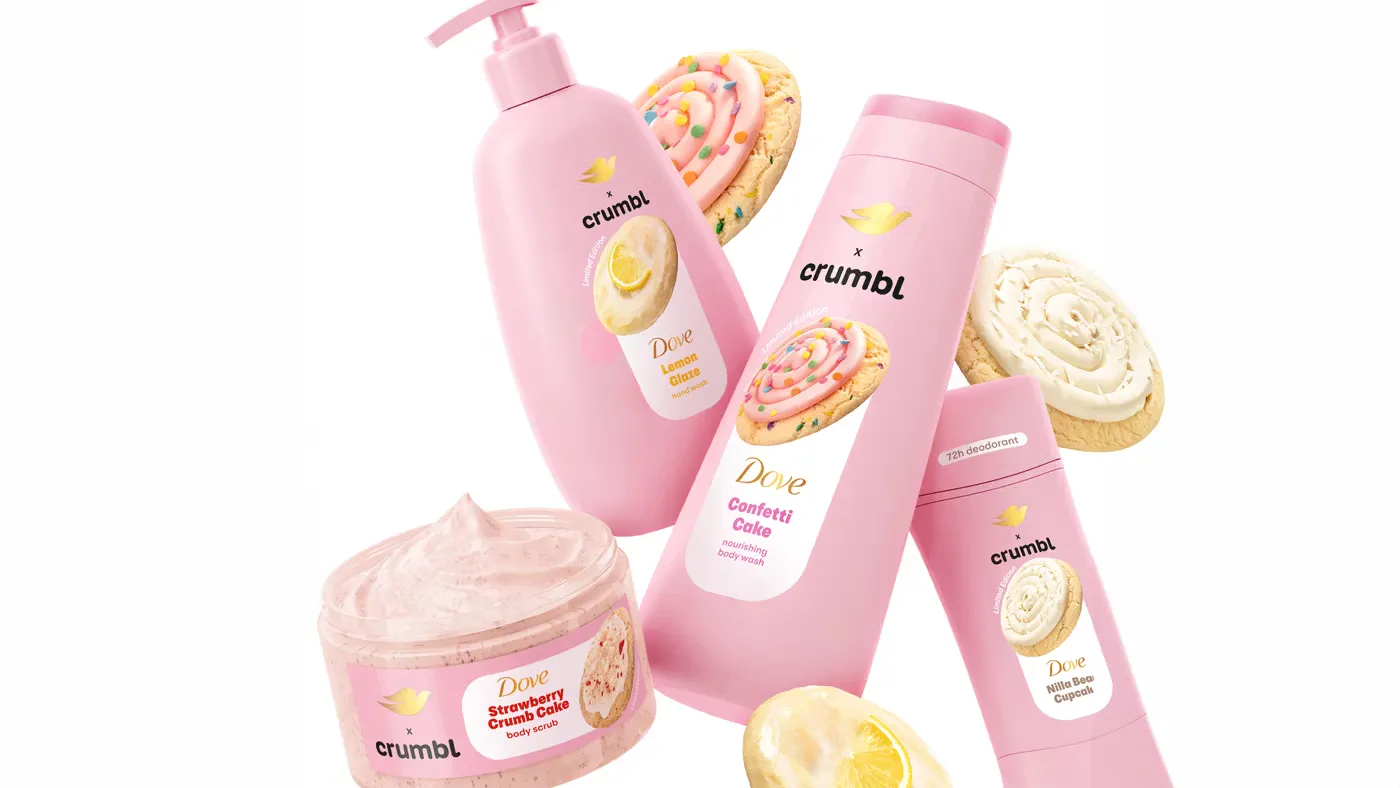
But the collaboration did something most partnerships never achieve: they hit a six-month sales in one month. More than half the buyers were first-time customers.
Products sold out at Walmart so fast a resale market emerged, with body wash bottles selling for dinner prices.
How did a dessert brand and a soap brand get two separated generations—each fiercely protective of their own identity—to participate in the same purchase without either compromising who they are?
Most collaborations force integration. They make you choose between loyalties. They create awkward middle-ground products for people who like both brands equally.
Dove and Crumbl did something different.
They didn’t merge the generations. They built continuity between separate spaces—letting each generation maintain their identity while creating connection through parallel private moments.
The mother smells strawberry crumb cake in her morning shower. The daughter smells it in her evening routine. Same scent. Different contexts. Different identities. But now there’s a thread connecting the kitchen counter moment to the bathroom vanity ritual.
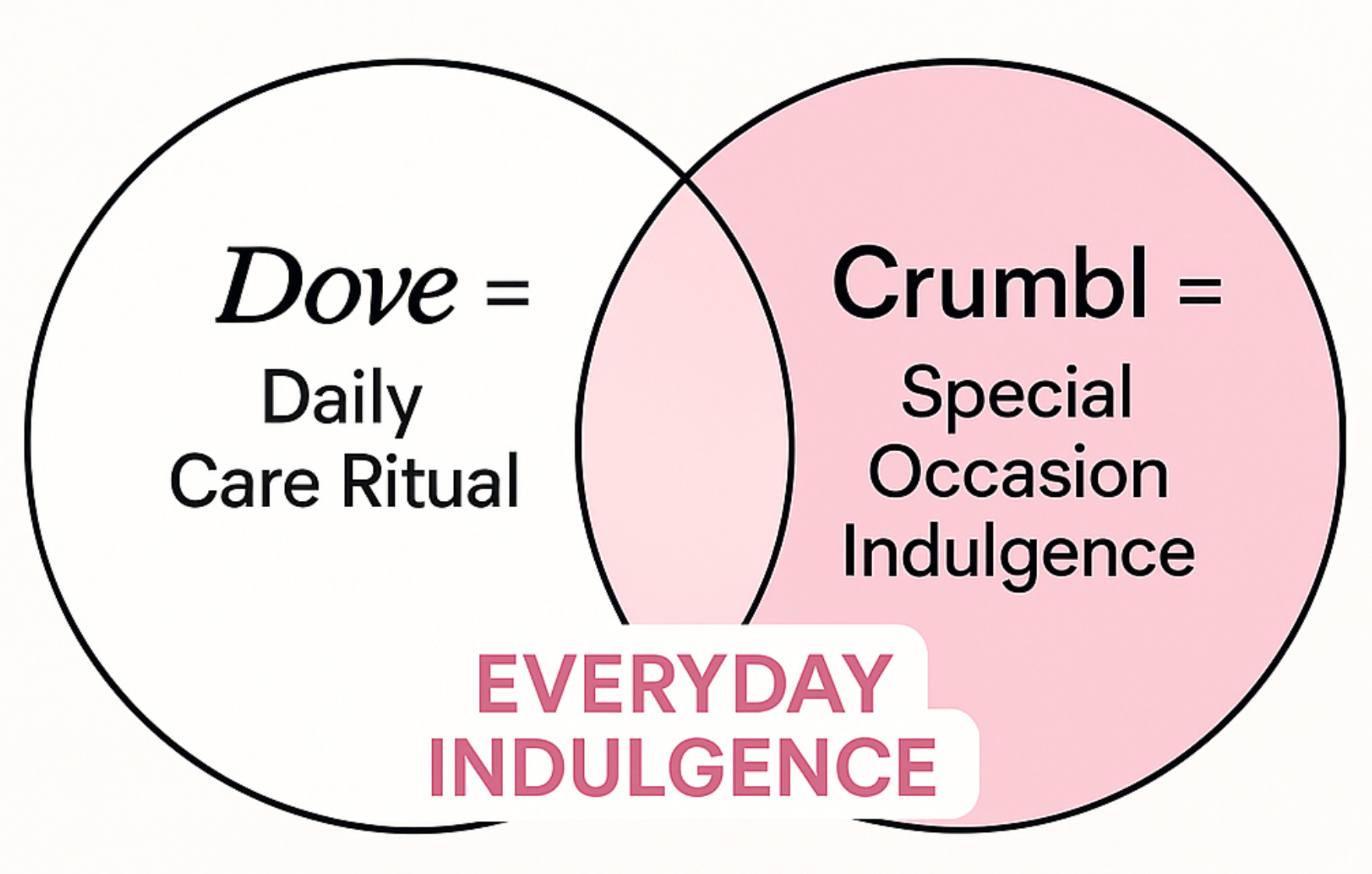
This isn’t about viral marketing. This is about how two category-defining brands collaborated to claim territory neither could occupy alone: “Everyday Indulgence.”
Let me show you the story everyone missed.
How Dove and Crumbl Built Category Authority
Dove’s 20-Year Journey to Permission Authority
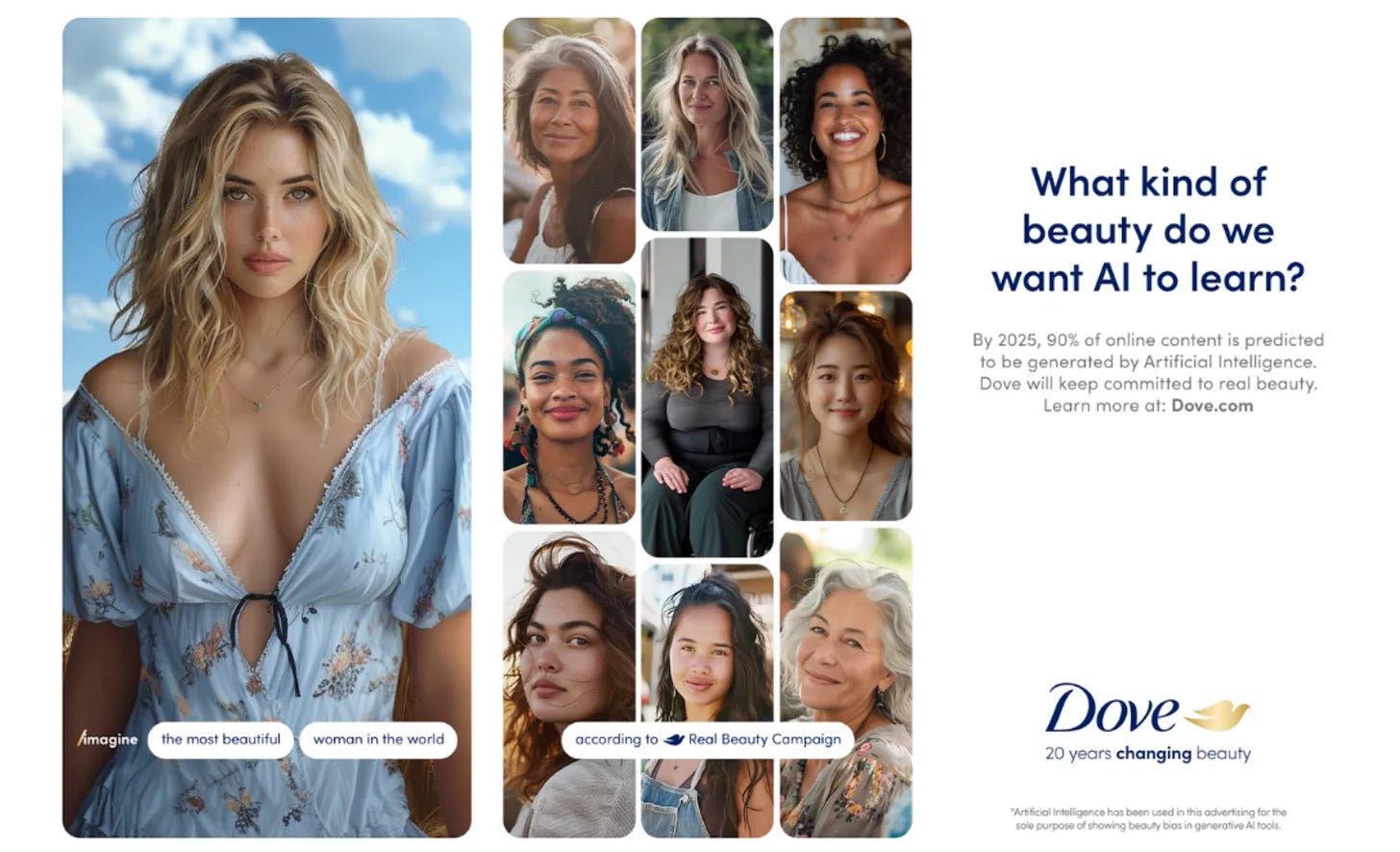
In 2004, Dove discovered something that changed everything: only 2% of women globally considered themselves beautiful.
That research became the foundation for a two-decade transformation. Dove didn’t just market soap—they created a new category of permission. The “Real Beauty” campaign eliminated airbrushed models. The Self-Esteem Project reached 82 million young people. Sales grew from $2.5 billion to over $4 billion.
More importantly, Dove earned something competitors couldn’t replicate: they became the brand that gave women permission to feel beautiful without meeting industry standards, to choose gentle care without apology, to prioritize themselves.
By 2025, Dove owned “you deserve daily care” for an entire generation. Over 20% market share in body wash—not through features, but through meaning.
But there was a positioning boundary: to Gen Z, Dove coded as “mom’s brand.” Practical, reliable, trustworthy—and therefore basic.
Crumbl’s Meteoric Rise to Experience Territory
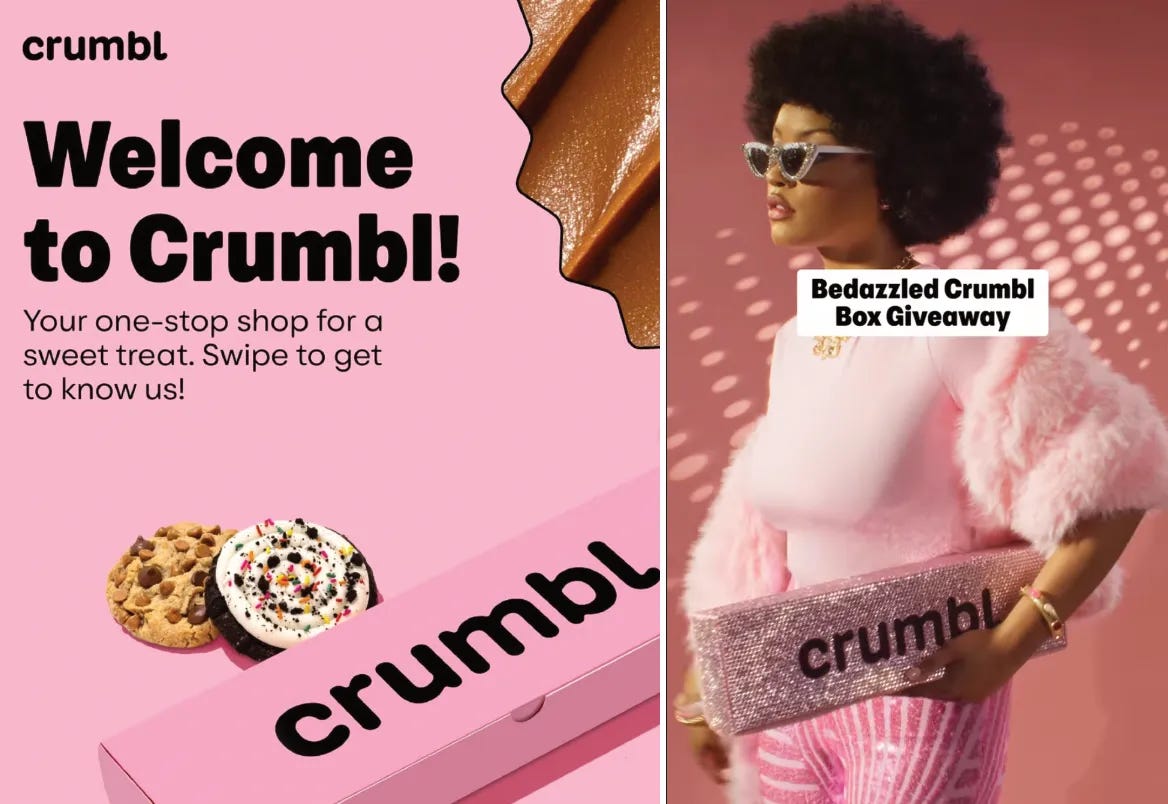
In 2017, two cousins with zero baking experience opened a cookie shop in Logan, Utah and created something unprecedented: cookies as weekly cultural events.
Jason McGowan and Sawyer Hemsley understood the experience economy. The pink box became a signal. The rotating weekly menu turned every Friday into a cultural moment. TikTok made it viral before most customers visited a store.
By 2024: 1,059 locations. $1 billion in system-wide revenue. More locations than all major cookie competitors combined.
They achieved this by owning a different permission: “guilt-free indulgence.” Gen Z didn’t buy cookies—they bought shareable moments that made treating yourself part of your identity.
But Crumbl hit its own boundary: special occasion territory. Weekend ritual. Event-driven. Not something you could do daily without seeming excessive.
Two permission-granters who’d reached the edges of their territory
Dove: “You deserve daily care” (but only for the mother’s generation)
Crumbl: “You deserve special indulgence” (but only for special occasions)
Neither could claim “everyday indulgence” without undermining their existing positioning. But together? They could unlock something neither generation realized they wanted: the permission to feel special every single day, in the privacy of their own routine.
The question was: how do you mobilize two separated generations—each protective of their identity—around a shared product without forcing integration?
Bridging Without Blending: Designing for Parallel Participation
Most brand collaborations fail because they force audiences to choose, to compromise, to awkwardly blend identities they want to keep separate.
Dove and Crumbl built something different: a way for two generations to participate simultaneously without ever having to acknowledge they were doing the same thing.
Why Walmart Became the Strategic Meeting Point
Crumbl has 1,059 destinations. Locations you drive to intentionally. The pink box experience requires pilgrimage.
Dove lives everywhere—but for this collaboration, they chose exclusive distribution through Walmart.
This wasn’t about convenience. This was about who controls the cart.
Mothers shop at Walmart. It’s in their routine—the weekly grocery run, the household needs, the “while I’m here” purchases. They have spending authority. They have time. They’re already making decisions about what comes home.
Daughters might come along. Or they might not. But they don’t control the cart.
The collaboration lives where the mother has both shopping permission and spending power—but the product itself carries the daughter’s cultural credibility through Crumbl’s pink packaging.
How Scent Creates Connection Across Separate Spaces
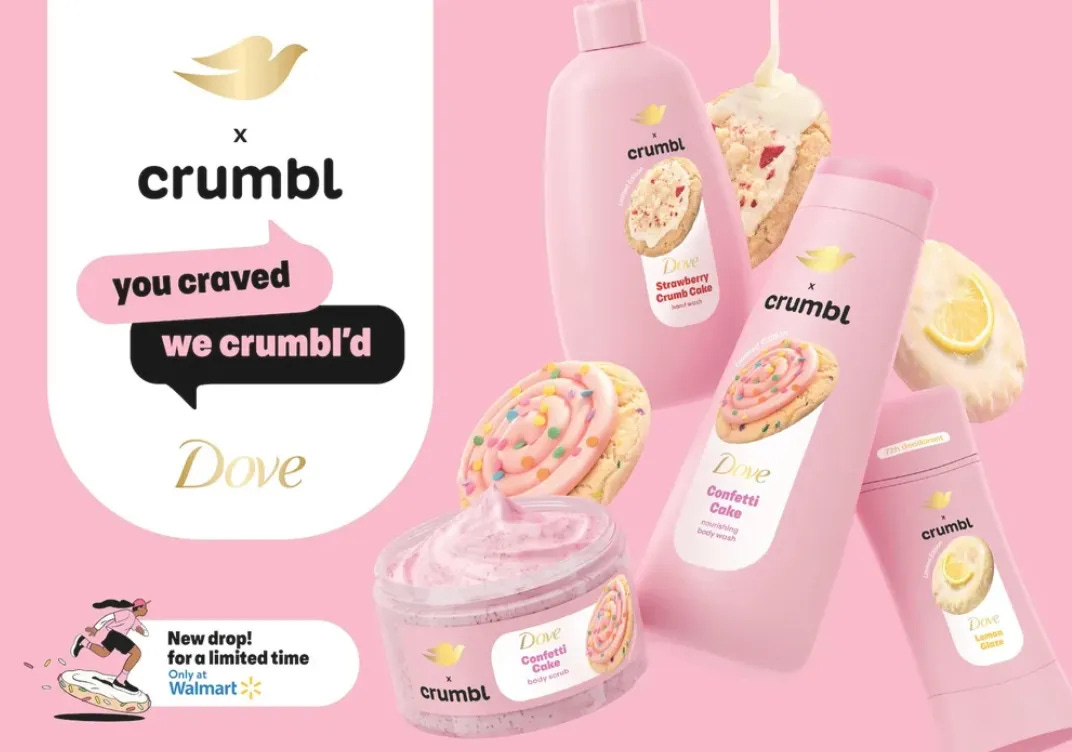
Four scents, each mapped to Crumbl’s most iconic cookies: Strawberry Crumb Cake, Lemon Glaze, Confetti Cake, Nilla Bean Cupcake.
But here’s what makes this strategic rather than gimmicky: scent creates memory continuity across physical spaces without requiring shared moments.
The daughter experiences Friday night Crumbl runs with friends. The pink box. The social media moment. The kitchen counter unboxing.
The mother watches from the periphery. She doesn’t participate—it’s not her thing. But she witnesses the ritual. She knows those scents. She associates them with her daughter’s joy.
Now both encounter those same scents in completely private spaces:
The mother, alone in her morning shower, smells strawberry crumb cake and thinks of watching her daughter enjoy those Friday nights—but she’s having her own moment, her own indulgence, her own permission to feel special.
The daughter, in her evening routine, smells the same thing and thinks of those same moments—but from her perspective, in her space, maintaining her identity.
Same scent. Different memories. Connected without forced connection.
The Pink Package Revolution
For the first time in Dove’s history, they changed their signature white bottle to Crumbl’s pink.
This wasn’t collaboration aesthetics. This was credibility transfer.
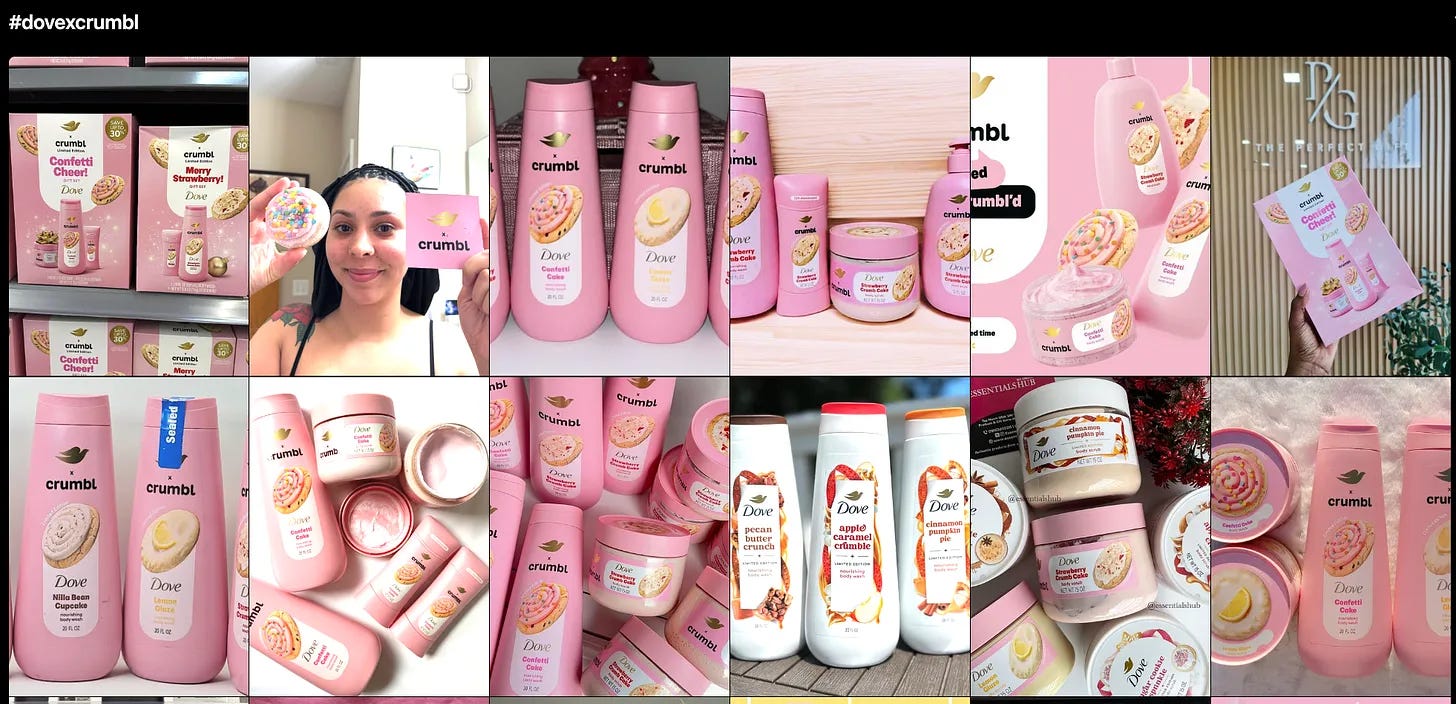
The pink packaging made Dove Instagrammable. For Gen Z, that matters. It transformed Dove from invisible bathroom basic to shareable moment. The daughter could photograph it, post it, participate in Crumbl culture—even though the product is soap.
But for the mother, that same pink packaging validates the purchase. It’s not “boring mom soap” anymore. It’s culturally relevant. It’s something her daughter might actually notice, might actually approve of, might actually want to try.
The packaging bridges the gap without either generation having to compromise.
Limited Edition Creates Shared Urgency
Launch through controlled leak—not press release. Let superfans “discover” and “leak” it on Reddit and TikTok. Create organic buzz that feels like insider knowledge.
Then weekly scent drops through mid-January. Each Friday (Crumbl’s signature day), new scent availability.
This created urgency without requiring daily purchase. The mother could participate in Crumbl’s cultural rhythm without changing her shopping behavior. The daughter could track drops without having to visit Crumbl locations.
Then the strategic pivot: add a fourth scent mid-campaign, extending through Mother’s Day timing.
This revealed the bigger game: Not just one-off collaboration, but seasonal reactivation potential. Limited edition creates urgency. Consumable product creates replenishment need. Annual calendar moments create permission to run it back.
Two Generations, Separate Paths, Same Destination
52% of buyers were first-time Dove customers. That’s the daughter’s generation, showing up where they never showed up before.
The remaining 48%? Dove loyalists who suddenly had permission to indulge daily, not just care daily.
Products sold out so fast a resale market emerged—people flipping body wash for $35, more than 5x retail price.
The mother made the purchase. The daughter provided the cultural validation. Both got everyday indulgence without compromising their separate identities.
The collaboration didn’t force integration. It enabled simultaneous participation through connected but separate experiences.
The “Everyday Indulgence” Market Validation Was Real
“Everyday Indulgence” was unmet demand existing at the intersection of two separated permissions. Limited edition drove trial. Daily consumption drove replenishment.
The mid-campaign addition of Nilla Bean Cupcake scent, timed nearly two months after launch, was validation of repeatable infrastructure. Seasonal moments drive reactivation.
And unlike typical one-off collaborations, this collaboration created a system. And the market proved the system worked.
With that in place, what’s next?
The Bigger Strategic Game: A Year of Gifting
Each seasonal drop becomes both limited edition urgency and gift-giving occasion. With 52% first-time Dove buyers and complete Walmart sell-outs, the collaboration proved both generations want this territory.
Imagine the demand for mother-daughter gift sets positioned as “bridging without blending” moments:
Holiday season: “Share the indulgence tradition”
Mother’s Day: “The perfect bridge gift”
Back-to-school: “New routines, same connection”
Valentine’s Day: “Self-love meets family love”
Gift sets transform collaboration from cash infusion to reliable revenue stream. Annual infrastructure instead of viral moment.
The 2026 Test: Mother’s Day Gift Sets
If Dove and Crumbl run Mother’s Day gift sets using the same strategy and achieve similar results, they’ll prove something few collaborations ever achieve: sustainable category territory that requires ongoing partnership to maintain.
“Everyday Indulgence” only exists when both brands participate. Neither can claim it alone. That’s when collaboration transcends marketing tactic and becomes strategic infrastructure.
The question isn’t whether they should run it back. The question is: can they afford not to? Because if the territory is real, and the system works, then every seasonal moment without this collaboration is territory left unclaimed—and available for competitors to occupy.
What Competitors Will Miss About This Collaboration
When competitors analyze this collaboration, they’ll see the tactics: cookie-scented soap, pink packaging, Walmart exclusivity, social media buzz.
And they’ll rush to copy them. Soap brands will hunt for dessert partners. Cookie companies will explore body care collaborations.
Most will fail.
Because what they’ll miss is the prerequisite: you must be a prime mover in your category before you can create shared territory with another.
Dove didn’t just make soap—they owned “you deserve daily care” for an entire generation. Crumbl didn’t just sell cookies—they defined “guilt-free indulgence” as cultural experience.
Without that level of category dominance, collaboration becomes a desperate attempt to associate with their credibility. They look diluted by association with your weakness.
The collaboration worked because neither brand needed the other’s positioning. They each brought defendable territory that enabled them to claim new territory together.
Competitors will copy the format and miss the foundation. They’ll create cookie-scented products without owning the daily care permission that makes indulgence feel earned. Or they’ll add everyday elements without the special occasion magic that makes indulgence feel special.
You don’t expand by reaching new audiences. You expand by claiming new territory at the intersection of what you already dominate and what someone else dominates that neither of you can claim alone.
Perfect. Here’s the tightened version - cut from 384 to 285 words, removed redundancy, sharpened the insights:
The Collaboration Framework
For strategy leaders ready to create territory instead of chasing attention, the diagnostic is straightforward:
What do you own that’s defensible? Dove owned “you deserve daily care.” Crumbl owned “guilt-free indulgence.”
What territory can’t you claim without contradicting that position? Dove couldn’t claim indulgence without undermining accessible care. Crumbl couldn’t claim everyday without diluting special occasion magic.
Who owns what you can’t claim? Each owned what the other needed but couldn’t access alone.
What emerges at the intersection? “Everyday Indulgence”—territory that requires both brands to maintain.
When clarity defines connection instead of compromise, you’ve entered the realm of prime movers.
How the Strategy Flywheel™ + AI Acceleration Revealed Prime Positioning Insights
I structured AI research through the Strategy Flywheel™, mapping each brand’s category positioning, collaboration mechanics and retail execution, performance validation across sales channels, and demographic analysis for both target generations.
Without strategic structure, I would have gathered scattered intelligence — brand histories, partnership announcements, Walmart inventory data, social media sentiment, retail analytics — with no strategic coherence.
Dove and Crumbl created “Everyday Indulgence” territory by bridging individual preferences without blending brand identities—an insight requiring simultaneous coordination of accessible self-care positioning, special-occasion territory, mother-as-buyer dynamics, and separate-spaces retail execution.
Connecting “mothers shop at Walmart” to “separate bathrooms enable shared ritual” required what AI still cannot supply: trained judgment that works backwards from business outcome to architecture.
AI compressed the timeline. Strategic synthesis came from human judgment: parallel participation beats forced integration.
Most stop at the story. The deeper question is how this collaboration reshaped both prime movers’ positioning. What powers are they building? Which disciplines are they mastering? The answers reveal competitive dynamics that extend far beyond one viral campaign.
The following strategic analysis is based solely on publicly available information, including social media posts, press coverage, and marketing campaigns. It represents an educational exploration of strategic thinking methodology and does not constitute investment advice. The author has no business relationship with Dove or Crumbl and may, in the future, consider potential investment or advisory opportunities with companies analyzed.
