
Becoming A Prime Mover: The Change You Create is the Position You Own
Prime Positioning - Episode 11: Owners create the strategy others rent.

Prime Positioning - Episode 11: Owners create the transformation others rent.
Sixty days ago, James lost his biggest customer mid-presentation. Today he walks into the same boardroom with three new customers, a transformed team, and a platform Amalakai can't replicate. The only question: will Sarah see recovery, or recognize something different?
Scaling Your Thinking Scales Your Leadership
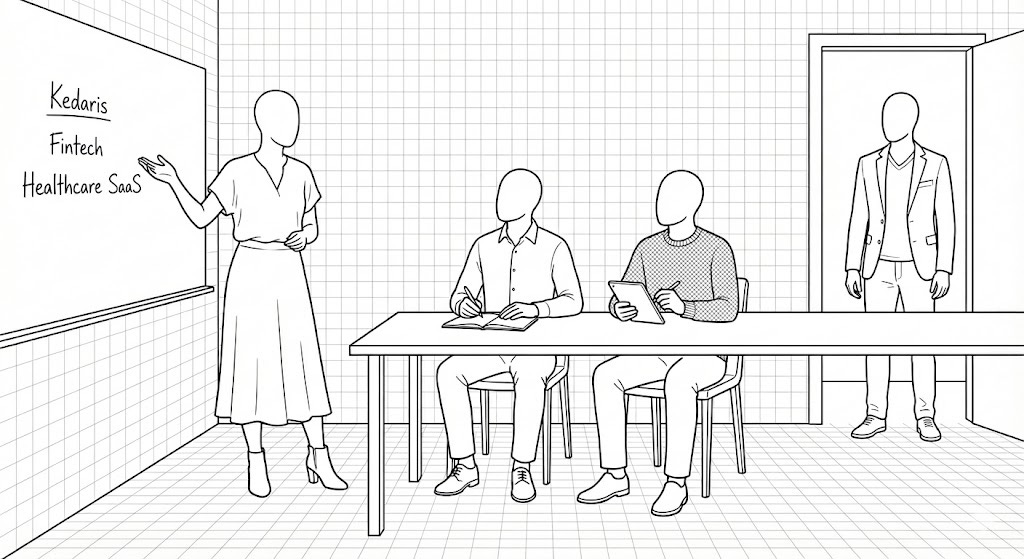
James walked into the Monday leadership sync expecting to run it. The Marketing VP was already at the whiteboard.
“We closed the fintech Friday,” she said without preamble. “Their CEO signed after the governance demo. And the healthcare SaaS cleared Legal review —contract’s ready for signature tomorrow.”
The Product VP picked it up. “That’s three transformations in sixty days. Kedaris, fintech, healthcare. Same pattern each time.”
“Platform integration on track,” the Engineering Director added. “We’ll have the architecture demonstrable for the board.”
James stood in the doorway. Three functions. Three updates. No one waiting for direction.
Six months ago, James would have built the entire board deck. Every slide. Every talking point. The team would execute what he designed.
The Marketing VP turned from the whiteboard. “Board presentation. I have customer transformation. Product has platform roadmap. Engineering has integration timeline.” She looked at James. “What do you want to present yourself?”
“The positioning,” James said. “What we’ve become.”
The Product VP nodded. “Makes sense. You saw it first.”
“Sam saw it first,” James corrected.
“Sam diagnosed it,” the Marketing VP said. “You built it.”
The meeting ran eleven minutes. No one scheduled a follow-up.
James returned to his office and pulled up his calendar. The board meeting was Thursday. Three days to finalize. But the deck was already converging—not because he’d orchestrated it, but because everyone saw the same picture.
His phone buzzed. Text from Sarah.
Looking forward to Thursday. Hoping for good news.
She was expecting Ramorian. He’d never told her they’d signed with Amalakai.
James typed back: Good news to share. Different than expected.
Her response came quickly: I trust your judgment. See you Thursday.
Decision Velocity Is Set Before the Meeting
The board deck assembled without chaos.
James remembered previous quarters—the scramble to align messaging, the late nights reconciling versions, the stress of ensuring every function told the same story.
This time, the story was already the same. Marketing’s customer section reinforced Product’s roadmap. Product’s roadmap validated Engineering’s timeline. Engineering’s timeline proved the transformation was systematic, not heroic.
The Product VP stopped by mid-afternoon. “Quick review of your positioning section?”
James turned his laptop. Three columns:
What We Were: Visibility platform. Helping teams see their operations.
What We Became: Transformation architecture. Helping organizations decide at opportunity speed.
What We’re Building: Integrated offering. Human coordination and platform governance unified.
The Product VP studied it. “You’re not mentioning Ramorian.”
“No.”
“Sarah’s going to ask.”
“I know.” James leaned back. “But if I lead with ‘we lost Ramorian,’ everything else becomes consolation. If I lead with what we’ve become, Ramorian is context.”
“And if she asks directly?”
“I tell her the truth. They chose tools over transformation.” James paused. “And we built something they can’t touch.”
The Transformation You Create Becomes Who You Are
Board meeting.
Same conference room where everything unraveled sixty days ago. Same faces around the table. Same screen waiting for slides.
Different company presenting.
“Sixty days ago,” James began, “Sarah asked me a question I couldn’t answer. She asked why our biggest customer was leaving despite loving our product.”
He clicked to the first slide.
“I spent sixty days finding the answer. Then building something different.”
He walked through Kedaris—four weeks from baseline to transformation, Lisa's team going from 0.4 decisions per meeting to 3.2. Then fintech: same diagnostic, same architecture, different industry. Signed Friday. Healthcare SaaS: Legal cleared, contract signed yesterday.
“Three customers in sixty days,” James said. “Not because we sold them software. Because we transferred capability.”
He clicked to the platform slide.
“Our team discovered something unexpected. The framework that transformed our coordination—Strategic Decision Architecture—it’s also governance architecture. The same structure that helps humans make aligned decisions can help platforms coordinate information.”
“We’re building that integration now. Human coordination and system governance unified. Not consulting plus software. Integrated transformation.”
Sarah leaned forward. “What does that mean for the product roadmap?”
James nodded to the Engineering Director, who walked through the timeline. Q2 demonstrable. Q3 beta. Q4 general availability.
The board asked questions. Good questions. Not the skeptical probing of sixty days ago. Genuine curiosity about direction.
Twenty minutes in, Sarah raised her hand.
"What happened with Ramorian?"
The room went quiet.
They signed with Amalakai," James said. No deflection. "They chose to rent decision support instead of owning transformation architecture.
Sarah’s expression was unreadable. “So we lost them.”
“We lost that deal.” James clicked to his final slide. “We gained something else.”
Tools support decisions. Architecture transforms how decisions happen.
"Ramorian wanted tools. Amalakai sells tools. Right fit for them." James paused. "But here's what I've learned. People in Ramorian's network are using language we created—'decision architecture'—without knowing where it came from. The market is finding us."
He looked at Sarah.
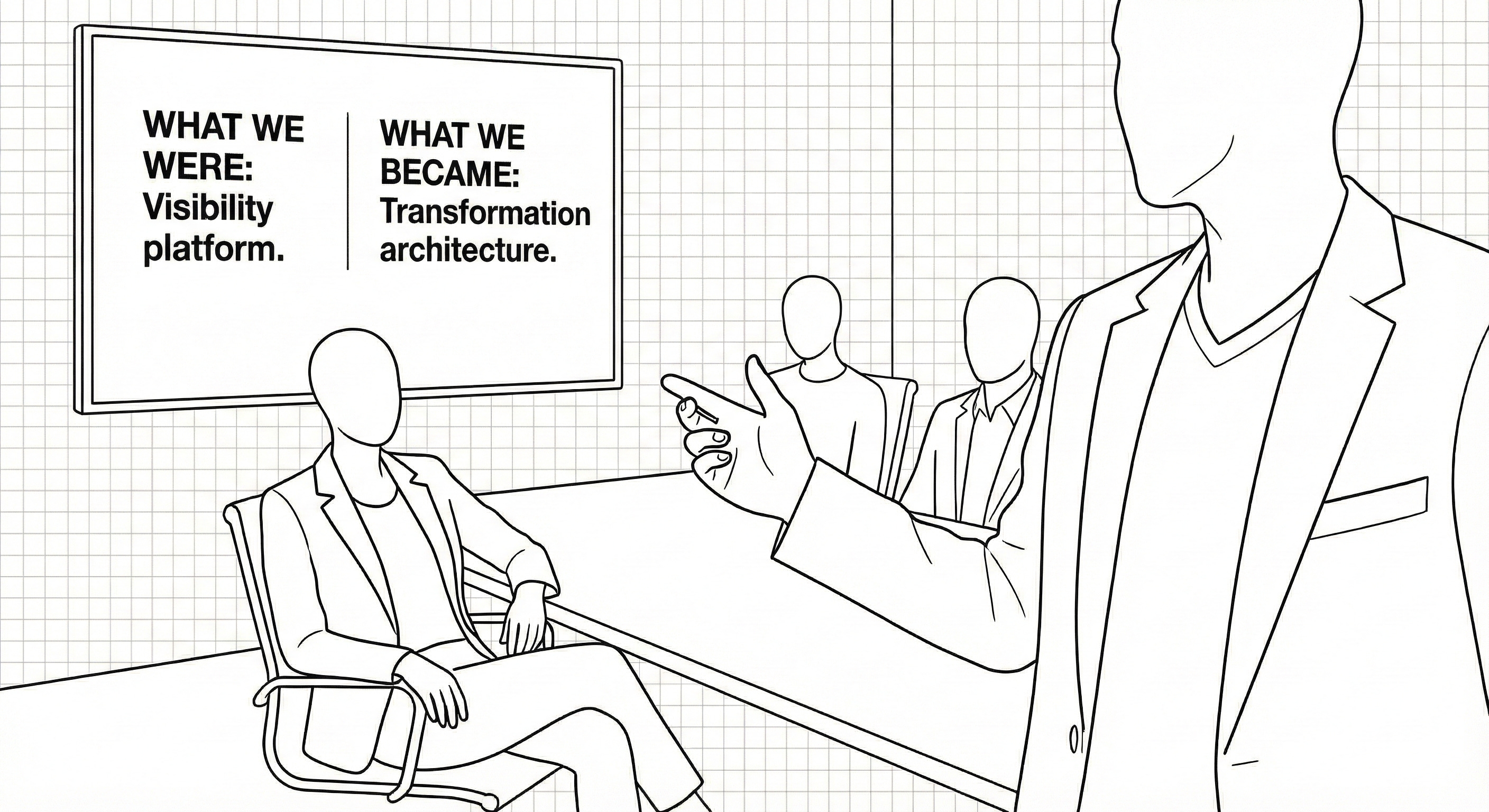
"Sixty days ago, we were chasing customers who wanted visibility. Today, we're attracting customers who want the transformation we own. That's a different company."
Sarah was quiet for a long moment.
“James,” she said finally. “This isn’t what I expected.” She paused. “It’s better.”
The meeting ran another twenty minutes. Budget discussions. Hiring plans. Normal board business, but with different energy. Strategic planning, not crisis management.
As the room cleared, Sarah stayed behind.
“The Engineering Director,” she said. “The platform integration was his insight?”
“He saw human and system architecture as the same problem. Nobody else was looking there.”
“That’s strategic thinking.”
James nodded. “Yes. He’s really stepped up. I’m promoting him to Engineering VP.”
Sarah considered this. “Good. Recognize what you want to see more of.” She gathered her materials, then paused. “James, sixty days ago I wasn’t sure you’d make it through this.”
“I wasn’t either.”
“What changed?”
James thought about Sam at the coffee shop. The napkin. The first customer call where he actually listened. The workshop where his team started seeing the same summit. Lisa saying “now we own it.”
“I stopped trying to win back what we lost,” he said. “Started building what we could own.”
Sarah almost smiled. “That’s the answer I was hoping you’d find.”
Create What's Next — and Others Will Follow
James found the Engineering Director in the smaller conference room, reviewing integration specs with his team.
“Got a minute?”
They walked to James’s office.
“The governance breakthrough,” James said. “Walk me through how you saw it.”
The Engineering Director relaxed. This was territory he understood.
“I was watching how we coordinate. The flywheel. Context moving between us so decisions happen without rebuilding everything.” He paused. “Then I realized the platform does the same thing. Information traveling between functions so each node can act. Same architecture. Different layer.”
“And the integration?”
“Strategic Decision Architecture for humans. The platform becomes—” he searched for the term, “—a decision velocity stack. Governance framework translated into system architecture.”
James let that phrase sit. Decision velocity stack. The Engineering Director had just named the premium offering.
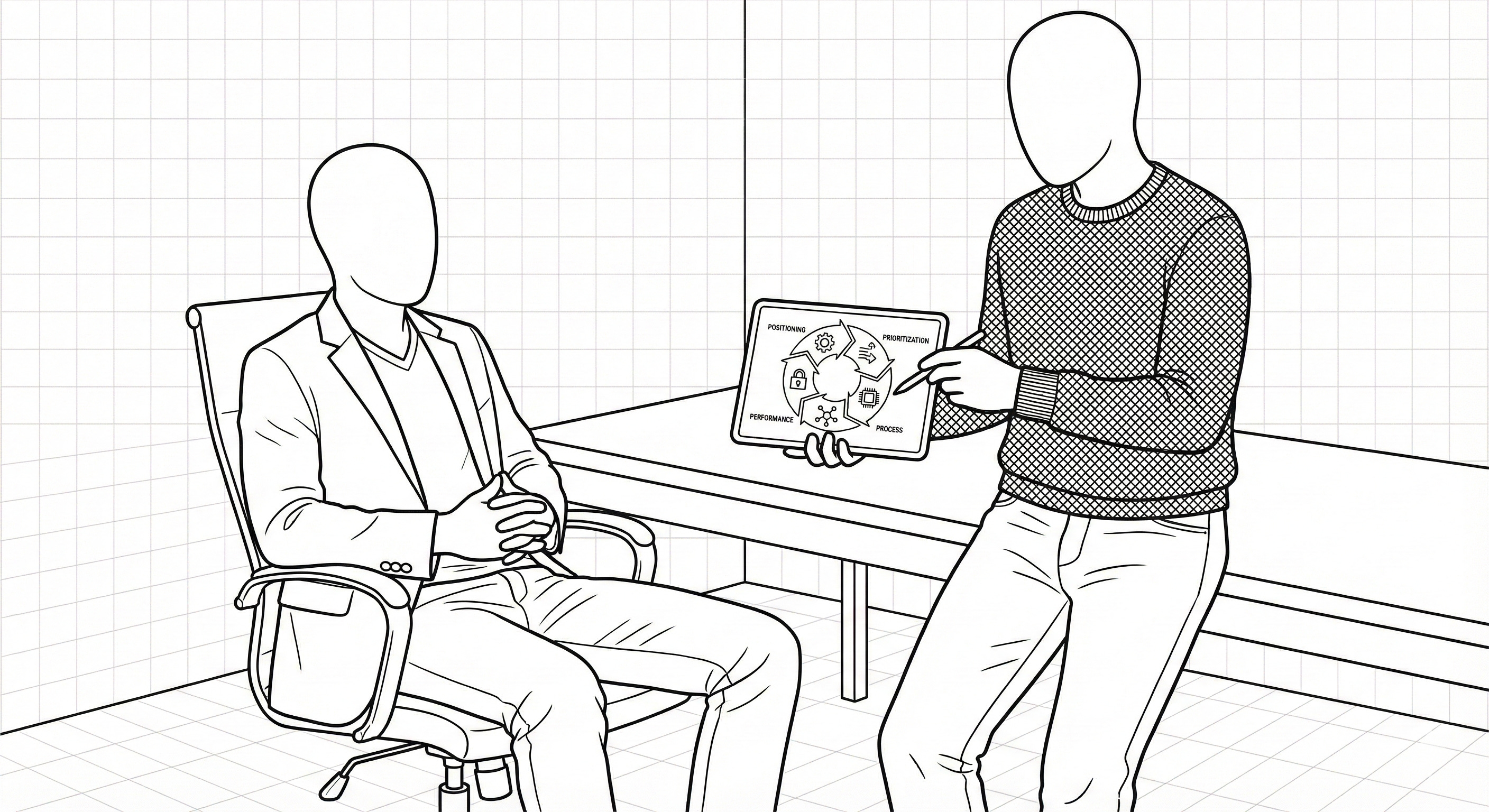
“Same foundation,” James said.
“Same foundation. Human coordination and system governance unified.” The Engineering Director met his eyes. "That's what Amalakai can't build. They're renting tool territory. We own the transformation architecture."
James nodded. “I’m promoting you. Engineering VP.”
The Engineering Director blinked. “I—”
“You saw what no one else saw. Then you built it. That’s not director-level work.”
“The team did the building. I just—”
“Connected pieces nobody else was connecting.” James leaned forward. “You didn’t wait for permission. You saw a pattern, validated it, brought it forward. That’s what VPs do.”
Silence. Processing.
“The platform integration,” the Engineering Director said finally. “Decision velocity stack. That’s the name?”
“That’s your name. It’s the right name.”
The Engineering Director was quiet for a moment. Then: “Six weeks ago, I didn’t know what Strategic Decision Architecture meant. Now I’m extending it.”
“That’s what capability transfer looks like,” James said. “Not repeating what you learned. Building beyond it.”
“Sam’s framework.”
“Sam’s foundation. Your extension.” James stood. “That’s the difference between renting methodology and owning it. You own this now.”
The Engineering Director nodded slowly. The weight of it settling.
They gathered the leadership team. Product VP, Marketing VP, the engineering team that had validated the architecture.
James kept it brief.
“Sixty days ago, we were in crisis. Lost our biggest customer. Fast execution, wrong direction.” He looked around. “Today, the board approved our new direction. Three customers signed. A platform integration competitors can’t touch. And a team that operates differently than any I’ve led.”
He turned to the Engineering Director.
“The governance breakthrough—Strategic Decision Architecture for humans, decision velocity stack for systems—came from one person who saw what nobody else was looking for.”
James paused.
“Effective immediately, we now have an Engineering VP.”
The Marketing VP smiled. The Product VP nodded. The engineering team exchanged glances—their leader recognized at the level he’d been operating.
The Engineering VP stood slightly awkward with the attention.
“The team built it,” he said. “I just saw the pattern.”
“That’s the job,” the Marketing VP said. “Seeing patterns nobody else sees.”
“And then building them,” the Product VP added. “Congratulations.”
James watched his leadership team. Marketing VP who’d gone from skeptic to advocate. Product VP who’d mapped the transformation stages. Engineering VP who’d unified human and system architecture.
They weren’t following his vision anymore.
They were building alongside him.
Operate From the Position You Own
Sam was already at their corner table when James arrived. Same spot. Same coffee shop. Sixty days since Sam had drawn a formula on a napkin and changed how James saw everything.
“Board meeting went well I assume,” Sam said as James sat down. Not a question.
“Sarah approved the direction. Three customers. Engineering VP promotion.”
“VP now?”
“He saw something no one else was looking for. Human coordination and system governance as the same architecture. Decision velocity stack.” James paused. “He built it in weeks.”
“He saw it in weeks,” Sam corrected. “The building was translation. The seeing was the breakthrough.”
They sat with that for a moment. The coffee shop hummed around them.
“I heard from David last week,” Sam said. “Ramorian.”
James straightened.
“He asked if I knew what you were building. Said people in his network kept mentioning ‘decision architecture.’” Sam’s expression was unreadable. “Couldn’t figure out where the language was coming from.”
“We haven’t published anything.”
“You don’t have to. Transformation spreads differently than features.” Sam paused. “He also said Amalakai’s struggling.”
James waited.
“They sold intelligent decision support. Better data, faster insights. Ramorian bought exactly what they asked for.” Sam shook his head. “Now they’re a couple months in, and David’s asking where the transformation is. They have better tools. They don’t have better decisions.”
“Tools don’t transform.”
“No. They don’t.” Sam leaned forward. “You didn’t lose Ramorian. You let them choose a different path. And that path is teaching them something your pitch couldn’t.”
James sat with that. Sixty days ago, losing Ramorian had felt like failure. Now it felt like positioning.
Sam was quiet for a moment. Then: “What actually transferred?”
James looked up.
“When you think about your team, Kedaris, the new customers—what moved from you to them?”
James considered the question. “Not the Strategy Flywheel itself. Lisa’s team built their own version. The Engineering Director saw it in platform architecture—something we never discussed.”
“So what moved?”
“Flywheel thinking.” James said it and recognized it was true. “The mental model. How to see strategic questions. How to recognize when elements connect versus scatter.”
He set down his coffee.
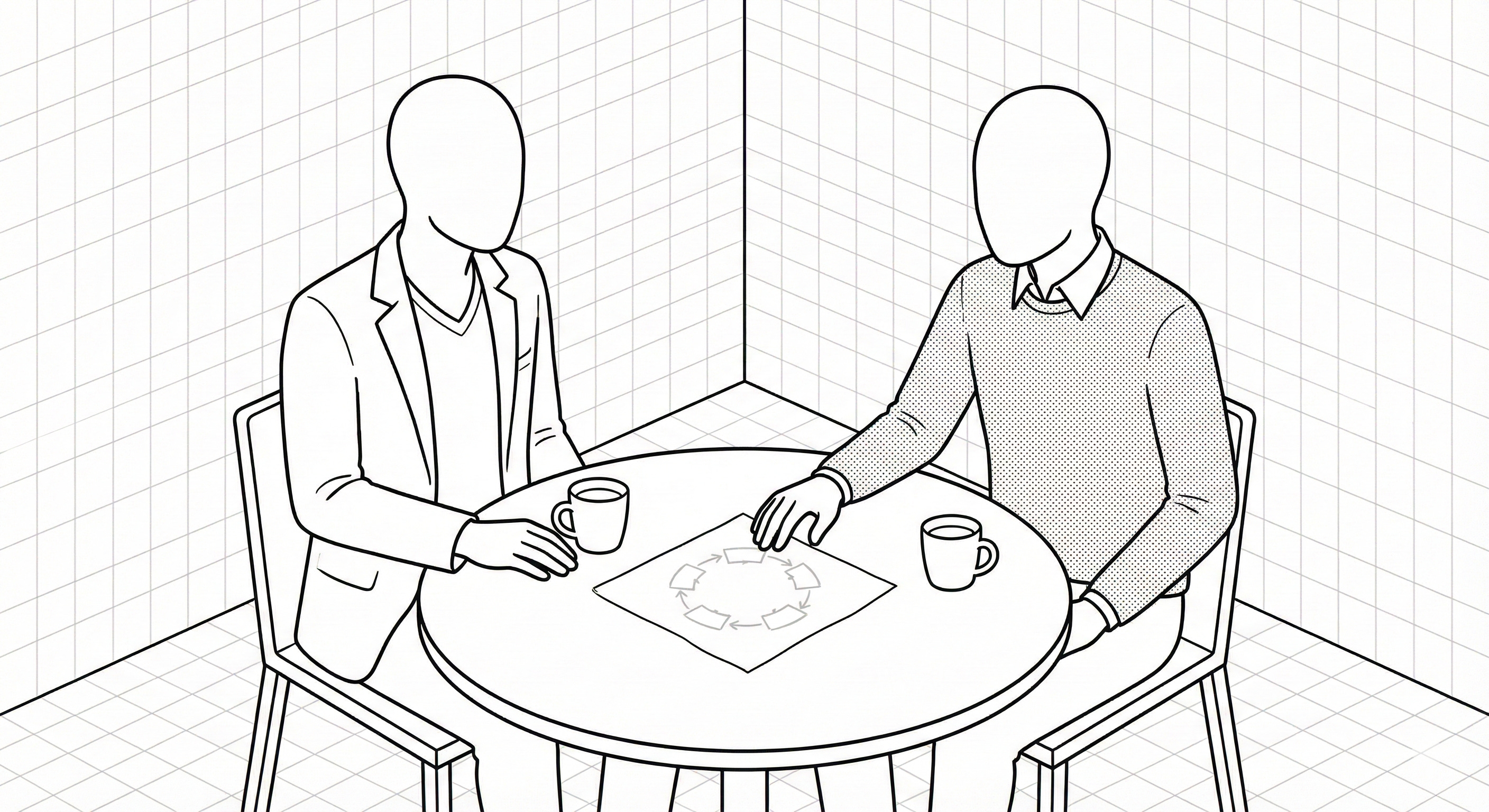
“That’s what creates context that travels. Not shared documents. Shared ways of thinking.”
Sam nodded slowly.
“That’s why some companies outperform. Their leaders don’t just have strategy. They have a way of thinking about strategy that everyone around them absorbs.”
He stood, gathering his things.
“You just made that transferable. The change you create is the position you own.”
James looked up.
“That’s what you built. Not a recovery. Not a turnaround.” Sam paused at the door. “A position.”
“When Ramorian figures out they need transformation instead of tools—and they will—they’ll know exactly who owns that territory.”
Then he was gone.
James reflected while finishing up his coffee.
He thought about the board meeting where everything unraveled. Sarah’s disappointed face. The adoption metrics glowing while his biggest customer walked away.
He thought about the customer calls where he finally listened. The workshop where his team started seeing the same summit. The moment when Lisa said “now we own it.”
And he thought about what Sam had just told him. Ramorian’s network using language Dayanos created. David asking where the transformation was. The market noticing before they’d published anything.
James finished his coffee. Left a tip. Walked out into the late afternoon.
Sixty days ago, he’d been counting time. Racing a deadline. Trying to recover what was lost.
Now he owned what he’d built.
PRACTICE: The Category Creation Test
Time: 2 minutes
Most leaders spend energy chasing what they lost. Category creators spend it building what they can own.
Think about your biggest recent setback—a lost customer, a failed initiative, a competitive loss.
Ask yourself: What would it look like to stop chasing recovery and start building a position competitors can’t touch?
Write one sentence about what you could own instead of what you’re trying to win back.
AI Prompt:
The setback I’ve been trying to recover from: [Your loss—customer, deal, initiative, market position]

What I’ve been doing to recover: [Your current approach—chasing, matching, competing]

If I stopped chasing recovery and started building ownership:

What transformation could I create that competitors can’t copy?

Not better features—different category

Not faster execution—different game

What would the market notice before I announced anything?

What language would spread?

What questions would people start asking?

What’s the position that emerges from that transformation?

Not what I sell—what I own

Not what I offer—what I define

What’s one move this week that builds toward ownership instead of recovery?

Help me see the category I could create instead of the ground I’m trying to retake.
Next: Epilogue - The Complete Framework
James’s transformation is complete. But the systematic framework behind it—the Strategy Flywheel, the expansion vectors that multiply advantage, the methodology that makes transformation transfer—that’s what the Epilogue reveals.
Not another episode. The blueprint.
Subscribe to receive the Epilogue when it releases, and share with a leader ready to stop renting strategy and start owning territory.